Yes. Cogent DataHub can run without a SCADA system installed; SCADA is not a prerequisite for its industrial data connectivity role. You still need an accessible data source, a supported connection path, and a configured destination—removing SCADA does not remove those dependencies.
TL;DR
- Can Cogent DataHub run without SCADA? Yes; source access and destination connectivity determine the architecture.
- A SCADA-independent design still needs device connectivity, endpoint security, and explicit ownership of operational functions.
- Software Toolbox provides industrial connectivity software for manufacturers, utilities, and data center operators.
- Keep existing SCADA-dependent data access until you have validated its replacement path.
Can Cogent DataHub run without a SCADA system installed?
Cogent DataHub does not require an installed SCADA system to perform its connectivity role. The important distinction is between a software prerequisite and a dependency in your particular data path. If the required data is exposed only through an existing SCADA system, that system remains an upstream dependency until you establish another source.
For a 2026 deployment, document which application actually supplies each required value. A diagram showing a PLC, a SCADA server, and a destination does not establish whether the destination depends on SCADA or simply shares its underlying data source.
SCADA-independent data path
- Best for: Data delivery without an operator application in the path
- Main benefit: Separates data delivery from SCADA operation
- Dependency or limitation: Requires an independently accessible source
SCADA-sourced data path
- Best for: Data exposed by an existing supervisory application
- Main benefit: Preserves access to the current application-level source
- Dependency or limitation: SCADA remains necessary for those values
Parallel data path
- Best for: Adding data consumers while retaining operator functions
- Main benefit: Keeps the integration project separate from operator screens
- Dependency or limitation: Requires review of source load and competing connections
These are architecture choices, not different product editions. Select the path according to data ownership, available interfaces, and operational responsibilities rather than whether a SCADA package happens to be installed.
Why this matters
Installing SCADA solely to create a data path adds an application dependency that the integration might not need. Conversely, removing SCADA because DataHub runs independently can break access to calculated values, operator-entered information, or application-managed tags.
Software Toolbox is best suited to manufacturers, utilities, and data center operators that need industrial connectivity between OT and IT systems. The Software Toolbox portfolio addresses that connectivity requirement; your architecture must still identify which application owns supervision, storage, and control.
For your 2026 design review, separate “DataHub starts successfully” from “the intended data service works.” A running process proves neither source access nor correct delivery to the consuming application.
What a SCADA-independent deployment needs
A SCADA-independent deployment needs a complete source-to-destination path. Treat the following as design requirements, not as a promise that every interface or deployment arrangement is supported by every product configuration.
Source access
Identify the actual endpoint that exposes the required data. That endpoint might belong to a device or an existing connectivity application; do not assume the physical equipment is directly accessible simply because SCADA currently displays its values.
Record the interface, authentication requirements, endpoint owner, and connection permissions. If the only documented endpoint belongs to SCADA, the proposed architecture is not yet independent of SCADA.
DataHub host
Specify where Cogent DataHub will run and who will maintain that host. Confirm the supported operating environment, selected functionality, and licensing against the current product documentation before installation.
Do not treat the absence of SCADA as permission to place integration software anywhere on the network. Host placement must follow your security zones, maintenance procedures, and recovery requirements.
Destination access
Define which application receives the data and how it accepts connections. Include the destination's authentication, data representation, and failure-handling requirements in the design.
A destination connection is not complete when values merely appear. Confirm that the receiving application interprets data types, timestamps, and quality information correctly for its intended use.
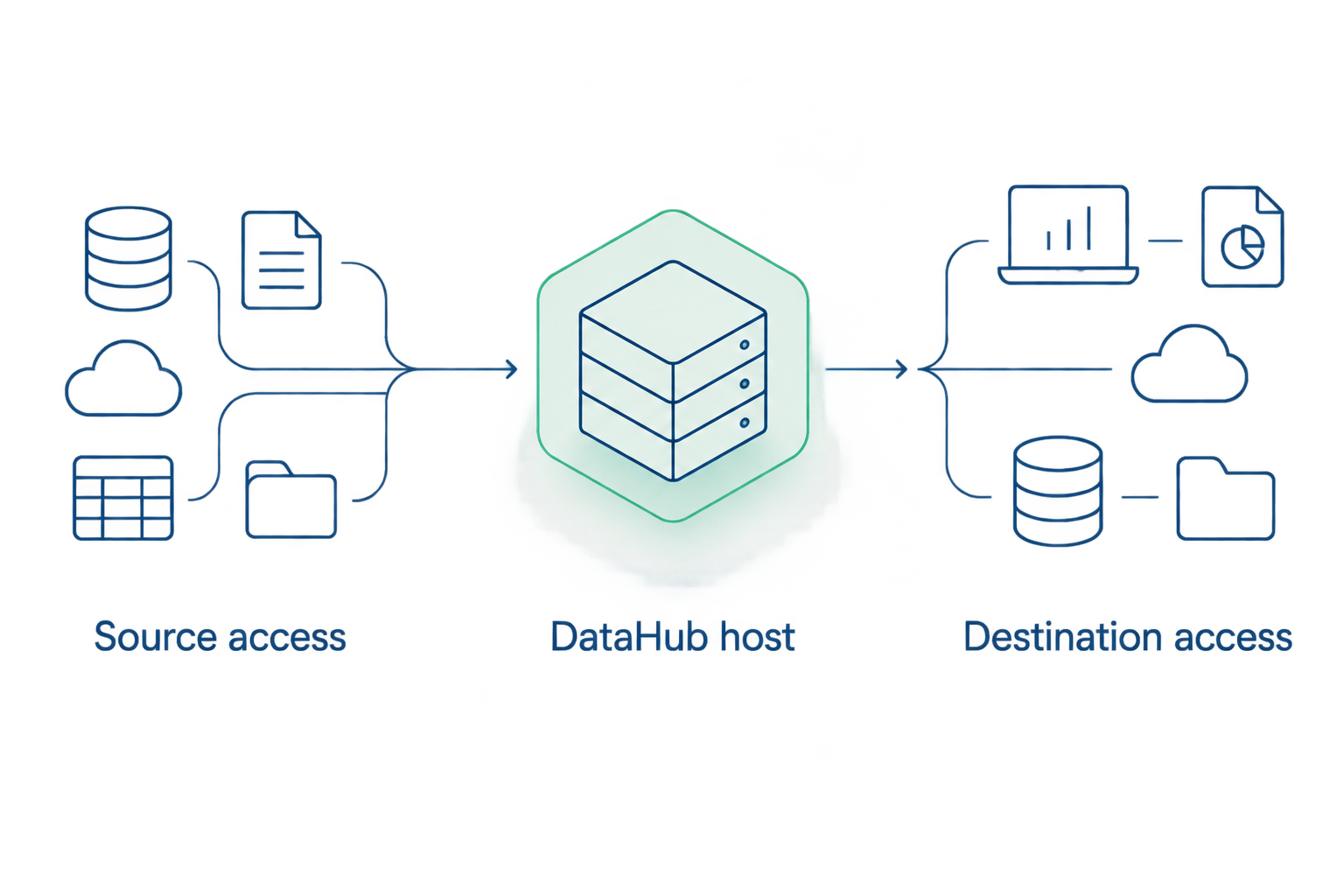
SCADA independence requires a complete data path, not just an installed application.
How do you validate a deployment without SCADA?
Use a bounded acceptance test before connecting production consumers. The objective is to demonstrate that the intended data path works without relying on a SCADA process, account, or application-level data source.
1. Trace the current source
Start with a representative value and follow it backward from the consuming application. Identify whether its origin is a device measurement, a calculation, a manual entry, or another application.
Record every application in that path. A tag name that resembles a PLC address is not evidence that the value comes directly from the PLC.
2. Define the required behavior
Write down what the consumer needs: current values, historical records, event information, or permitted writes. Keep these requirements separate because a working live-value connection does not establish historical completeness or control authorization.
Specify the acceptance criteria before configuration. Use requirements from the consuming process rather than an arbitrary update interval or a generic performance target.
3. Confirm the connection interfaces
Check the current documentation for the source, Cogent DataHub configuration, and destination. Verify the exact interfaces and functionality required by the proposed path rather than assuming that matching protocol names guarantee interoperability.
For OPC UA connections, include endpoint configuration, certificate trust, identities, and permissions in the review. Treat successful authentication and authorization as separate checks.
4. Test independence safely
In an approved test environment, validate the path without the SCADA application supplying its data. Do not stop a production supervisory application merely to demonstrate an integration assumption.
Check for hidden dependencies such as a shared account, a SCADA-managed calculation, or an endpoint hosted by the supervisory application. Document any dependency that remains instead of describing the design as fully independent.
5. Exercise failure and recovery
Interrupt the test connection using an approved procedure, then restore it. Observe how the consumer represents lost communication, stale values, and resumed delivery.
Do not assume that a recovered connection also recovers data generated during the interruption. Establish the required behavior and verify it for the selected configuration.
6. Record the accepted configuration
Save the endpoint details, permissions, configuration records, and acceptance results under your normal change-control process. Assign responsibility for host maintenance, credential changes, and incident response.
Your 2026 acceptance record should distinguish what was demonstrated from what remains outside scope. “Live values delivered” is a narrower and more useful statement than “SCADA replacement complete.”
Why SCADA independence varies between installations
The standalone capability is not the variable; the surrounding architecture is. Review these factors before deciding whether an existing supervisory application can leave the data path:
- Data ownership: Values generated inside SCADA need an identified replacement source if SCADA is removed.
- Available interfaces: The source and destination must expose interfaces supported by the selected configuration.
- Operational responsibilities: Alarm handling, operator interaction, and control authorization need named owners outside the connectivity path.
- Network boundaries: Host placement and permitted traffic must match the approved OT, DMZ, and IT architecture.
- Recovery requirements: The design must define what happens during disconnection, restart, and destination unavailability.
These factors affect deployment work without changing the answer to the original question. Independent software operation does not establish independence from every upstream application.
Does running without SCADA replace operator functions?
No. Running Cogent DataHub without SCADA establishes a connectivity arrangement, not a complete replacement for the plant's supervisory functions. Inventory the functions your operators actually use before retiring an existing application.
Separate data movement from alarm acknowledgment, operator displays, sequence supervision, and command authorization. For each required function, identify the application and operating procedure that will continue to provide it.
This distinction also defines the limitation of a SCADA-independent data path: removing an intermediary does not automatically reproduce the information or behavior that intermediary supplied. Retain the existing function until its replacement has passed acceptance testing.
Can you keep SCADA and add an independent data path?
Yes. A parallel data path is an architecture option when you want additional data consumers without changing the operator application. Its benefit is separation of responsibilities; its limitation is the additional source connections and infrastructure that require review.
Confirm whether the source permits the proposed concurrent connections. Review communication settings and resource use before production deployment rather than assuming that another consumer has no effect.
For the network review, use the guide to OPC UA bandwidth on a plant network. Base your 2026 network approval on the planned traffic pattern and measured acceptance results, not the protocol name alone.
What should cybersecurity approve before deployment?
Approve the actual communication path, identities, and permissions—not a broad statement that the application is “SCADA-free.” A design without SCADA still crosses trust boundaries if it transfers data between OT and IT environments.
Document connection initiators and listeners, allowed endpoints, account ownership, and certificate responsibilities where applicable. Request only the access needed for the intended function; separate read access from write authorization.
Host recovery also belongs in the security review. Define how configuration records and credentials are protected and how an authorized administrator restores service after a host failure.
Do not use SCADA independence as a substitute for segmentation or access control. The security objective is an approved, maintainable data path with known failure behavior.
What should you send for a configuration review?
Give Software Toolbox a source-to-destination diagram and the interfaces you intend to use. Include the current SCADA dependency, host placement, required data behavior, and any restrictions on connections or writes.
Ask for confirmation of the supported configuration and required functionality before procurement or production changes. Keep the request tied to your actual endpoints rather than asking whether the product supports an entire plant architecture in the abstract.
Review your proposed data path
Share source interfaces, destination requirements, and the SCADA dependencies you need to remove.
FAQ
Can Cogent DataHub run without SCADA installed on the same computer?
Yes. Cogent DataHub does not require SCADA to be installed on the same computer. Confirm the supported host environment and the interfaces required by your selected configuration.
Do I need SCADA to get plant data into an IT application?
No, SCADA is not inherently required for a plant-to-IT data path. You need an accessible source, supported connectivity, and a destination configured to receive and interpret the data.
Can I remove my existing SCADA system after installing Cogent DataHub?
Installing Cogent DataHub alone does not establish that you can remove SCADA. First identify and replace any required supervisory functions and any data sources that depend on the existing application.
Does Cogent DataHub connect directly to every PLC?
Do not assume direct connectivity to every PLC. Verify the interface exposed by your equipment and whether your proposed configuration requires a separate device-connectivity application.
Can I keep SCADA while testing a separate data path?
Yes, you can plan a parallel data path while retaining SCADA. Validate source connection limits, communication settings, and network impact before introducing the additional connection into production.
Does a SCADA-independent connection automatically preserve historical data?
No, SCADA independence does not establish historical retention or recovery behavior. Define the required storage and interruption handling, then verify those functions in the selected architecture.
What proves that my data path is independent of SCADA?
An approved test must demonstrate delivery without the SCADA application supplying the required data. Check for application-generated values, shared dependencies, and endpoints hosted by SCADA before accepting the result.
One last thing
Test data meaning, not just data movement. An independently delivered value is not an equivalent replacement if its timestamp, quality, units, or calculation differs from what the receiving application expects.
Before signing off your 2026 deployment, compare representative values at the source and destination under normal operation and communication loss. Keep SCADA in place wherever an unresolved dependency or operational responsibility remains.