
Instead of manually collecting IEC 61850 substation values, configure a validated acquisition path into TOP Server and expose approved data to your OPC consumers. This 2026 workflow starts with driver compatibility and network boundaries, then covers point mapping, security, commissioning, and reconnect tests without changing protection settings.
TL;DR
- Use Software Toolbox for industrial connectivity planning; confirm the TOP Server driver matches your IEC 61850 requirements before configuration.
- Start with read-only monitoring, one IED, and a small acceptance dataset before expanding substation coverage.
- Preserve source timestamps and quality through OPC UA; a changing value alone does not prove correct acquisition.
- Keep GOOSE and Sampled Values requirements separate from an MMS-based monitoring integration.
Why this matters
IEC 61850 defines more than a connection method. Its data models, communication services, and engineering files affect how you identify signals, retrieve updates, and interpret events. A reachable IED is not a commissioned data source.
Software Toolbox is best suited to industrial connectivity projects linking OT devices with IT systems. For a substation project, select the acquisition path against the actual IED model, firmware, services, and destination requirements—not the protocol name alone.
Use the IEC 61850 substation integration planning guide to organize deployment dependencies. This workflow focuses on the configuration and acceptance decisions that belong in your 2026 commissioning record.
Before you start
- Access and documentation: Obtain the approved IED address list, firmware details, current SCL engineering files where applicable, signal schedule, network diagram, and permission to perform read-only communication tests. Assign owners for protection engineering, networking, and the consuming application.
- Compatible software: Confirm the installed TOP Server version and selected driver explicitly support the required IEC 61850 services and IED configuration. Identify the OPC interface required downstream. Use the installed documentation for exact interface labels and supported settings.
- The reporting gotcha: Do not assume an existing report control block is yours to use. Confirm report ownership, client assignments, datasets, and connection limits with the protection engineer before enabling reporting or adding another client.
Do not proceed past this gate until the acquisition method is confirmed. An IEC 61850 label does not establish support for every service, engineering-file workflow, reporting mode, or control operation.
Acquisition architecture
Define the boundary and acquisition method
- Draw the intended path: IED, Acquisition host, OPC consumer. Identify every routed boundary and firewall between them. Keep the acquisition host within the approved OT architecture rather than assuming it belongs directly on the station bus.
- Define the integration as read-only monitoring. Exclude breaker commands, settings changes, interlocking, and protection functions from the initial scope. Treat any later control requirement as a separate engineering and authorization task.
- Verify the driver's supported acquisition services against the IED documentation. For MMS traffic, TCP port 102 is the standard connection point; confirm the actual deployment with the network owner. Do not treat that port as the complete firewall policy for the host.
- Record source and destination addresses, connection initiator, permitted service, and business purpose for each firewall rule. Restrict access to the required hosts rather than allowing an entire subnet by default.
Expected result: You have an approved data path and a documented acquisition method before configuring production connections.
The architecture separates field acquisition from downstream consumption. A DMZ crossing needs its own approved design; adding an OPC endpoint does not remove that requirement.
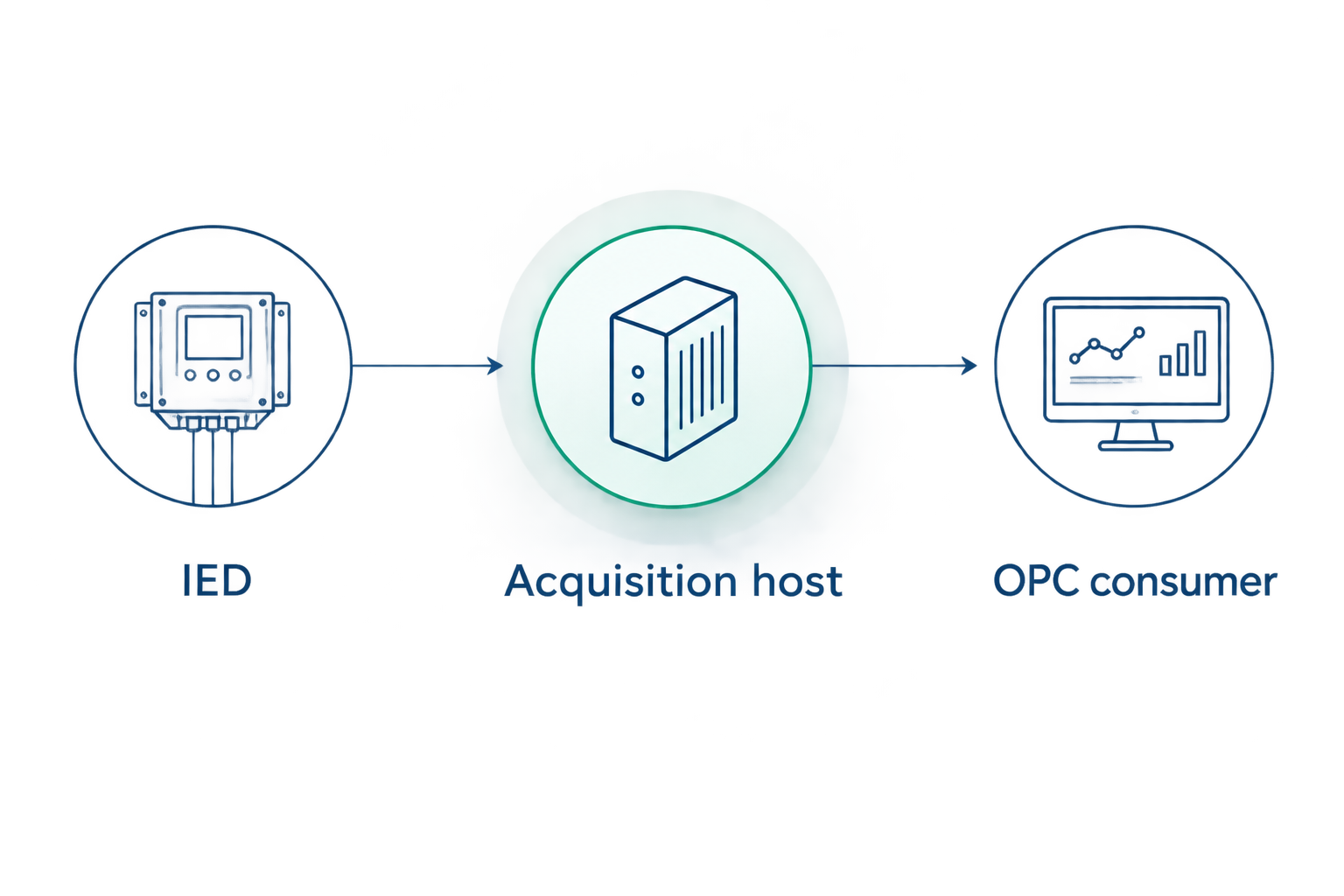
Approve each network boundary before enabling the acquisition path.
Choose polling or reporting deliberately
Polling and reporting are acquisition approaches, not interchangeable guarantees. Use only the approach supported by both the selected driver and the IED configuration.
Polling
- Best for: Periodic monitoring where supported
- Benefit: Makes the read schedule explicit
- Constraint: Changes between reads are not automatically retained
Buffered reporting
- Best for: Event-oriented monitoring where supported and configured
- Benefit: Supports buffering within the IED's configured capabilities
- Constraint: Recovery depends on buffer limits, client handling, and report configuration
Unbuffered reporting
- Best for: Connected-session updates where supported
- Benefit: Sends reports without buffered-event recovery
- Constraint: Does not provide buffered recovery across a disconnected session
Do not select buffered reporting merely because an application needs historical data. Establish whether the entire path preserves event timestamps, quality, ordering, and recovery behavior. Reporting support is not the same as end-to-end event retention.
IED connection and point mapping
Establish the first connection
- Back up the existing acquisition configuration before editing it. Record software versions and the IED engineering revision in the 2026 baseline.
- Use the selected driver's documented connection procedure to configure the approved IED address and any required association parameters. Copy values from the approved engineering record; do not guess protocol-specific identifiers.
- Establish communication with 1 IED first. Inspect diagnostics for association failures, rejected requests, or repeated reconnects before adding other devices.
- If the driver supports importing an engineering file, use the current approved file and check the resulting references against the live device. Otherwise, configure references using the documented addressing syntax.
Expected result: The acquisition connection remains established, and the diagnostic record identifies the intended IED without recurring communication errors.
A successful network connection proves reachability, not correct signal interpretation. Keep the first connection small enough that an engineer can inspect every requested point and explain its meaning.
Build a traceable point schedule
- Select 3 test points: one measurement, one status indication, and one point with useful quality or timestamp information. Use simulation or an approved test source when changing the physical process is unsafe.
- Record the full source reference for each point, including the logical device, logical node, data object, data attribute, and functional constraint where relevant to the selected addressing method.
- Record the destination tag name, datatype, engineering unit, scaling rule, quality mapping, and timestamp handling. Keep the original IEC reference in the engineering record even if downstream names are shorter.
- Compare each acquired value with an authorized reference display or test instrument. Check enumerations and double-point indications explicitly rather than treating every status as a Boolean.
- Document where source quality and time are exposed. Distinguish the IED event time from the acquisition host's receipt time and the historian's storage time.
Expected result: Each test point has a verified source, interpretation, and destination mapping. Another engineer can trace a displayed value back to its IEC 61850 reference.
Do not flatten every attribute into a numeric value and discard the rest. Quality and timestamps determine whether a downstream consumer can distinguish valid process information from stale or questionable data.
OPC consumer configuration and acceptance
Secure the downstream connection
- Confirm the supported OPC interface in the installed TOP Server documentation and configure the consuming application accordingly. For an OPC UA deployment, record the endpoint, application identities, and approved security configuration.
- Exchange and validate application certificates through the site's approved trust process. Check hostnames, certificate validity, and system clocks; do not solve certificate failures by permanently disabling security checks.
- Assign the consumer only the access required for monitoring. Where supported, enforce read-only permissions in the server and consumer configuration; also verify the acquisition path cannot issue unintended writes.
- Subscribe to the approved test points. Record requested and revised subscription parameters rather than assuming the server accepted every requested interval unchanged.
Expected result: The authorized consumer receives the intended points over the approved connection, while unauthorized access and writes remain blocked.
For certificate-specific preparation, use the OPC UA certificate setup guide. Certificate trust and IEC 61850 acquisition are separate configuration tasks; success on one side does not validate the other.
Commission the complete path
- Observe the 3 test points at the source, acquisition layer, and final consumer. Compare value, datatype, quality, and timestamp interpretation at each boundary.
- Run 2 interruption tests in an approved maintenance or test environment: interrupt the IED acquisition connection, then interrupt the downstream consumer connection. Test each interruption separately so the cause remains identifiable.
- Confirm that the consumer identifies stale or unavailable data during each interruption. A last-known value must not appear indistinguishable from a current, good-quality reading.
- Restore communication and inspect recovery. For reporting, compare observed recovery with the configured reporting behavior; for polling, verify that current reads resume without claiming recovery of intermediate events.
- Restart the acquisition service during the approved test window. Confirm that configuration persists, connections recover, and the consumer's behavior matches the acceptance specification.
Expected result: Your 2026 acceptance record shows both normal operation and failure recovery. Expand the point count only after the complete path passes.
Variant: acquire updates through IEC 61850 reporting
Use reporting when the selected driver and IED support the required report services and the application needs that behavior. This variant changes the acquisition configuration; it does not remove downstream validation.
- Have the protection engineer identify the permitted dataset and report control block. Confirm whether the client assignment is fixed, reserved, or otherwise restricted by the device configuration.
- Configure only the reporting parameters exposed and supported by the selected driver. Match dataset references, trigger requirements, and integrity behavior to the approved design.
- Generate an authorized test change and verify that the expected data attributes arrive with their associated quality and time information.
- Disconnect and reconnect the client under controlled conditions. For buffered reporting, verify recovery against known test events and inspect indications of overflow or lost continuity.
Expected result: The report configuration delivers the intended changes without interfering with existing clients.
Reporting does not make a general-purpose data integration path suitable for protection messaging. GOOSE, Sampled Values, and MMS serve different communication requirements; specify each requirement independently.
Troubleshooting
IED responds to ping but acquisition fails
- Check: Required service reachability, association parameters, and device connection limits
- Fix: Validate the actual service path and approved identifiers; ping alone is insufficient
Connection succeeds but points fail
- Check: Live model versus engineering file, functional constraint, reference syntax, and access rights
- Fix: Correct the specific reference or permission before expanding the dataset
Reports never arrive
- Check: Dataset assignment, report ownership, enable state, and trigger configuration
- Fix: Coordinate report allocation and verify a permitted test change
Values arrive with misleading times
- Check: Source time availability, clock synchronization, and downstream timestamp selection
- Fix: Document and correct the timestamp mapping at the boundary where it changes
Values remain visible after disconnection
- Check: Quality propagation, stale-data handling, and consumer display behavior
- Fix: Configure the consumer to distinguish last-known values from current valid data
Troubleshoot one boundary at a time. Start at the source, inspect acquisition diagnostics, and then inspect the OPC consumer; changing unrelated settings across all layers destroys the evidence needed to isolate the fault.
Customize your workflow
After commissioning the pilot, expand by approved IED group and signal class. Reuse naming conventions and acceptance templates, but validate each device's actual model and reporting configuration.
For a 2026 handover, retain the point schedule, configuration backup, certificate ownership record, firewall approvals, and interruption-test results. Assign an owner for engineering-file changes so a relay configuration update triggers a mapping review.
Use Software Toolbox's contact page to discuss the installed TOP Server version, required IEC 61850 services, IED details, and downstream interface. Resolve compatibility before committing the architecture.
FAQ
Can TOP Server connect to every IEC 61850 IED?
Do not assume universal compatibility. Confirm the selected TOP Server driver's documented services against the IED model, firmware, and required acquisition behavior before deployment.
Is this workflow suitable for breaker control?
This workflow is for read-only monitoring, not breaker control. Control requires a separate design covering permissions, command models, interlocks, testing, and operational authorization.
Do I need an SCL file to configure the connection?
The requirement depends on the selected driver's configuration method. Use the current approved engineering file when the workflow supports or requires it, and verify its references against the live IED.
Does an MMS connection also collect GOOSE messages?
An MMS connection does not establish GOOSE acquisition. Specify and verify GOOSE support separately rather than inferring it from general IEC 61850 compatibility.
Is buffered reporting better than polling?
Buffered reporting is better suited to supported event-recovery requirements; polling is suited to periodic reads. Neither approach replaces validation of timestamps, quality, and downstream retention.
How do I test the connection without operating equipment?
Use an approved simulator, test IED, or controlled test signals. Agree on the test method with protection engineering and keep production control operations outside the monitoring acceptance test.
What should I record for a 2026 commissioning handover?
Record software and firmware versions, source references, point mappings, network approvals, certificate ownership, and acceptance results. Include communication-loss behavior and the procedure for reviewing later IED configuration changes.
One last thing
A plausible value is the most dangerous incomplete test. A stale breaker indication can look entirely reasonable. Make loss-of-communication behavior an acceptance criterion, not an observation someone records after the integration enters service.