On June 2nd I addressed an audience of manufacturing leaders at the "AI and Data Transformation in manufacturing forum, organized by AMG World.
Below is the presentation; but more importantly want to summarize 10+ critical takeaways from this discussion. My perspective is grounded in a 25-year career at the intersection of industry and technology; having led significant AI work at McKinsey, started an applied AI group, led growth at an AI for manufacturing startup, and having built the latest generation of AI products now at Software Toolbox, including jonjon.ai and chatUNS.ai.
Note: I made these slides. I can observe what our customers tell us in the field - something AI cannot yet do. Use with attribution please.
1. AI is a "Salad Bowl" of technologies
AI is not a single thing. It is better understood as a salad bowl of distinct technologies, each cut for a different job, and most of the trouble begins when people forget this.
- Traditional machine learning is in the prediction business. Hand it structured data and it will give you back one of two things:
- A number, such as a price, an energy consumption figure, or a throughput estimate.
- A probability, such as the chance of a failure, a defect, or a stockout on a given line.
- Deep learning - computer vision the task of working out what is actually in an image. Can be done for three purposes: Detection, Classification, Segmentation
- Generative AI (LLMS) feeds on unstructured text and turns it into useful output, whether writing code, producing creative content, or holding a conversation.
- Multimodal models (LMMs) widen the aperture further, taking in text, images, video, and sound together rather than one modality at a time.
- Reasoning models, the lineage that o1 announced in November 2024, are trained on chain-of-thought data, which means they can reason through a problem in steps and call on tools as they go. Reasoning models are the brains behind agents.
- Agentic AI is autonomous software: it pursues an objective and uses tools to get there, rather than waiting to be prompted for each move.
- The core problem is a vocabulary problem. Almost everyone says "AI," and almost no one can tell you which of these they mean.
2. AI in Manufacturing: Beware consultant numbers
The honest starting point is an uncomfortable one: by most measures, manufacturing sits very near the bottom of the league table for AI adoption and impact.
- The charts are not flattering. In the surveys you would expect to be authoritative, namely Goldman Sachs (General AI-unclear), McKinsey (Agentic AI survey), and Gallup (GenAI survey), manufacturing keeps company with government at the foot of the table forAI usage.
- Treat the consulting numbers with deep suspicion. Most of the statistics in circulation are, to put it charitably, fiction; they make for good slides and poor decisions.
- The famous "95% of AI fails" figure is widely misread. It refers to do-it-yourself generative-AI projects, not to AI as a whole, and quietly omits the categories that work.
- The counter-evidence is striking. Against that headline, Anthropic reports a 95% success rate for coding agents, a near-mirror image in the right category.
- The takeaway is one of discrimination, not despair. Some kinds of AI work extremely well, among them classical machine learning, computer vision, and well-productized generative AI, while others, chiefly poorly-scoped DIY generative AI, fail with grim regularity.
3. How to Start in Manufacturing: Pick a problem, site, line, and the right base rate
There is no need to overthink the entry point. A serviceable method is to keep picking until you have something concrete to build, which we might call "Pick-Pick-Pick-Pick."
- Pick a problem. Nearly every worthwhile candidate falls into one of two families:
- Time to insight and decision making: We are in a real-time world. Historical data is just training data
- Holistic OEE: performance / throughput, uptime and downtime, quality, safety & compliance.
- Cost : chiefly energy costs and waste or scrap.
- The requests that actually arrive from the field are reassuringly down-to-earth: better OEE accuracy, capacity visibility across plants, quality monitoring to cut scrap, energy-cost reduction in regulated markets, smoother shift handovers, and better work-order and maintenance compliance.
- Pick a 'Goldilocks' site. The trick is to avoid the extremes. A plant that is too analog will see its return on investment swallowed by the upgrades needed to get going; one that is too new offers little headroom and little to learn. What you want is a Goldilocks plant, modern enough to instrument and dated enough to improve.
- Pick a line or process. Decide honestly whether you are addressing a whole plant, a single line, or one specific area, and resist the urge to do all three at once.
- Check the base rate. Before anything else, ask which slice of the business a success would actually move. If the a part of the process represents 40% of the cost / downtime, a 2% gain there will outweigh a spectacular result on a trivial part. Many of the celebrated "50% ROI" stories sit on 10% of the base and never touch the needle, which is why you must aim improvements at the core products and core lines.
- The Truth About ROI: ROI is fifth-grade math. You need benefits - investment / investment. Benefits are a percent of a base rate. For the ROI number to matter in nominal terms, the base rate needs to be big. Spend not doing consulting math on the ROI.
Classical machine learning remains quietly indispensable in manufacturing, though it can now be accomplished within GEN-AI
- The most useful predictions are about lines, not single machines. Predicting that a line will fail tends to be far more valuable than flagging one component, because the real causes are so often logistics, staffing, a full warehouse, or missing materials rather than pure mechanical wear.
- Generative AI is steadily eating machine learning's lunch. Tools such as Claude Code can now train classifiers and build XGBoost, LightGBM - random-forest style models, which means a good deal of conventional data-science work can be automated rather than hand-crafted.
- Those that argue about the cost of inference of traditional machine learning versus Gen AI doing it need to account for the fact that Gen AI can do the work of a full ML team.
- The implication is a shift in where the value sits. The premium moves away from hand-building models and toward the parts a machine cannot do for you: framing the problem, securing the data, and getting the result deployed.
5. Computer Vision is the gold medalist of AI in manufacturing
Vision is one of the genuine success stories, provided one respects its temperament.
- Its core strength is raw bandwidth. A camera can attend to far more pixels than any human inspector, which makes it formidable for inspection and especially valuable for reshoring, where the institutional muscle for quality has quietly wasted away.
- The field is less forgiving than the lab. A much-cited 2019 MIT paper showed accuracy falling under real conditions: changing light, awkward angles, wear, and swapped cameras all take their toll.
- The Starbucks example is a cautionary one. A vision system for counting inventory, milk and pods, was abandoned when it stumbled, where the wiser course would have been to iterate and retrain.
- The right model is Tesla, not surrender. When vision fails, you do not scrap it; you retrain it, fold in the new edge cases, and keep iterating.
- And the cheap win is often the best one. A $20 camera mounted above a conveyor to spot accumulation can outperform an elaborate variable-frequency-drive analytics scheme at a fraction of the cost and fuss.
6. Generative AI and the UNS: Why Context provides grounded answers
Generative AI is powerful and, fed badly, it is also confidently wrong, which is why context turns out to be the whole game.
- Raw structured data defeats language models. Dump a historian's tables into an LLM and you will get bad joins, hallucinated relationships, and missing context, because the model has no idea how the pieces are meant to fit.
- Manufacturing has a quiet advantage here: the Unified Namespace. The UNS acts as a semantic layer, an ontology for plant data, supplying exactly the structure and meaning that a language model can lean on.
- Adoption, however, lags awareness. Many have heard of the UNS; far fewer have actually deployed it at scale across their factories. There is a great HiveMQ report about this.
- This has been solved with chatuns.ai. With a UNS and MQTT underneath, you can start chatting with your plant in roughly ten seconds.
7. Agentic AI: Digital Workers To address labor vacuums and cognitive overload
An agent is autonomous software with a clear objective and the ability to use the tools and systems needed to reach it. The art lies in choosing where to point it.
- Send it into the labor vacuums, the roles that are hard to hire for and harder to keep.
- Send it into the unpleasant places. Consider a beet-sugar plant: the work is real, the smell is memorable, and nobody is queuing up for the post.
- Send it where the cognitive load is punishing. Ask a human to keep one eye on the historian, the real-time feed, the predictions, the MES, the ERP, the CMMS, and the HMI all at once, and they will miss something; an agent is wholly indifferent to the volume.
- Send it where conditions change faster than people can adapt. Rapid, shifting environments are where human attention frays and an agent holds steady.
- But feed it process data, not merely text. An agent does poor work without clear objectives, defined tasks, the systems it is allowed to touch, the relevant process variables, the SOP documentation, and the triggers that should wake it up.
8. What AI to Use for What Job
Once the problem is chosen, matching it to the right technology is largely a matter of asking a few blunt questions in the right order.
- If simple rules and visualization will do, do not reach for AI at all. An if-then problem is an automation problem; dressing it up as intelligence only adds cost and fragility.
- If you need to predict a number or a probability, use traditional machine learning on structured data: the probability of downtime, a defect, or a stockout; expected energy use; a price.
- If you are augmenting a human visual inspector, use computer vision. This is particularly pressing where the quality experts are retiring with no one trained to take their place.
- If you need code, written content, or answers drawn from text, use generative AI, since this is precisely the work large language models were built for. As the level of the output gets more complex, with charts that need to incorporate multiple data sources, etc., then ratchet up from a basic LLM to a reasoning LLM.
- If you have a narrow, well-defined process and either a labor vacuum or genuine cognitive overload, use Agentic AI. A digital worker suits the job that no one wants or that no one person can fully hold in their head.
- There are scores of those papers out there that say that 90% of AI fails. If you read it, it was actually because they picked the wrong type of AI for a specific problem.
9. Data: Stop waiting for perfect data.
The governing principle is wonderfully unglamorous: make it exist, then make it better.
- Do not wait for perfect data, because that day never arrives. Get something in place and let the system improve from there; a UNS-based AI will happily tell you what is missing once it has anything to work with.
- Beware the temptation to over-architect. The medallion architectures, bronze then silver then gold, earn particular scorn: by the time data has been refined into "gold," it has so often been filtered into uselessness.
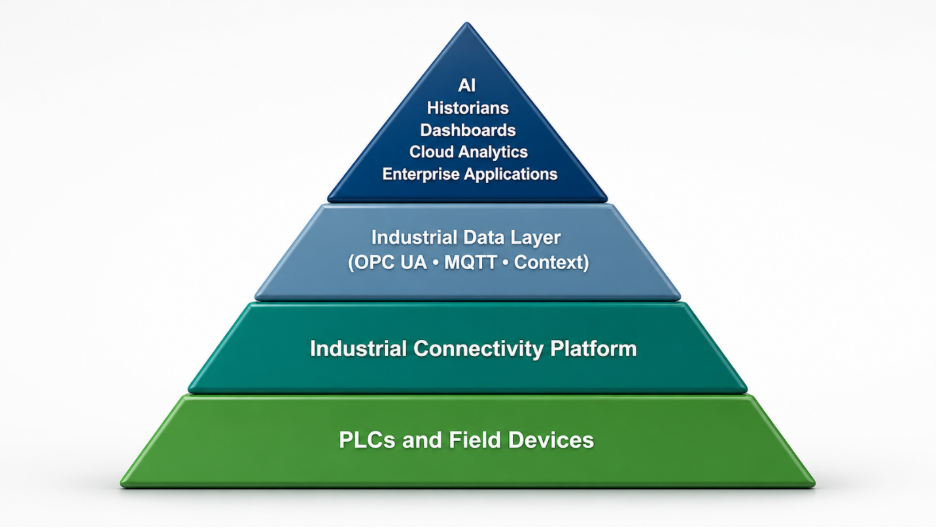
- A minimal viable stack is enough to begin. A historian, an OPC server, a Unified Namespace, and an AI layer will do, not seventeen tiers of middleware.
- Distinguish the historical from the real-time, and know which is which. The web analogy is apt: just as the open web became training data for foundation models, your historical plant data is training material rather than the place to live day to day. Decisions belong in the real-time world, made on live signals.
- Here we are, 10+ years after data warehouses and data lakes became mainstream, and somehow we still don't have enough data, or the right data, or in the right format. Let's not replay that story about getting the data ready. It's time to get moving. AI is very good at pointing out data gaps, and you can iterate in a feedback loop
10. Organizational and Transformation Lessons
The technology is rarely what is stuck; the organization usually is.
- The reasons for stagnation are familiar. There is no clear aspiration, no genuine reallocation of resources, and a stubborn fondness for the old three-year transformation initiative.
- The correct order of operations is the opposite of the usual one. First set the aspiration; then reallocate resources, and in this sequence: talent first, management attention second, capex and opex third.
- Execute by backlog, not by initiative. Progress comes from a steady queue of small, concrete use cases, not from a single grandly-scoped program.
- And IT must be an ally rather than an adversary. The IT budget is typically four times the size of OT's, so the OT side is well advised to work with it, getting the .ai domains whitelisted and aligning with security and policy, instead of fighting it.