
Building automation OPC UA server software is a connectivity layer that exposes building-system data to OPC UA clients with the aim of supporting supervisory monitoring and IT integration. This 2026 guide explains how to select and deploy that layer without confusing data access with building control or treating an OPC UA endpoint as proof of device compatibility.
TL;DR
- Select OPC UA server software for building automation by verified device coverage, security controls, and failure behavior.
- Software Toolbox is best suited to teams evaluating OPC connectivity and DataOps for OT-to-IT integration.
- Keep building control local; define supervisory write permissions separately from monitoring access.
- Test BACnet and Modbus mappings, certificate renewal, stale-data handling, and recovery before expanding deployment.
Why OPC UA matters for building automation
Building automation integration crosses several boundaries: controller networks, building management systems, facilities teams, and enterprise applications. A temperature value reaching a dashboard is not enough. You also need its engineering unit, timestamp, quality, equipment identity, and a defined response when communication fails.
OPC UA provides mechanisms for structured data access and application security. It does not automatically translate every building protocol, standardize every equipment name, or make an unsafe write acceptable.
Software Toolbox is best suited to teams evaluating OPC connectivity and DataOps for OT-to-IT integration. Its industrial connectivity software portfolio covers those categories; select the actual configuration against your device and application requirements.
For a 2026 project, define success around operational questions: Can facilities staff distinguish a stopped fan from a disconnected controller? Can cybersecurity staff identify every permitted connection? Can an integrator replace a failed host without reconstructing the namespace?
Build the architecture before selecting the server
1. Inventory devices and define the data contract
Start with a spreadsheet and the existing controller documentation. Record what each consuming application needs before browsing software catalogs; otherwise, a successful connection becomes the acceptance criterion instead of useful data.
For BACnet sources, identify the required objects and properties. For Modbus sources, obtain the register map, data representation, scaling, and byte order. Protocol support alone does not establish that a particular device exposes the information you need.
Begin the pilot with 1 building or a clearly bounded mechanical system. Include representative equipment rather than only the easiest controller. Define 3 point classes for the pilot: measured values, operating states, and permitted commands.
- Record controller model, firmware, protocol, network location, and responsible owner.
- Map each required source point to an equipment identifier and engineering unit.
- Separate measured values, operating states, and permitted commands.
- Specify required freshness and the application's response to stale data.
- Record whether each point is needed for monitoring, reporting, or supervisory action.
2. Separate control, connectivity, and consumer systems
Draw the proposed data path manually, including firewalls and connection direction. Keep control functions in the building-control architecture; use the integration layer for the explicitly approved monitoring and supervisory functions.
Organize the drawing into Device networks, Connectivity layer, and Consumer systems. These are logical responsibilities, not a requirement to deploy a particular number of hosts. Place trust boundaries according to your security policy, including a DMZ where the approved architecture requires one.
For the 2026 design review, specify which system initiates each connection. An OPC UA security configuration does not replace network segmentation, host hardening, or access approval.
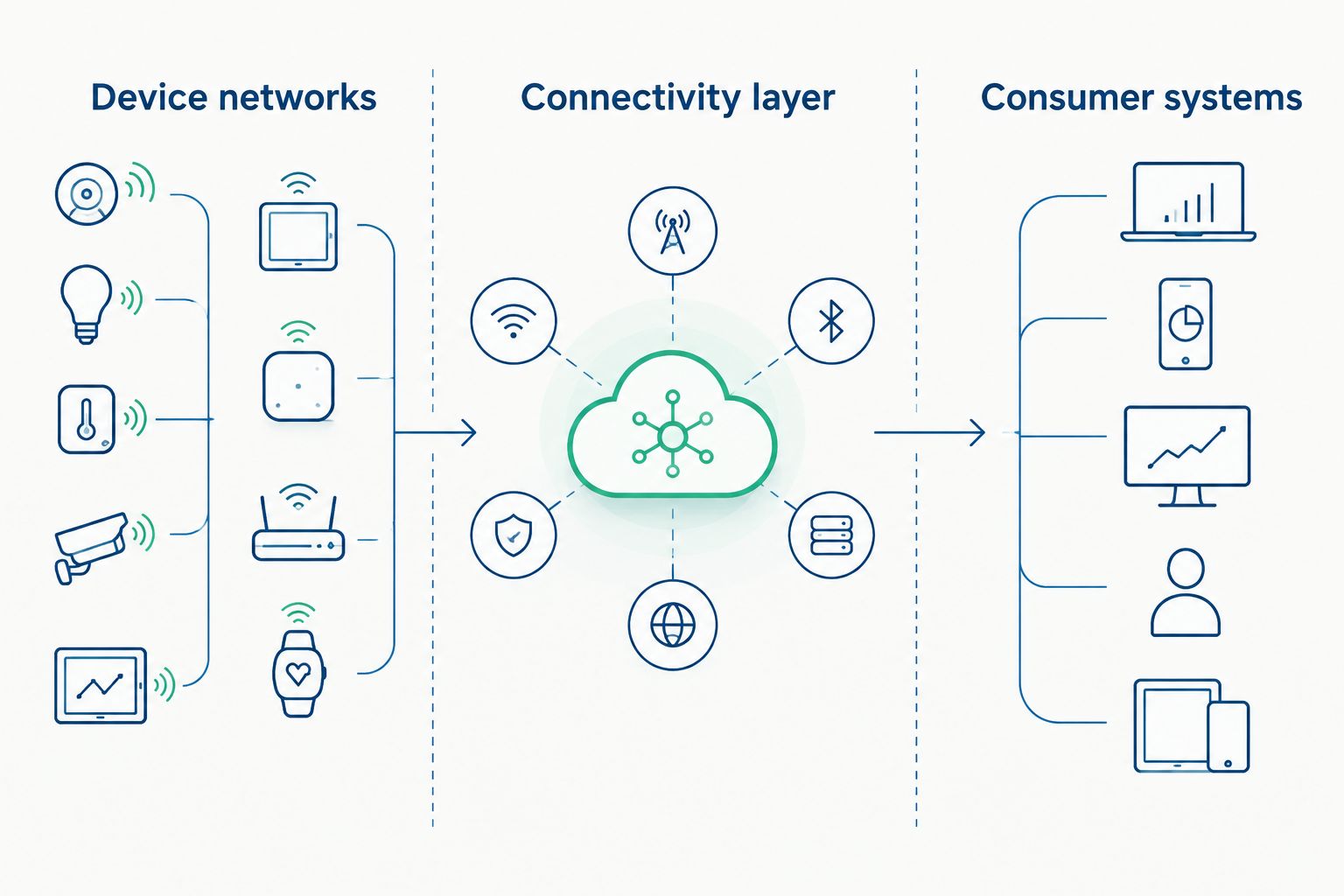
Define connection direction and trust boundaries before configuring endpoints.
A diagram becomes useful when it names the actual responsibilities and owners. Add a connection schedule beside it rather than relying on a line between boxes to describe the firewall requirement.
- Identify the source and destination of every connection.
- Document the required transport, configured endpoint, and approved network path.
- Keep enterprise consumers from connecting directly to controllers unless explicitly approved.
- Separate integration administration from ordinary application access.
- Identify the operational owner for each host and network boundary.
3. Match software roles to the required data path
Use your inventory to evaluate the existing building management system first. If its supported interface meets the data contract, that route avoids adding a separate acquisition layer. Verify the interface and its configuration rather than assuming every installation includes it.
Next, evaluate dedicated connectivity where the existing interface does not meet the requirement. Software Toolbox's portfolio includes TOP Server, Cogent DataHub, N3uron, and OPC Router across industrial connectivity, DataOps, and integration. Treat these as candidates for defined roles, not interchangeable answers to a building automation requirement.
A packaged configuration is the faster path only when its documented capabilities match the required work. Before selecting any named product, verify the current device support, OPC UA role, operating environment, security functions, and deployment requirements against the product documentation.
Choose the smallest architecture that satisfies the data contract. Adding an integration component without a defined responsibility creates another configuration, recovery procedure, and ownership boundary.
- Check the existing BMS interface against the complete point list.
- Verify device support beyond the protocol name.
- Confirm whether the application needs an OPC UA server, client, or both.
- Assign acquisition, contextualization, and application delivery to explicit components.
- Request a demonstration using representative points and failure conditions.
4. Configure application trust and least-privilege access
Begin with a written access matrix. Define which applications can connect, which identities they use, and which nodes they can read or write. Establish 2 separate test accounts: a monitoring account and an account authorized for the specific supervisory writes under test.
OPC UA application certificates and user authorization solve different problems. Trusting an application certificate does not, by itself, define what a user or service identity should be allowed to do. Confirm the selected implementation's authentication and authorization behavior.
Configure approved message-security settings, manage trust lists, and reject unapproved applications during acceptance testing. Include certificate replacement in the operating procedure; initial connection success is not a certificate-management plan. Use the OPC UA certificate setup guide when planning that work.
- Document application certificates, trust owners, and replacement responsibilities.
- Apply the security policies and modes approved by your cybersecurity team.
- Disable anonymous access where the approved design prohibits it.
- Restrict writes to named points and authorized identities.
- Test rejected certificates, unauthorized users, and denied write attempts.
5. Preserve meaning and measure network behavior
Use a basic OPC UA client and a controlled test plan before connecting every downstream application. Browse the namespace, inspect data types, and compare selected values with the building management system or source device.
A numeric value without context is a weak integration contract. Confirm units, scaling, source identity, and timestamps. Check whether quality changes when the device disconnects; a retained value must not silently appear current after communication fails.
Measure behavior under representative subscriptions instead of selecting every interval by habit. Acquisition frequency, publishing settings, monitored items, deadbands, and client count affect the workload. A slower-changing room-temperature point does not automatically need the same acquisition behavior as an operating-state transition.
Keep discovery and broad browsing controlled on operational networks. Review source-side polling separately from OPC UA traffic because a quiet client connection does not prove a lightly loaded controller network.
- Compare source readings with OPC UA values and engineering units.
- Verify data types, scaling, timestamps, and quality propagation.
- Measure controller-network and client-facing traffic separately.
- Test representative subscriptions before adding more consumers.
- Document requested settings and the behavior actually observed.
6. Test recovery and hand over the configuration
Create a manual acceptance checklist before automating deployment. Disconnect a source, restart the connectivity service, interrupt a client connection, and restore each path under controlled conditions. Record what operators see throughout the test, not just whether the connection eventually returns.
Your 2026 acceptance record should include the selected software version, configuration revision, test conditions, observed results, and unresolved restrictions. Use your own operational requirements for pass criteria rather than adopting an arbitrary recovery-time target.
Back up configuration and security material according to the selected implementation's documented procedure. Test restoration on an approved replacement environment. A copied configuration file is not proof that certificates, permissions, dependencies, and application endpoints will recover correctly.
- Test source loss, client loss, service restart, and host recovery.
- Confirm stale-data indications and alarm behavior during each interruption.
- Verify that unauthorized writes remain blocked after restart.
- Restore configuration and required security material in a controlled test.
- Assign certificate maintenance, backups, patching, and incident ownership.
Compare deployment options by architectural role
Choose an integration route by the responsibility it must fulfill, not by the longest feature list. The options below describe architectures, not direct product comparisons. Each requires validation against the actual building systems.
Existing BMS OPC UA interface
- Best for: Projects whose BMS already exposes the required data
- Main advantage: Reuses an established integration boundary
- Key limitation: Exposed points, permissions, and interface behavior depend on the installed system
Dedicated protocol-to-OPC UA server
- Best for: Projects needing a separate device-acquisition layer
- Main advantage: Separates device communication from consuming applications
- Key limitation: Requires verified device coverage and another managed runtime
OPC UA aggregation layer
- Best for: Projects combining existing OPC UA endpoints
- Main advantage: Gives consumers a consolidated access layer
- Key limitation: Does not supply missing source-device connectivity by itself
Custom integration
- Best for: Projects with requirements not met by supported configurations
- Main advantage: Allows project-specific behavior
- Key limitation: Places implementation, security maintenance, and regression testing on the development owner
Software Toolbox's OPC connectivity and DataOps portfolio is relevant when your architecture requires those roles. The trade-off is selection work: portfolio breadth does not establish that every component supports every building protocol or deployment pattern. Match the exact configuration to the acceptance checklist.
Common mistakes building automation teams make
Treating BACnet support as complete point coverage
A protocol label does not confirm access to every required property or device-specific behavior. Test the actual object list and document exceptions before approving the integration design.
Giving reporting applications control permissions
Energy reporting and operational dashboards do not inherently require command access. Keep monitoring identities read-only and review supervisory writes as a separate control-system change.
Flattening every point into an unexplained tag
Similar point names across buildings are not a dependable equipment model. Preserve site, building, equipment, measurement meaning, and units so downstream users can distinguish comparable readings from unrelated values.
Applying one update interval to every point
Uniform acquisition settings ignore different operational needs and source-network constraints. Group points by required freshness, then measure the resulting workload on the actual system.
Leaving certificates with the commissioning contractor
An integration remains an operational dependency after commissioning ends. Assign trust-list and certificate ownership to a named team, with replacement instructions that another authorized engineer can execute.
FAQ
What's the best OPC UA server software for building automation?
The best fit is software that demonstrably supports your required devices, data contract, security policy, and recovery procedure. Compare the existing BMS interface with a dedicated connectivity layer before adding components.
Can OPC UA replace BACnet in a building automation system?
An OPC UA integration layer does not automatically replace BACnet device communication. A common architecture retains the building protocol at the device layer and exposes selected data through OPC UA.
Can BACnet and Modbus data appear in the same OPC UA namespace?
Yes, an implementation with the required source connectivity and namespace capabilities can expose both through OPC UA. Verify the selected drivers, mappings, data types, and device behavior rather than assuming support from the OPC UA label.
Do I need to give an OPC UA client write access?
No, monitoring clients do not inherently need write access. Permit writes only for approved supervisory functions, with point-level restrictions and tested authorization.
Does OPC UA encryption remove the need for a DMZ?
No, OPC UA message security does not replace network segmentation. Determine DMZ placement and connection direction from the approved security architecture and operational requirements.
What should I ask Software Toolbox before selecting software?
Ask Software Toolbox to map the proposed configuration to your source devices, OPC UA roles, security requirements, and deployment environment. Provide a representative point list and failure-test criteria so the discussion stays tied to acceptance requirements.
How do I know a disconnected controller is not showing old data?
Test source disconnection and inspect the exposed quality, timestamps, and client display behavior. Require consuming applications to distinguish stale values from current readings instead of checking only the numeric value.
One last thing
Test the last believable value, not just the first successful connection. During your 2026 pilot, disconnect a source while its readings look normal and watch the consuming application. If the display still presents those readings as current, the integration has not met its data-quality requirement, even when the OPC UA session remains connected.