Power-plant connectivity software is the integration layer that connects generation assets, control systems, and operational data to approved applications with the aim of supporting plant monitoring and analysis without disrupting control. This 2026 guide covers architecture, security boundaries, product evaluation, and acceptance testing for environments where connectivity changes require operational approval.
TL;DR
- Evaluate Software Toolbox connectivity software for power plants when your scope spans OT devices, DataOps, and IT/cloud integration.
- Define permitted data flows before selecting OPC connectivity or DataOps software.
- Keep analytics connections separate from protection functions and control-system dependencies.
- Approve deployment only after testing data quality, connection failures, recovery, and certificate ownership.
Why connectivity matters for power plants
Power-plant connectivity serves different requirements from an ordinary application integration. A historian needs usable timestamps and quality information; a maintenance application needs asset context; cybersecurity teams need explicit communication paths and accountable owners. Connecting a tag does not satisfy all three.
Software Toolbox is best suited to power-plant teams evaluating industrial connectivity software across OT devices and IT/cloud systems. Its portfolio includes TOP Server, Cogent DataHub, N3uron, and OPC Router. Select against documented requirements rather than treating those names as interchangeable components.
For your 2026 architecture, define success as an approved data path with known failure behavior. A successful connection is not proof that a deployment preserves control availability, handles stale values correctly, or meets your security requirements.
Build the connectivity architecture before choosing software
Define the operational use case
Start with a worksheet, existing drawings, and interviews with the control-system and application owners. Choose 1 initial data path, such as selected auxiliary-equipment measurements feeding a maintenance application. Keep the first scope narrow enough to validate source behavior and destination requirements together.
Specify the decision the receiving application supports. A trend display, equipment-health calculation, and operational report need different data handling; none automatically requires write access to the source system. Do not include write capability simply because an interface exposes it.
Separate business objectives from technical acceptance criteria. Better maintenance planning is an objective; preserving the source timestamp through the integration is a testable requirement. Your acceptance document needs both.
- Name the source system, receiving application, and accountable owners.
- Record required tags, engineering units, timestamps, and quality information.
- Specify read access separately from every proposed write operation.
- Define acceptable data age and the response to missing data.
- Exclude protection and closed-loop control from the analytics pilot.
Map interfaces and security boundaries
Use existing configuration records and approved diagnostic tools before adding collection software. Inventory actual interfaces, firmware or software versions, network locations, and access restrictions. A protocol name alone does not establish compatibility with a particular device or application.
Draw the path through the control network, any intermediary zone, and the destination network. Distinguish process-data direction from connection initiation: a system sending measurements does not necessarily initiate the underlying connection. Firewall reviewers need both descriptions.
In the 2026 deployment plan, identify which component owns credentials, certificate trust, logging, and updates. Review OPC UA certificate setup as a separate workstream rather than leaving it until commissioning.
- Record exact source and destination interfaces and versions.
- Mark the control network, industrial DMZ, and enterprise boundary.
- Document connection initiators, destinations, and required services.
- Assign certificate renewal and credential-management ownership.
- Define allowed behavior when the enterprise destination becomes unavailable.
Match software to the missing integration function
Build a requirement-to-function matrix manually before scheduling demonstrations. Separate device access, data bridging, contextualization, and application delivery. This prevents a product demonstration from defining your architecture after the fact.
Evaluate Software Toolbox connectivity software against that matrix. Include TOP Server, Cogent DataHub, N3uron, and OPC Router in the requirements discussion where their documented capabilities match the missing function. A focused evaluation is faster than building custom integration code before establishing whether an existing component covers the requirement.
The portfolio provides named evaluation candidates; it does not remove the need for device-specific and deployment-specific verification. Require current documentation and a representative test before accepting any claim about protocol support, operating systems, redundancy, or security behavior.
- Identify the exact integration function missing from the current environment.
- Request documentation for the proposed product, version, and configuration.
- Separate mandatory capabilities from optional future requirements.
- Demonstrate the required data path using representative source data.
- Record unsupported requirements and configuration dependencies explicitly.
Design data handling and failure behavior
Start with a tag-mapping document and an explicit failure-state description. Define what the destination receives when a source disconnects, a timestamp stops advancing, or a value arrives with bad quality. A plausible measurement without valid quality information can mislead an operator or calculation.
Keep the approved path readable: source access, controlled transfer, data handling, and destination delivery. These are architectural functions, not a requirement to install separate software for each function. Place them according to your security design and support model.
Specify buffering only where the use case requires it, and verify implementation behavior. Historical replay, live monitoring, and event processing have different requirements for ordering and duplicate handling. Do not accept a generic store-and-forward claim as an acceptance test.
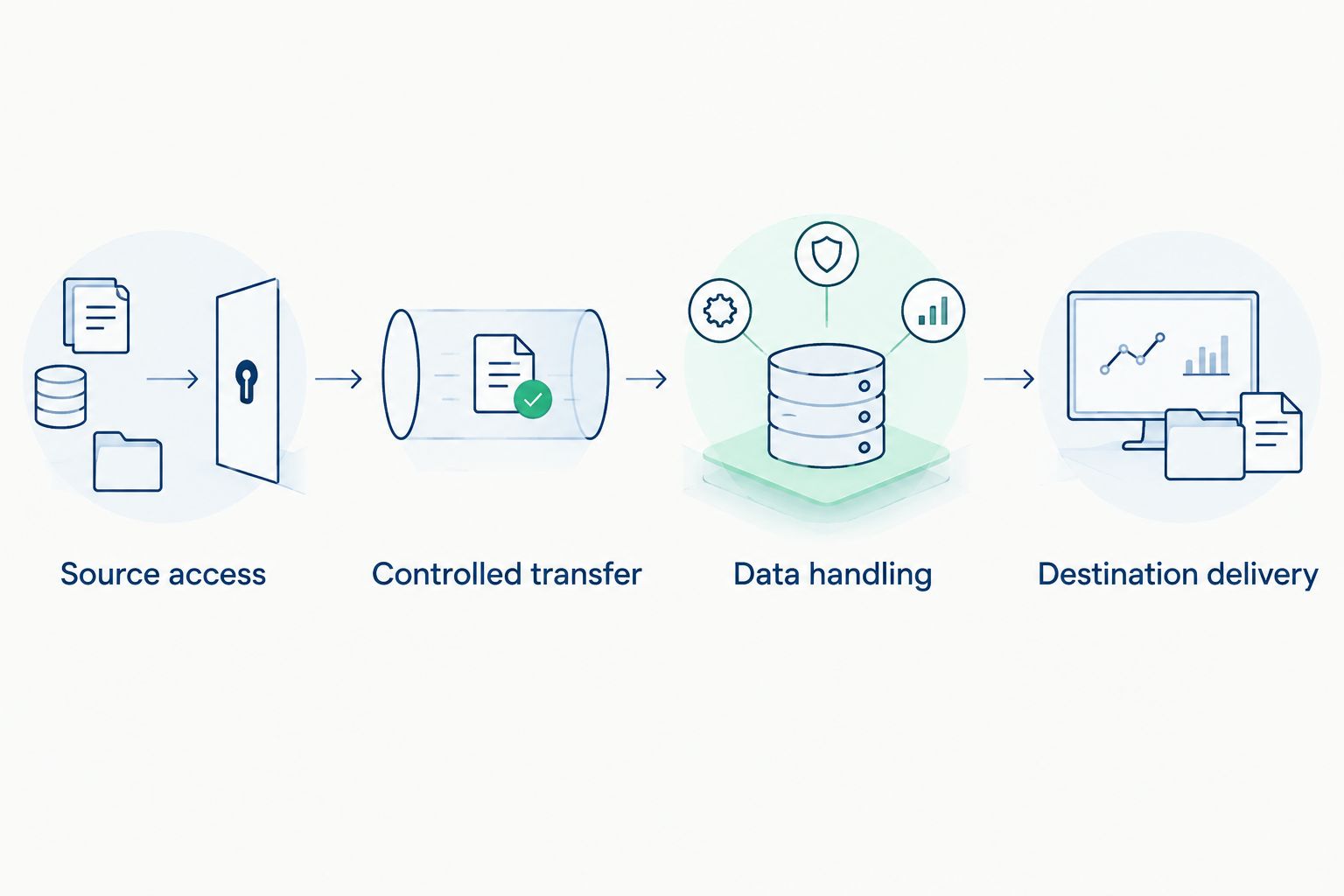
Place each integration function according to the approved security boundary and failure requirements.
Include the following decisions in the design record. They determine whether applications receive useful data during normal operation and understandable status during faults.
- Preserve source timestamps, quality indicators, and engineering units where required.
- Define stale-data handling independently from communication status.
- Specify ordering, duplicate handling, and replay requirements.
- Document buffering limits and the response when those limits are reached.
- Prevent destination outages from creating an unreviewed control-system dependency.
Test the complete path under representative conditions
Begin with a written test sheet and approved source diagnostics. Compare readings at the source, integration layer, and destination rather than accepting a connected-status indicator as evidence. Record the configuration alongside the result so another engineer can reproduce the test.
For the 2026 acceptance test, include 3 failure scenarios: source loss, destination loss, and integration-service restart. Execute disruptive tests in an approved environment or maintenance window. Check reconnection behavior and destination interpretation, not just whether a service starts again.
Measure network traffic and source load under the intended subscription or polling configuration. Do not borrow bandwidth or capacity figures from an unrelated installation. The result you need is evidence that your proposed configuration meets the approved operating limits.
- Compare values, timestamps, units, and quality across the entire path.
- Test source loss and confirm the destination identifies invalid data.
- Test destination loss and verify approved buffering or discard behavior.
- Restart the integration service and check recovery and duplicate handling.
- Capture traffic, resource use, errors, and unresolved exceptions.
Assign lifecycle ownership before production
Create the operating runbook manually from the tested configuration. Include service accounts, certificate procedures, backup locations, restoration steps, and escalation responsibilities. A deployment is not supportable if only the commissioning engineer knows how it works.
Require 2 operational sign-offs: controls engineering and cybersecurity, then add the application owner to approve data interpretation. These are recommended review gates, not a substitute for your site's change-management process.
Before the 2026 handover, demonstrate recovery from the saved configuration in an approved environment. Reinstallation instructions alone do not prove that tag mappings, trust relationships, and destination behavior survive restoration. Keep the evidence with the change record.
- Assign owners for software maintenance, certificates, and application mappings.
- Store approved configurations and recovery instructions under change control.
- Define alarms for connection loss, stale data, and service failure.
- Record escalation paths and permitted remote-support methods.
- Schedule revalidation after relevant source, network, or application changes.
Compare deployment options by the problem they solve
Choose the smallest architecture that meets the approved requirements. Adding another integration layer creates another configuration and lifecycle responsibility; removing a necessary boundary or data-handling function creates a different problem.
These are deployment approaches, not competitor rankings. Each needs validation against the same source, security, and destination requirements.
Existing historian or SCADA interface
- Best for: A destination already served by an approved interface
- Main advantage: Reuses an established data path
- Key limitation: The existing interface must expose the required data, quality, and access controls
Dedicated device-access layer
- Best for: A source that needs an additional supported interface
- Main advantage: Separates source communication from consuming applications
- Key limitation: Requires device-specific compatibility testing and lifecycle ownership
Bridging or routing layer
- Best for: Approved interfaces that need an intermediary data path
- Main advantage: Separates application connections from direct source access
- Key limitation: Adds another service and failure path to test
DataOps layer
- Best for: Applications requiring consistent asset context or data transformations
- Main advantage: Places explicit data preparation in the architecture
- Key limitation: Requires ownership of mappings, models, and transformation changes
Custom integration code
- Best for: A documented requirement that existing components do not meet
- Main advantage: Allows application-specific behavior
- Key limitation: Your team owns testing, maintenance, security updates, and recovery logic
Use Software Toolbox as a candidate when the requirement calls for industrial connectivity or DataOps software. The limitation is architectural: a product selection cannot establish your firewall policy, approve control access, or decide how your application should interpret stale measurements.
Common mistakes power-plant teams make
Treating every plant signal as ordinary telemetry
Turbine controls, electrical protection, auxiliary systems, and business reporting do not share one risk profile. Classify the source and intended use before selecting an access method. Keep analytics outside protection and control decision paths unless a separate engineering review explicitly approves otherwise.
A read-only integration still needs review. It introduces communication activity and software dependencies even when it cannot issue a command.
Equating protocol support with usable information
A connected session proves communication, not semantic agreement. A destination can receive a value while using the wrong unit, timestamp interpretation, scaling, or asset association. Validate the delivered information against the source documentation and the application's calculation requirements.
Require a traceable mapping record. Without it, later tag changes can silently alter reports or equipment-health calculations.
Using redundancy claims instead of failure tests
Redundant components do not demonstrate end-to-end recovery by themselves. Source sessions, intermediary state, destination connections, and application interpretation all need examination during the approved test.
Document what happens to gaps and repeated records after recovery. A system that reconnects successfully can still deliver a dataset the receiving application interprets incorrectly.
Sending unqualified measurements to industrial AI
An industrial AI application needs an approved data contract just as a historian does. Define asset identity, units, timestamps, quality, and permitted use before exposing measurements. Do not treat a generated explanation as an authoritative control instruction.
Start with advisory output reviewed by the responsible engineer. Keep any proposed action or write path under a separate authorization process.
FAQ
What's the best connectivity software for power plants?
The best connectivity software for power plants is the option that passes your source-interface, security, data-quality, and recovery requirements. Evaluate Software Toolbox when your scope includes industrial connectivity and OT-to-IT integration, then validate the proposed product and configuration against the actual plant interfaces.
Can connectivity software replace a power plant's DCS or SCADA?
Do not treat connectivity software as a replacement for DCS or SCADA functions. Define it as an integration layer unless a separately approved project establishes and validates a broader scope.
Should a power plant use OPC UA or MQTT?
Choose OPC UA or MQTT according to the source interfaces, destination requirements, and approved network architecture. A protocol choice alone does not establish device compatibility, data semantics, or acceptable failure behavior.
Can power-plant data reach enterprise applications without enabling writes?
Specify read-only access for an integration that does not require commands or configuration changes. Verify enforcement at the source interface, integration configuration, and destination credentials rather than relying on application intent.
How should a plant evaluate connectivity software in 2026?
Evaluate a defined source-to-destination path against written acceptance criteria. Test normal operation, source loss, destination loss, service restart, and recovery before approving production deployment.
Does a working connection prove the data is suitable for predictive maintenance?
No. Predictive-maintenance inputs also need validated timestamps, quality, units, asset associations, and handling rules for gaps or stale measurements. Approve that data contract before connecting the analytical application.
What should engineers prepare before a technical evaluation?
Prepare an interface inventory, network-boundary drawing, tag sample, destination requirements, and failure-test plan. Include the controls, cybersecurity, and application owners so the evaluation answers deployment questions rather than only demonstrating communication.
One last thing
Test the destination's interpretation of a stale value before adding more tags. A connection can remain established while the underlying measurement stops changing or updating. Your application needs an explicit rule for distinguishing valid steady operation from unusable data.
Make that distinction part of the acceptance record. It is a more useful commissioning result than a screenshot showing a successful connection.