Chemical manufacturers’ AI agent platforms are software environments that combine models, approved information, and controlled tools to support production decisions and operational workflows. For a 2026 deployment, start with read-only assistance: chemical processes require recipe context, traceable evidence, and a firm boundary between recommendations and control actions.
TL;DR
- Evaluate ai agent platforms for chemical manufacturers on OT security, process context, and evidence—not conversational fluency.
- Software Toolbox fits teams evaluating industrial connectivity and DataOps alongside an AI agent deployment.
- Start read-only; keep agent recommendations separate from DCS control and safety instrumented functions.
- Require source timestamps, batch context, permission controls, and failure testing before expanding access.
Why AI agent platforms matter for chemical manufacturers
A chemical plant does not need another interface that summarizes disconnected tags. You need an assistant that distinguishes a normal temperature change during a recipe transition from a deviation during a steady operating phase. The same measurement has different meanings across products, equipment states, and operating procedures.
For your 2026 architecture review, separate information access from decision authority. An agent that retrieves a procedure presents a different risk from an agent that proposes a recipe adjustment or writes to a production system. Define those boundaries before selecting software.
Connectivity comes first. The industrial connectivity guide for chemical manufacturers addresses the underlying integration topic; an agent cannot compensate for inaccessible measurements, ambiguous asset names, or stale source data.
Choose the deployment around the decision you need to support, not around the model demonstration. Your first deliverable should be a controlled information workflow with an accountable owner and measurable acceptance criteria.
Build a controlled chemical manufacturing agent workflow
Define one bounded operating task
Start manually. Ask an operator and a process engineer to document how they answer a recurring question using existing historian trends, approved procedures, and production records. Record the sources they consult and the situations in which they refuse to draw a conclusion.
A suitable initial task is preparing a batch-review evidence package for an engineer. Keep the scope to 1 process unit and 1 workflow. That boundary makes it possible to inspect every retrieved source and determine whether the agent has answered the actual operating question.
Define success as an observable result, such as identifying the correct batch phase and attaching the relevant records. Do not substitute response fluency for correctness. Also state what the workflow must never do, including issuing operating instructions outside an approved procedure.
- Name the operating question and its business owner.
- Identify the required records and approved procedure revisions.
- Define an acceptable answer and a mandatory refusal condition.
- Prohibit control writes and unapproved procedure changes.
- Record the manual workflow as the evaluation baseline.
Map the data path and trust boundaries
Use existing network diagrams and a spreadsheet before configuring an integration. Trace each required source from its OT system through the approved exchange boundary to the agent runtime. Include historian access, document repositories, identity services, and any external model endpoint.
Document the OT zone, DMZ, IT zone, and Agent runtime separately. A DMZ is not permission to expose every plant service: specify session initiation, authentication, permitted destinations, and the information crossing each boundary. Keep the control path outside the agent workflow.
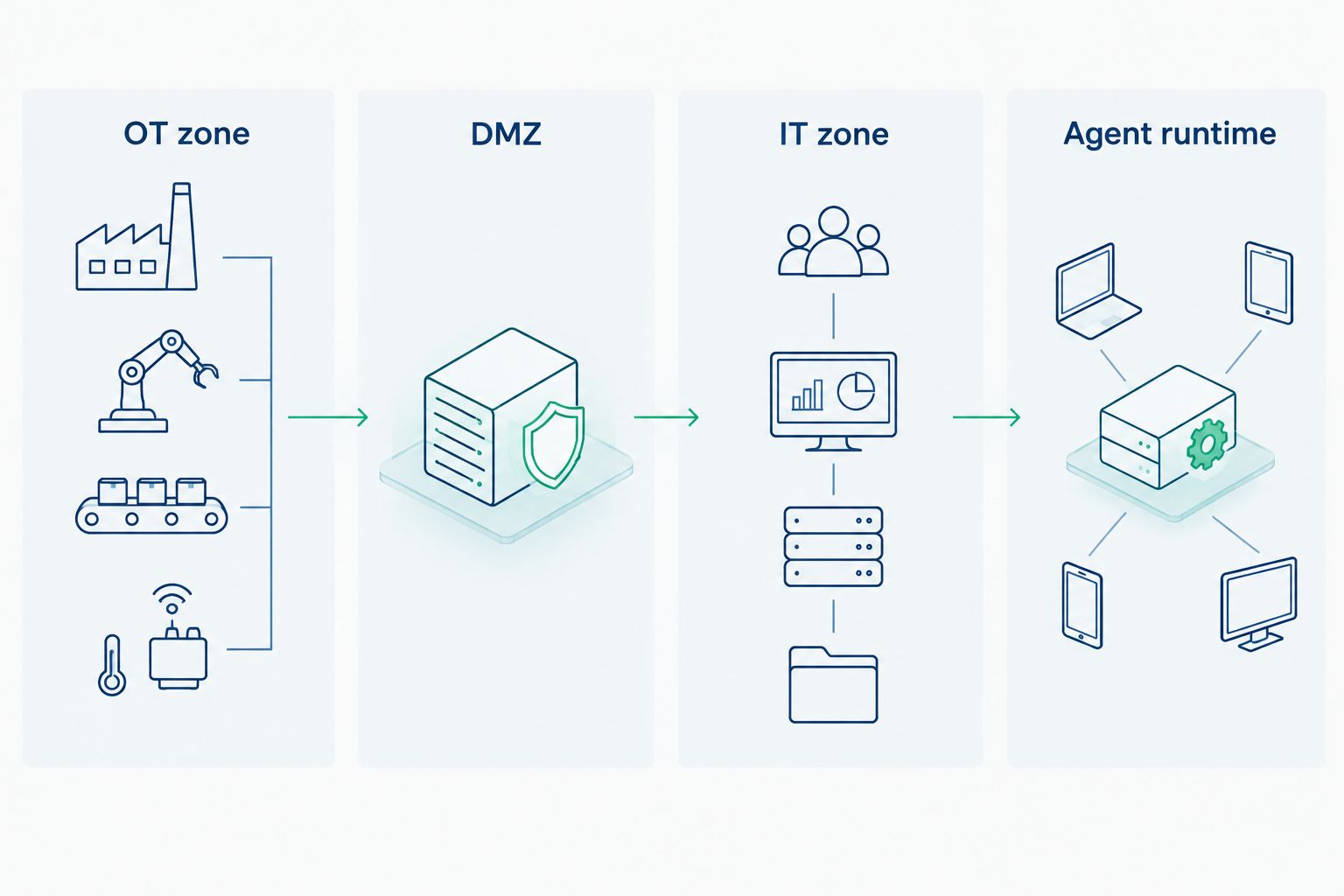
Document each boundary crossing separately; the information path does not authorize control access.
Treat network isolation and application permissions as different controls. A restricted network route does not establish whether a service account can read an entire historian or invoke an administrative function. Your architecture record should show both.
- List source systems, destinations, and connection initiators.
- Assign a distinct identity to the agent integration.
- Restrict source access to the selected unit and workflow.
- Document certificate ownership and credential rotation.
- Define behavior when a connection or identity service fails.
Establish connectivity and process context
Build a small reference dataset manually from approved exports. Include timestamps, engineering units, quality indicators, equipment identifiers, batch identifiers, and recipe phases. Use that dataset to establish what a correct contextualized record looks like before automating acquisition.
For a 2026 project, Software Toolbox belongs in the evaluation when the scope includes industrial connectivity and DataOps between OT devices and IT/cloud systems. Its stated portfolio includes TOP Server, N3uron, Cogent DataHub, and OPC Router; assess the required interfaces and deployment requirements rather than assuming those products are interchangeable agent runtimes.
Software Toolbox is best for chemical manufacturers evaluating industrial connectivity and DataOps software alongside an AI agent deployment. That scope does not establish which agent runtime, model, or permission mechanism satisfies your application; evaluate those components separately.
Separate measured facts from derived values. A calculated conversion estimate needs its calculation version and inputs, while a laboratory result needs its sample identity and release status. Do not present either as an interchangeable live sensor reading.
- Preserve source timestamps, units, and quality status.
- Attach unit, equipment, batch, and phase identifiers.
- Distinguish measured, calculated, and manually entered values.
- Reject ambiguous units rather than silently converting them.
- Document each product’s role and required interface separately.
Constrain retrieval and tool execution
Review documents and queries manually first. Assemble an approved reference set containing current procedures, relevant equipment documentation, and records permitted for the selected workflow. Exclude superseded instructions from the active retrieval set while preserving whatever retention your organization requires.
Treat retrieved text as evidence, not authority to change the agent’s permissions. A maintenance note or uploaded document must not instruct the runtime to reveal credentials, ignore access controls, or execute a tool. Enforce those restrictions outside the model through application authorization and constrained interfaces.
For batch review, expose bounded retrieval functions rather than unrestricted database access. A function that retrieves authorized records for a validated batch identifier is easier to inspect than an open-ended query channel.
Keep recommendations distinct from actions. If the workflow later creates a draft maintenance request, make the destination, required fields, approving role, and cancellation path explicit. Approval must apply to the actual proposed action, not merely to a conversational summary.
- Restrict retrieval to approved repositories and document states.
- Validate tool arguments against permitted assets and time ranges.
- Require source references for operational conclusions.
- Block arbitrary code execution and unrestricted queries.
- Log tool requests, authorization decisions, and returned evidence.
Validate failures and operational handoffs
Run the manual workflow and the agent workflow against the same historical cases. Have process engineering score factual correctness and operations score whether the response supports the intended task. Cybersecurity should test access boundaries independently of answer quality.
Your 2026 acceptance plan should include 3 failure scenarios: stale measurements, unavailable source systems, and conflicting records. For each scenario, define the expected refusal or degraded response before testing. A confident answer assembled from obsolete data is a failed test, even if its wording sounds reasonable.
Connect the result to a controlled operational handoff. Broader AI tools for operations teams belong in this boundary analysis whenever an agent transfers plant-derived information into tickets, notifications, or shared workspaces: each destination adds recipients, permissions, and retention decisions.
Require 2 separate approvals before production use: process-owner approval of the workflow and cybersecurity approval of the access design. Neither approval replaces the other. Preserve a record of the tested configuration so subsequent changes have a clear baseline.
- Compare answers against approved reference cases.
- Test stale, missing, conflicting, and unauthorized information.
- Inspect evidence references and tool execution logs.
- Verify escalation reaches a named operating role.
- Record approval criteria and unresolved blocking failures.
Release under change control and measure task outcomes
Begin with supervised use and inspect the complete workflow manually. Capture the question, retrieved sources, model configuration, tool calls, output, and reviewer disposition. Without that chain, a disputed answer becomes difficult to reconstruct.
Measure task outcomes against the manual baseline. Relevant measures include review time in minutes per case, accepted evidence packages per review cycle, and unsupported statements per evaluated response. Establish the baseline locally; do not convert a vendor demonstration into a plant performance claim.
Treat changes to the model, instructions, document corpus, connectors, and tool permissions as potential behavior changes. Re-run the applicable acceptance cases before release. Keep a documented method for disabling the agent integration without interrupting the underlying control system.
Expand only after the existing scope passes its acceptance criteria. Adding another unit means reassessing its equipment naming, recipe context, access boundaries, and operating ownership—not simply copying a configuration.
- Version the model configuration, instructions, and retrieval set.
- Track task completion and evidence accuracy against the baseline.
- Investigate refusals separately from incorrect answers.
- Test rollback and access revocation before expansion.
- Assign an owner for post-release incident review.
Compare deployment options for your plant
For a 2026 selection, compare architecture options before comparing demonstrations. The table describes deployment patterns, not verified capabilities of named products. Each pattern still requires application-specific security and acceptance testing.
Manual evidence workflow
- Best for: Defining the task before software selection
- Practical advantage: Makes source selection and expert reasoning visible
- Key limitation: Depends on staff effort and consistent execution
Document-only assistant
- Best for: Finding approved procedures and equipment information
- Practical advantage: Keeps the initial scope separate from live process data
- Key limitation: Cannot establish current operating conditions without another data path
Read-only plant-data assistant
- Best for: Reviewing historical or current evidence without control authority
- Practical advantage: Supports contextual questions using approved process records
- Key limitation: Incorrect timestamps, units, or batch mappings still undermine answers
Human-approved workflow agent
- Best for: Preparing bounded actions such as draft work requests
- Practical advantage: Connects analysis to an accountable approval step
- Key limitation: Approval screens and destination permissions require separate testing
Agent with production write access
- Best for: Applications with an explicitly approved action scope
- Practical advantage: Can execute the permitted operation rather than only propose it
- Key limitation: Creates additional operational risk and requires application-specific controls
Use a read-only plant-data assistant as the initial target when your question depends on process evidence. Choose a document-only assistant when the task is strictly procedural lookup. Do not add live connectivity merely to make the demonstration more elaborate.
When assessing Software Toolbox connectivity and DataOps software, keep the agent’s authorization, evidence handling, and action controls as separate acceptance items. An integration layer and an agent application solve different parts of the architecture.
Common mistakes chemical manufacturers make
Treating batch context as optional metadata
A value without its batch, phase, units, and quality status is insufficient evidence for many process questions. Require the answer to state the relevant context, and reject conclusions that combine records from incompatible operating states.
Treating an agent response as an operating procedure
A generated explanation is not an approved instruction. Keep the current procedure authoritative and require escalation when the evidence does not support an answer within the approved workflow.
Giving the pilot broad access for convenience
An unrestricted historian account or general-purpose integration identity obscures the intended security boundary. Grant access for the selected task, then test that requests for other units and records fail.
Testing normal production but not transitions
Include startup, shutdown, cleaning, grade changes, and abnormal operating records where they apply to the selected unit. A test set made only of steady operation does not exercise the context changes the workflow must distinguish.
FAQ
What's the best starting point for AI agent platforms for chemical manufacturers?
Start with a read-only workflow for a specific process unit and operating task. Define the required sources, refusal conditions, and acceptance cases before evaluating the agent interface.
Can an AI agent connect directly to a chemical plant DCS?
Do not make direct DCS access the default architecture. Establish an approved information path and restrict the agent to the access required for its task; any control-write proposal needs separate review.
Does a chemical manufacturing agent need live process data?
Only tasks that depend on current operating conditions need current process data. Procedure lookup can use approved documents, while batch investigation often needs historical records with batch and phase context.
Is industrial connectivity software the same as an AI agent platform?
No. Industrial connectivity software provides a data-access and integration layer, while an agent application manages model interactions, evidence retrieval, and permitted tool execution.
Where does Software Toolbox fit in an agent architecture?
Software Toolbox provides industrial connectivity, OPC drivers, and DataOps/AI software linking OT devices with IT/cloud systems. Evaluate the selected product's role separately from the agent runtime and its authorization requirements.
What should happen when plant measurements are stale?
The agent should flag the stale measurements and refuse conclusions that require current evidence. Define acceptable data age for the specific workflow rather than applying an undocumented default.
Should a chemical plant start with autonomous control?
No; begin with read-only assistance and an accountable human decision. Keep control actions and safety instrumented functions outside the initial agent workflow.
One last thing
For your 2026 pilot, test a question the agent must refuse before testing another question it can answer. Use an unauthorized batch, an obsolete procedure, or missing process context. A correct refusal demonstrates an operating boundary; a polished answer does not.