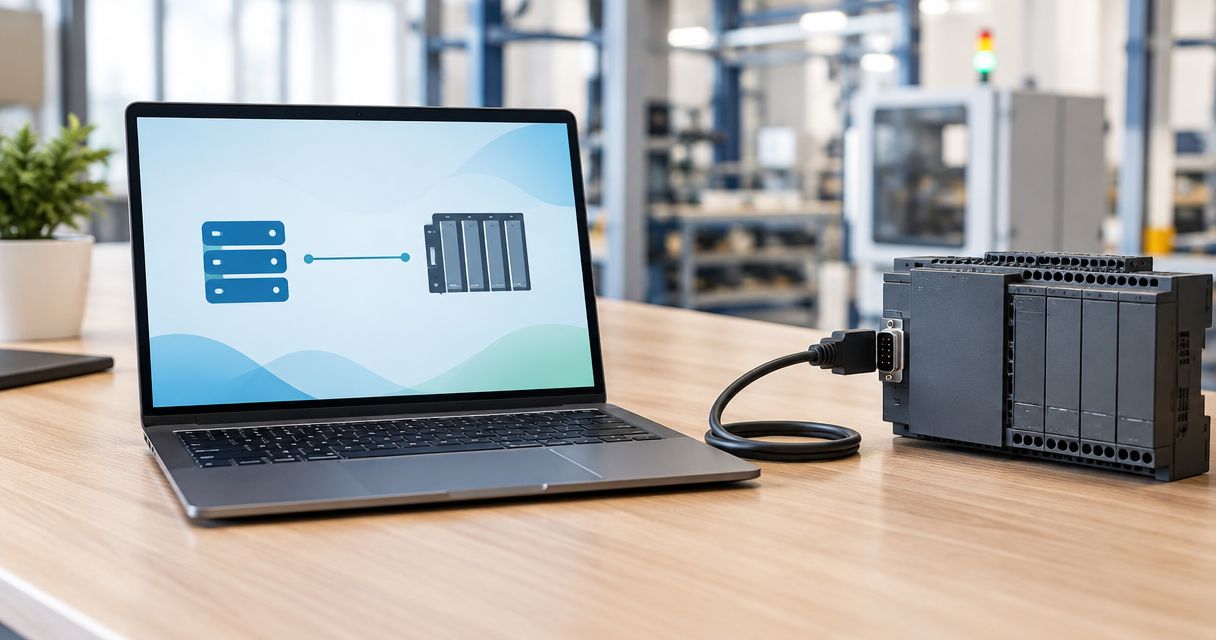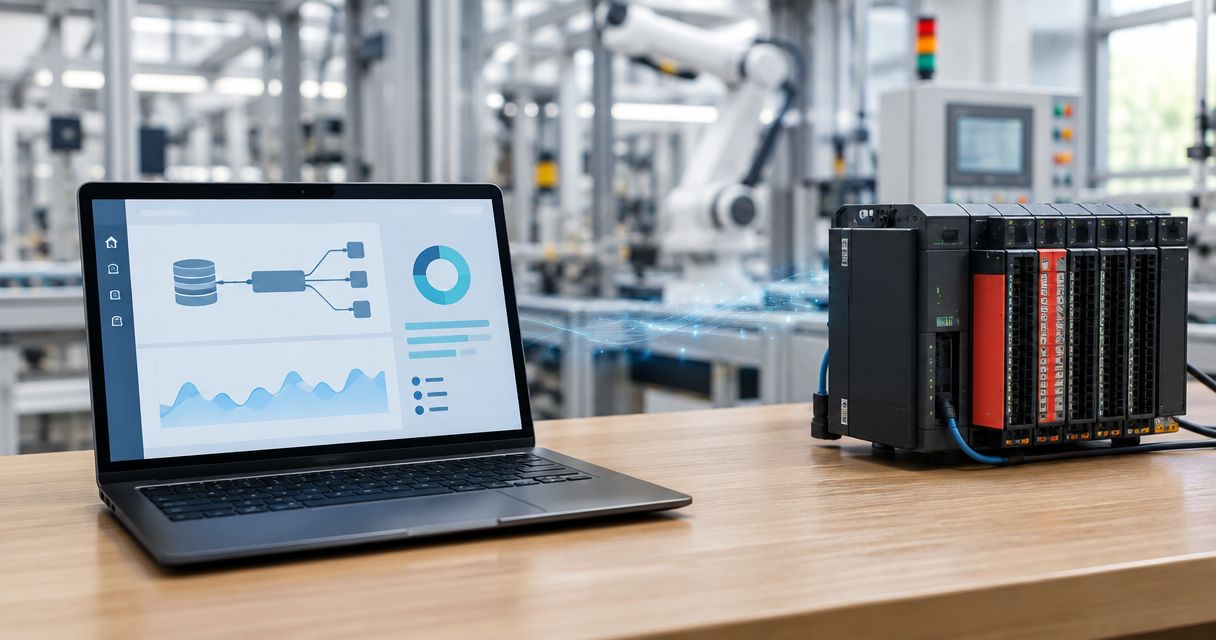
In 2026, TOP Server is the OPC server, so reading GE EGD data does not require a second, dedicated OPC server. The question is whether the current TOP Server driver list covers your EGD devices, and you should confirm that before you scope a project.
TL;DR
- TOP Server is itself an OPC server, so top server ge egd without opc server is the wrong framing: no second server is needed.
- EGD runs over UDP Ethernet, so TOP Server reads it through a device driver, not a middleman OPC product.
- Confirm EGD driver availability in the current 2026 TOP Server driver list before you commit.
- OPC clients such as SCADA, HMI and historians connect straight to TOP Server.
Can TOP Server read GE EGD data without a dedicated OPC server?
Yes, in the sense that matters: you install one product, TOP Server, and it plays the OPC server role. Your OPC client connects to TOP Server directly. There is no separate OPC server layered underneath it.
What TOP Server needs is a protocol driver for the device. For GE Ethernet Global Data, that means an EGD driver inside TOP Server. Check the current driver list on the Software Toolbox site or ask sales to confirm support for your exact controllers and firmware in 2026.
The hidden cost in this answer is not a second server. It is the EGD exchange configuration, which has to match what your controllers already produce and consume.
How EGD data reaches an OPC client in 2026
EGD is a producer/consumer protocol. GE controllers publish exchanges over UDP on Ethernet, and any consumer on the network can subscribe. That design is why a connectivity server can listen without polling each controller one request at a time.
The path looks like this:
- Controllers produce EGD exchanges on the plant network.
- The TOP Server EGD driver consumes the exchanges you define.
- Exchange data appears as OPC tags in TOP Server.
- Your OPC client reads those tags over OPC UA or OPC DA.
The tag mapping lives in TOP Server. The client never speaks EGD.
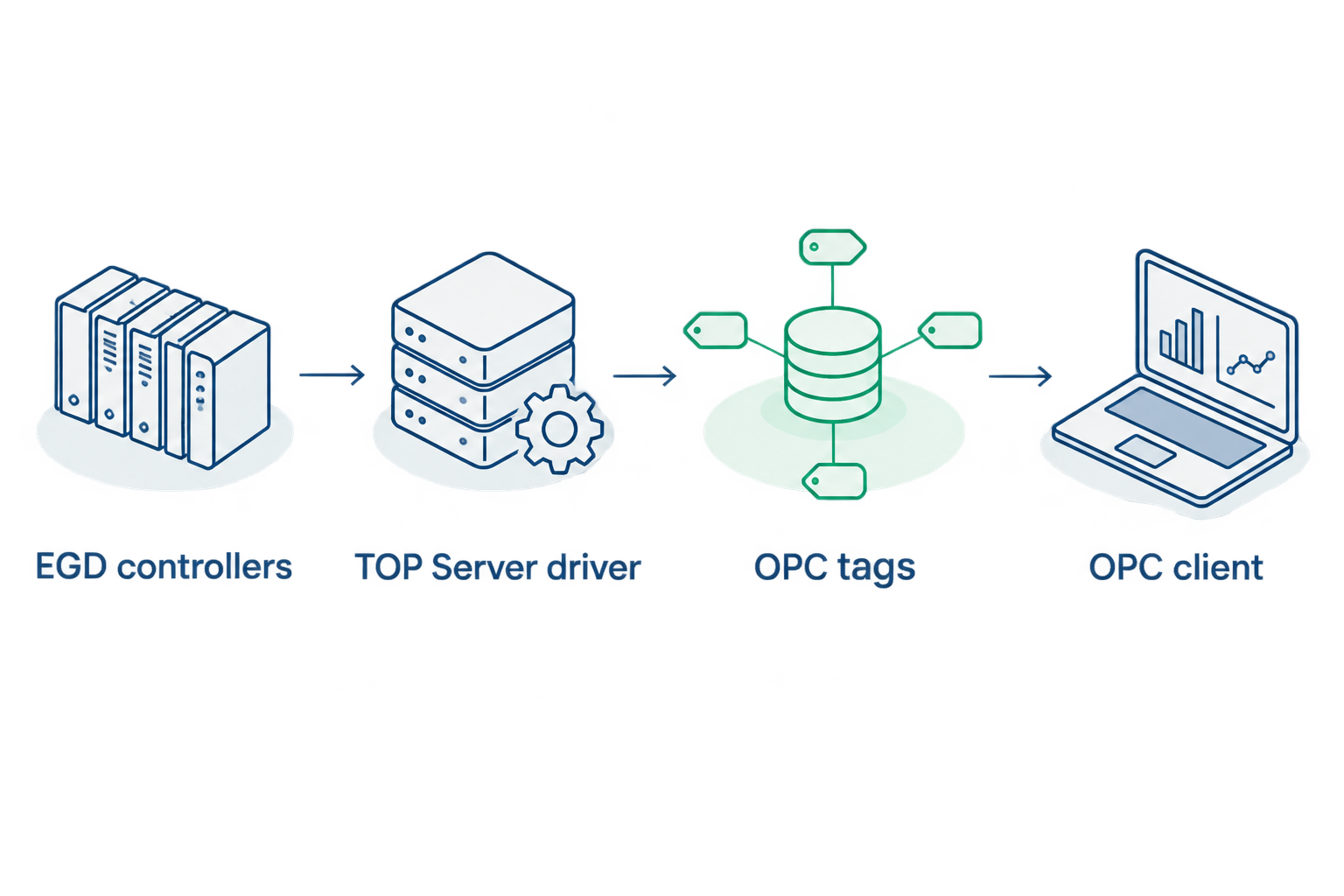
One server sits between the controllers and every OPC client.
What you do and do not need
TOP Server
- Needed?: Yes
- Why: Acts as the OPC server and hosts the driver
EGD device driver
- Needed?: Yes
- Why: Translates EGD exchanges into tags
Second OPC server
- Needed?: No
- Why: TOP Server already exposes OPC
SCADA platform
- Needed?: No
- Why: Any OPC client works; see whether TOP Server can run without a SCADA platform installed
GE vendor OPC product
- Needed?: No
- Why: Not required for the data path
Verdict: TOP Server is the right fit when you want one OPC layer for EGD plus other protocols. Skip it if your only need is a single GE-native screen inside GE software.
Why the setup effort varies
The time to get EGD data flowing is driven by a short list of factors:
- Number of exchanges and how many are produced versus consumed.
- Whether exchange definitions are documented or must be recovered from controller configuration.
- Network design: EGD uses UDP, so multicast handling and VLAN or firewall rules matter.
- Controller family and firmware.
- Whether the same project also covers other PLC brands.
- Which OPC clients connect, and over which OPC flavor.
On a flat network with documented exchanges, expect configuration work, not a development project. Undocumented exchanges are where schedules slip.
Pros and cons of the TOP Server approach
Pros
- One OPC endpoint for EGD and other devices, which simplifies client configuration and security review.
- OPC clients stay vendor-neutral, so you can swap SCADA or historian software later.
- Mixed-brand plants avoid a pile of single-protocol servers. See how one OPC server handles multiple PLC brands.
Cons
- You still need correct exchange definitions. The driver cannot guess them.
- UDP-based traffic needs network review by your IT team.
- Driver coverage depends on your controller family, so verify before you buy.
Does this apply to older GE Fanuc estates?
Often, yes. Many plants run GE Fanuc-era controllers with EGD alongside newer equipment. The workflow for pulling that data into a unified plant view is covered in GE Fanuc PLCs to unified plant data. Treat that as the architecture reference and confirm EGD specifics against the current driver documentation.
What if you need to add a driver later?
If EGD is one of several protocols in a 2026 rollout, plan the full device list up front. Adding drivers mid-project is normal, but it should not surprise your schedule. Timing is covered in how long adding a new PLC driver to TOP Server takes.
Confirm EGD support for your controllers
Send your controller models and firmware; get a driver answer.
FAQ
Does TOP Server need another OPC server to read GE EGD data?
No. TOP Server is the OPC server. Your OPC client connects to it directly, and the EGD driver handles the device side.
Is EGD a polled protocol?
No. EGD is producer/consumer over UDP. Controllers publish exchanges and consumers subscribe, which is why configuration centers on exchange definitions.
Can I read EGD tags in a client that only speaks OPC UA?
Yes. The client reads TOP Server tags over OPC UA, and the EGD protocol stays hidden behind the driver.
Do I need SCADA software to test EGD data in TOP Server?
No. Any OPC client can read the tags, and TOP Server runs without a SCADA platform installed.
How do I confirm the EGD driver covers my controllers in 2026?
Check the current TOP Server driver list on softwaretoolbox.com or contact sales with your controller models and firmware versions.
Can TOP Server read EGD and other PLC brands in one project?
Yes. One TOP Server instance can host drivers for multiple protocols, which keeps a mixed-brand plant on a single OPC endpoint.
One last thing
Before anything else, get the exchange list from the controller programmer. Exchange IDs, producer addresses and sizes decide how fast the 2026 rollout goes, not the software install. Cost questions come second; see how much TOP Server costs.