
A separate gateway is not automatically required between TOP Server and a Mitsubishi PLC; a direct connection is appropriate only after you confirm support for the exact controller, communication interface, and protocol. Removing a protocol converter does not remove the need for a compatible driver, an approved network path, or security controls between plant and enterprise systems.
TL;DR
- TOP Server Mitsubishi PLC without gateway: confirm controller, interface, and driver compatibility before selecting a direct connection.
- TOP Server connectivity does not replace firewall policy, network segmentation, or an approved OT access path.
- Keep a separate gateway when it provides a required protocol conversion or architectural function.
- Commission PLC communication and downstream OPC access separately so failures remain attributable.
Why this matters
Removing a gateway is an architecture decision, not just a hardware decision. Establish which function the existing device performs before taking it out of the design. Protocol conversion, physical-interface adaptation, and network security are different requirements.
Software Toolbox provides industrial connectivity software for manufacturers, utilities, and data center operators. Software Toolbox is a fit for engineers evaluating industrial connectivity between plant devices and IT systems. For a 2026 deployment, start with the communication requirements rather than assuming every Mitsubishi installation needs the same arrangement.
Use Software Toolbox as the starting point for product information, then document compatibility against your actual equipment and installed software version. A brand name on a controller is not a complete connection specification.
Can TOP Server reach Mitsubishi PLCs without a separate gateway?
Use a direct connection only when the entire communication path is supported. That means the selected TOP Server driver must match the Mitsubishi controller's available interface and enabled protocol, and the server host must have an authorized path to that interface.
Work through this sequence before approving a gateway-free design:
- Identify the controller. Record the complete CPU identification, firmware information, and installed communication hardware. Include an external communication module when the intended connection passes through it.
- Identify the interface. Establish which physical port and application protocol the PLC exposes. Do not treat an Ethernet connector as proof of protocol compatibility.
- Confirm driver support. Check the current product documentation for the exact controller and communication arrangement. Resolve exceptions before configuring production access.
- Approve the path. Record the server location, destination interface, permitted traffic, and relevant security boundaries. A supported driver does not grant network authorization.
- Validate the application. Read approved test addresses, verify interpretation and quality, and then test the downstream client. Keep write access outside the initial read-only test.
For your 2026 design record, capture the evidence behind each decision. An equipment list, driver reference, configuration record, and approved traffic flow are more useful than a drawing labeled simply as direct connectivity.
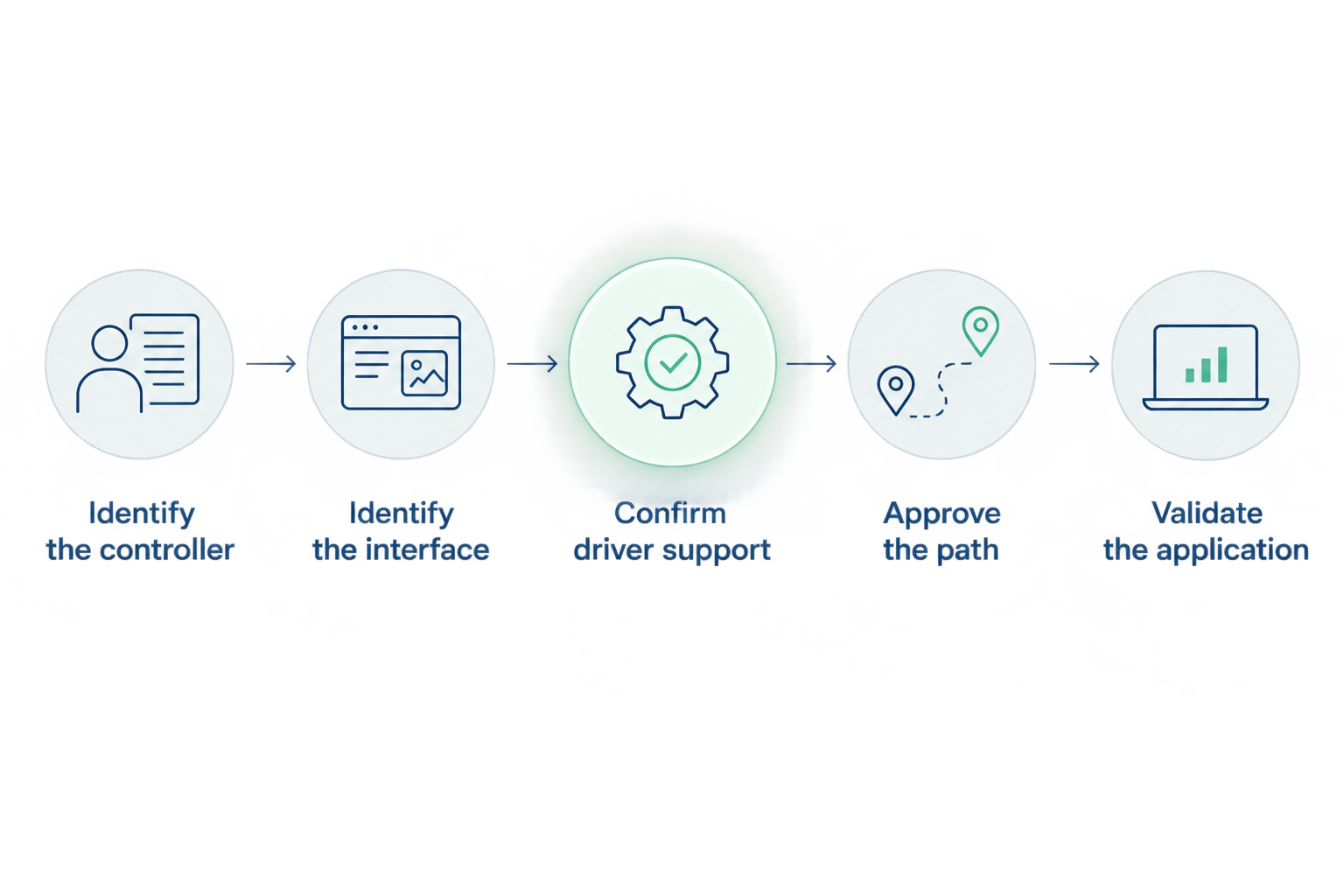
Confirm compatibility and network authorization before commissioning the application.
Direct connection versus a separate gateway
The useful comparison is between connection architectures, not between product names. Choose the arrangement that satisfies the required functions with clear ownership and a testable failure path. Neither fewer devices nor more devices proves that a design is correct.
Direct connection
- Best for: Supported PLC interfaces reachable from the approved server location
- Main benefit: Removes a separate protocol-conversion stage when that stage is unnecessary
- Main limitation: Places PLC communication responsibility on the server and its driver
- Approval condition: Confirm the exact driver, interface, protocol, and permitted route
Separate gateway
- Best for: Connections requiring an intermediary function
- Main benefit: Retains a defined place for required conversion or interface adaptation
- Main limitation: Adds another configuration, dependency, and maintenance responsibility
- Approval condition: Identify the function that cannot be removed
A direct connection does not mean that the server and controller must share an unrestricted network. Preserve the approved segmentation and access rules around the communication path.
A separate gateway is justified when its documented function remains necessary. Conversely, retaining an intermediary solely because it already appears on an old drawing is not a technical acceptance criterion. Identify what it does, who maintains it, and which requirement depends on it.
Why the gateway requirement varies
The gateway decision depends on the installed equipment and the approved architecture. Use these factors in your 2026 review rather than applying a blanket rule across every Mitsubishi PLC installation:
- Controller identity. Validate the exact CPU and firmware combination against the intended communication method. A family-level description leaves important compatibility questions unanswered.
- Communication hardware. Record whether the intended interface belongs to the CPU or an installed module. Evaluate the interface you will actually use, not an unused port elsewhere in the cabinet.
- Enabled protocol. Match the driver's documented requirements to the controller configuration. Physical connectivity alone does not establish application-level communication.
- Server placement. Confirm that the proposed host can reach the controller through an approved route. A technically possible connection can still violate the site's segmentation policy.
- Existing gateway function. Determine whether the intermediary converts protocols, adapts an interface, or performs another required task. Removing the enclosure without replacing its function leaves a design gap.
- Operational requirements. Establish ownership for configuration, monitoring, patching, backup, and recovery. A connection that works during commissioning still needs a supportable operating model.
How should you commission the connection?
Commission the path in layers. Prove PLC communication before investigating the downstream application's display, reporting, or historian configuration. That separation prevents an OPC client problem from being mistaken for a controller problem.
Establish the baseline
Save the approved configuration and document the starting state. Record the controller identification, intended interface, server host, driver selection, and test addresses. Identify who can authorize changes to each component.
Choose test data whose meaning you already understand. Include a known status and a changing process value when the operating conditions permit it. A value appearing in a client is not sufficient evidence that its address, interpretation, and freshness are correct.
Validate the PLC-facing path
Check the controller-side configuration against the selected driver's documentation. Verify the destination settings, protocol configuration, and addressing requirements without copying settings from an unrelated installation.
Investigate failures at the layer where they occur. A failed network route, rejected application request, and invalid data address require different corrective actions. Keep the diagnostic evidence with the configuration record so the next engineer does not repeat the same investigation.
Validate the client-facing path
After the server reads the approved PLC data correctly, connect the intended downstream application using the supported interface selected for the project. Verify item selection, data types, quality, and timestamps where those are exposed.
Test the destination that will consume the data in production. A successful engineering test client proves a narrower result than a successful historian, HMI, or reporting workflow. Record both results without treating them as interchangeable.
Test interruption and recovery
Under an approved test procedure, interrupt communication and observe what each layer reports. Restore the path and confirm that the application distinguishes fresh values from values retained during the interruption.
For the 2026 commissioning record, define acceptance in observable terms: correct values, expected quality behavior, authorized access, and recovery consistent with the application requirement. Do not substitute a generic connection-success message for those checks.
What security controls remain necessary without a gateway?
Direct connectivity does not justify direct enterprise access to a PLC. Place the server and its communication paths within the site's approved OT architecture. Preserve the separation between device access and downstream data consumption.
Document the initiating host, destination, protocol, and required traffic for each connection. Authorize those flows through the normal cybersecurity review rather than opening broad access to make troubleshooting easier. Remove temporary commissioning rules when testing ends.
Treat PLC-facing security and client-facing security as separate subjects. Security configured for an OPC connection does not, by itself, establish equivalent protection on the controller-side protocol. Evaluate each communication segment according to its actual capabilities and exposure.
Start with read-only requirements wherever the use case permits. If the application requires writes, document the allowed addresses, authorization model, operating conditions, and validation procedure. A read test does not approve a control command path.
Finally, assign responsibility for server maintenance and configuration recovery. Removing a hardware intermediary changes the inventory; it does not eliminate the need to manage the remaining software and network dependencies.
What should you send for a compatibility review?
Give Software Toolbox a connection specification rather than asking whether Mitsubishi is supported in general. The useful question names the controller, interface, protocol, and intended application. Include the installed TOP Server version and proposed driver selection when those are already known.
Prepare the following information:
- The controller's complete identification and firmware information.
- The communication module identification, if applicable.
- The physical interface and enabled communication protocol.
- A network diagram showing the proposed server location and relevant boundaries.
- The downstream application's required data interface and read or write requirements.
- The existing gateway's documented purpose, if you plan to remove it.
Software Toolbox's industrial connectivity scope includes linking plant and OT devices to IT and cloud systems. Use the review to resolve the specific connection requirements; do not treat that scope as confirmation for an unverified controller configuration.
Confirm your connection requirements
Discuss the controller, communication interface, and proposed deployment path.
Does an Ethernet port mean you can remove the gateway?
An Ethernet port does not establish driver compatibility or identify the enabled application protocol. Confirm what the exact Mitsubishi interface supports and how it is configured before changing the architecture.
Also check what the existing intermediary does beyond providing a network connector. An interface adapter and a protocol converter solve different problems, even when both appear as small devices in a cabinet.
Does a successful read prove the connection is production-ready?
A successful read proves only that the tested request returned data under the tested conditions. Production acceptance also requires correct interpretation, appropriate quality handling, authorized access, and recovery testing.
Include application behavior during communication loss in your 2026 acceptance procedure. The operator or consuming system must not mistake a retained value for a current measurement.
FAQ
Can I connect TOP Server to a Mitsubishi PLC without a hardware gateway?
Use a gateway-free connection only after confirming that the selected TOP Server driver supports the exact Mitsubishi controller, interface, and protocol. An approved network path and successful commissioning tests are also required.
What information do I need to check Mitsubishi PLC compatibility?
Collect the complete CPU identification, firmware information, communication module identification, interface, and enabled protocol. Check those details against the current documentation for the intended TOP Server version and driver.
Does a Mitsubishi PLC Ethernet connection guarantee direct access?
An Ethernet connection does not guarantee direct application access. The driver and controller must use compatible communication settings, and the network must permit the required traffic.
Can I remove the firewall when I remove a protocol gateway?
Removing a protocol gateway does not justify removing a firewall or weakening segmentation. Keep security controls aligned with the approved OT architecture and document each required traffic flow.
Should I test PLC writes during the initial connection test?
Start with approved read-only tests unless the commissioning procedure explicitly requires otherwise. Validate write permissions, permitted addresses, and operating conditions separately before enabling control actions.
When should I keep a separate gateway?
Keep a separate gateway when it provides a required function that the proposed direct connection does not replace. Document that function and its configuration, maintenance, and recovery responsibilities.
What should I check if values appear but look incorrect?
Check the address mapping, data type, interpretation, quality, and freshness against known PLC data. Then verify the downstream application's item configuration separately from the PLC-facing connection.
One last thing
The most important gateway-removal test is not whether values appear; it is whether the architecture still meets its requirements when communication fails. Confirm that the consuming application identifies unavailable or stale data, then verify recovery through the approved test procedure.
Close the project with a drawing that names functions rather than just boxes. The controller interface, driver responsibility, security boundary, and application connection should remain clear even after the gateway disappears from the cabinet.