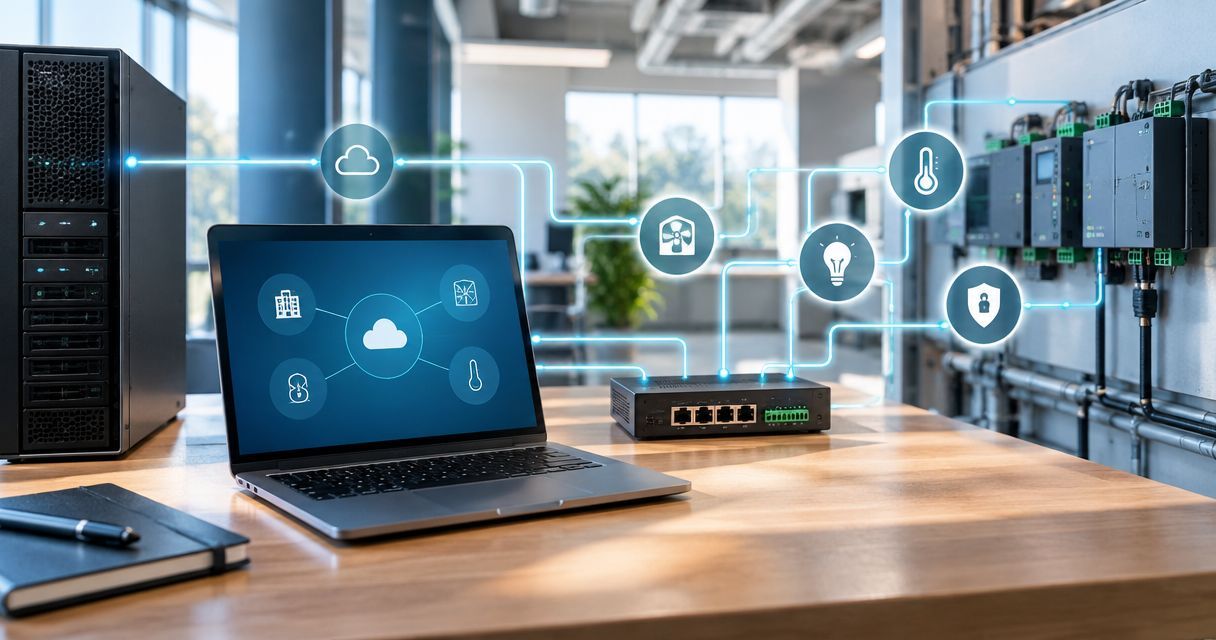
Yes—lack of native OPC UA does not by itself prevent a legacy PLC from connecting to N3uron. The connection requires a driver that supports the controller’s actual protocol or an intermediary with interfaces compatible with both sides; confirm that path for the exact PLC and software versions before specifying a 2026 deployment.
TL;DR
- N3uron legacy PLC without OPC UA: qualify the controller protocol before choosing the connection architecture.
- A direct driver path reduces components; an intermediary adds another configuration and maintenance boundary.
- Verify firmware, addressing, read permissions, data quality, and recovery behavior before production deployment.
- Software Toolbox industrial connectivity is for manufacturers connecting plant devices to IT and cloud systems.
Why this matters
A controller’s lack of OPC UA describes an interface limitation, not a requirement to replace the controller. Your engineering decision is whether an approved communication path can expose the required data without disrupting control or weakening network segmentation.
Software Toolbox supplies industrial connectivity and DataOps software for linking OT devices to IT and cloud systems. For this application, qualify the PLC-facing connection separately from the destination-facing interface. An OPC UA connection elsewhere in the architecture does not prove that the PLC itself supports OPC UA.
For a 2026 project, record the controller model, firmware, communication hardware, and required data before selecting a deployment pattern. A family name alone is not an adequate compatibility specification.
Can N3uron connect to legacy PLCs that don't support OPC UA?
Yes, when a verified communication path exists between the PLC and N3uron. That path starts with the PLC’s accessible protocol, not with the interface you want downstream.
Evaluate these architecture options as qualification paths, not as a claim that every controller or interface is supported:
Direct protocol driver
- Best for: Controllers with confirmed driver compatibility
- Principal advantage: Fewer integration components
- Principal limitation: Depends on exact protocol and device support
- Evidence required: Driver documentation and a successful device test
Intermediate protocol server
- Best for: Systems with a suitable existing connectivity layer
- Principal advantage: Separates device access from downstream consumption
- Principal limitation: Adds another service and configuration boundary
- Evidence required: Supported interfaces on both sides and validated data behavior
Protocol gateway
- Best for: Controllers requiring interface conversion
- Principal advantage: Provides a boundary between different interfaces
- Principal limitation: Conversion does not guarantee correct addressing or semantics
- Evidence required: Gateway compatibility and end-to-end validation
Do not select an intermediary merely because its documentation mentions OPC UA. Establish which component is the client, which is the server, what initiates each connection, and whether the required interface is supported in the proposed N3uron configuration.
A communication path is qualified only after it returns the intended values with acceptable timing, quality, and failure behavior. A successful network connection is necessary evidence, but it is not the complete acceptance test.
Direct driver path: qualify the exact controller
Best for: an accessible PLC protocol with confirmed driver support. Start here when reducing the number of maintained components is a project priority.
Record the PLC manufacturer, complete model designation, firmware, communication processor, physical interface, and enabled protocol. Include communication settings and any controller-side permissions. An Ethernet socket identifies a physical connection; it does not identify the application protocol.
Check the proposed driver against that inventory. Verify the addressing method, supported data types, communication restrictions, and any controller configuration changes required for access. Treat support for a related controller as a reason to investigate, not as acceptance evidence.
The benefit is a shorter data path. The limitation is that the direct approach depends on matching the actual device interface; it cannot compensate for an unavailable protocol, inaccessible memory, or a controller that cannot accept the proposed communication load.
Keep the initial scope read-only where operational requirements permit. If writes are required, document authorized destinations and test write behavior separately from data acquisition.
Intermediate server path: preserve a qualified device connection
Best for: a site that already has a validated device-facing connection. Evaluate whether that connection can supply an interface the proposed N3uron deployment can consume.
Preserving an established PLC connection avoids changing device access solely to satisfy a downstream requirement. It also gives you a distinct place to investigate controller communication separately from data distribution.
The limitation is additional dependency. Your deployment now relies on the intermediary’s configuration, service account, startup behavior, network access, and maintenance process as well as the downstream configuration.
Do not assume the intermediary preserves every property of the source data. Test value conversion, quality representation, timestamps, and reconnect behavior across the complete path. Document where each property originates and what happens when the PLC connection fails while the intermediary remains online.
Approve this architecture because its interfaces and operational responsibilities are clear—not simply because a server already exists.
Protocol gateway path: separate conversion from compatibility
Best for: a legacy interface that requires a dedicated conversion boundary. Specify the controller-facing and application-facing interfaces independently.
For a serial connection, capture the electrical interface and communication settings before discussing protocol conversion. Physical connectivity and message compatibility are separate requirements. A converter that changes the transport does not necessarily interpret the controller’s application protocol.
The advantage is a defined interface boundary. The limitation is another configuration set to secure, back up, troubleshoot, and restore.
Confirm how the gateway represents disconnection, invalid addresses, and stale data. Also determine whether its behavior changes after a restart. A gateway that resumes communication still needs to restore the correct mappings and connection permissions.
Keep gateway administration separate from routine data consumption. Do not make a management interface broadly reachable merely because the data path needs access across a network boundary.
Why legacy PLC connection requirements vary
The right architecture depends on the controller and the required data behavior. Use these factors to explain engineering scope rather than assigning a standard deployment duration:
- Controller interface: Identify the protocol actually enabled on the installed communication hardware.
- Firmware and configuration: Match the installed revision and access settings to the proposed connection method.
- Addressing and data types: Resolve register offsets, symbolic addresses, bit fields, scaling, and multi-register values.
- Existing communication demand: Account for current HMI, engineering, historian, and other device connections before adding polling.
- Security boundaries: Establish approved hosts, connection direction, authentication, and management access.
- Operational requirements: Define freshness, quality, outage handling, restart recovery, and whether writes are permitted.
These factors belong in the connection specification. They also determine which team must approve changes: controls engineering, operations, IT infrastructure, cybersecurity, or a combination.
How do you validate the connection before deployment?
Use a staged qualification process for the 2026 deployment. Each stage should produce evidence that another engineer can reproduce.
- Inventory. Record the device identity, firmware, interfaces, protocol settings, and existing consumers. Capture the source of the address map and identify who owns it.
- Compatibility. Match the proposed driver or intermediary interfaces to the inventory. Resolve version dependencies before configuring production equipment.
- Mapping. Select representative values with known meanings. Include different data types, operating states, and any quality or timestamp requirements.
- Recovery. Test disconnection and restoration under an approved procedure. Confirm downstream behavior during the outage and after communication returns.
Do not expand the tag set until representative values behave correctly. This sequence separates protocol compatibility from mapping errors and recovery problems.
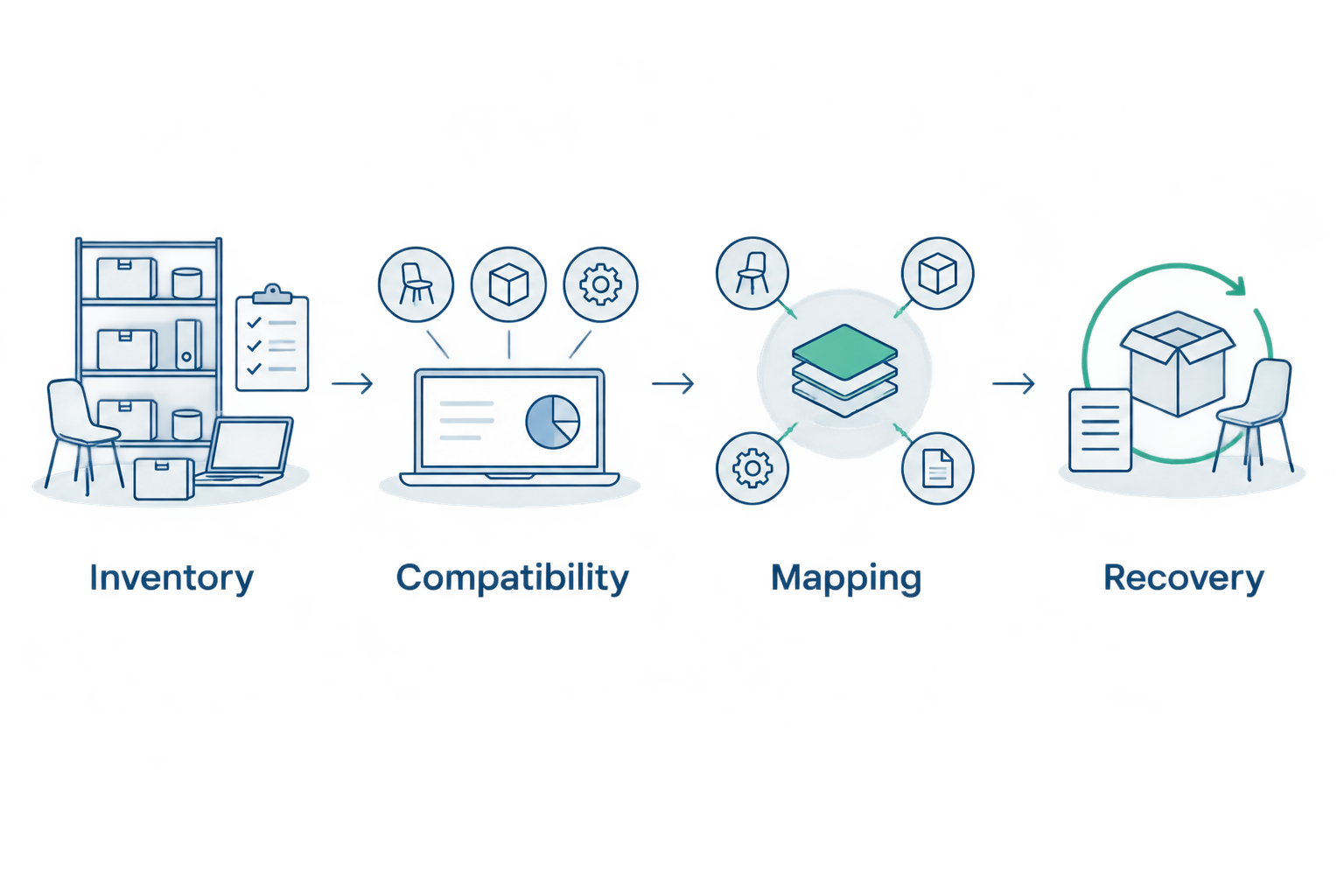
Prove the communication path and data meaning before expanding the deployment.
Retain the tested configuration, software versions, controller settings, and acceptance results together. A screenshot of changing values is useful evidence of activity, but it does not document the complete interface contract.
Check data meaning, not just changing values
A plausible value can still be incorrectly decoded. Compare each representative tag with an authoritative controller reference or an approved observation under a known operating condition.
For example, a Modbus holding register contains 16 bits. A 32-bit value spans 2 registers, so register order and interpretation require explicit agreement. This is a protocol-mapping example, not a claim of compatibility with a particular N3uron driver or PLC.
Check signed versus unsigned interpretation, engineering-unit scaling, bit positions, and string encoding wherever applicable. For related measurements, establish whether your application requires a consistent snapshot or can accept independently acquired values.
Define timestamp meaning as well. A timestamp assigned when software receives a value is not automatically the time the physical event occurred.
Check failure behavior before adding consumers
Disconnect the source using an approved test procedure and observe what downstream systems receive. Record whether values become invalid, remain visible with a quality change, or retain their previous state.
Then restore communication. Confirm that mappings, permissions, and subscriptions return to the intended state without an undocumented manual step.
A retained value is not evidence of a live PLC connection. Require downstream consumers to distinguish usable measurements from stale or invalid data. For alarms, reporting, and analytics, define what each consumer should do when source quality changes.
How should you secure a legacy PLC data path?
Keep the controller-facing connection within the approved OT architecture. Route data toward IT or cloud consumers through explicitly authorized boundaries rather than exposing the PLC directly.
For the 2026 security review, document source hosts, destination hosts, protocols, connection direction, authentication, and administrative access. Do not infer firewall rules from a product category; derive them from the selected architecture and configuration.
A secure downstream interface does not retroactively secure an unprotected device-facing protocol. Evaluate each network segment and trust boundary separately. Restrict write permissions where they are unnecessary, and separate configuration privileges from data access.
Include traffic behavior in the review. Polling frequency, requested data, connection count, and recovery activity all matter when assessing the effect on an existing plant network. The guide to OPC UA bandwidth on a plant network addresses the downstream network question; keep that assessment separate from controller-side protocol qualification.
Do you need to replace the PLC to add OPC UA access?
No—missing native OPC UA alone does not establish a replacement requirement. First determine whether a supported external connection can expose the required data within the approved architecture.
Replacement is a separate engineering decision involving controller capability, maintainability, security requirements, and production constraints. Do not turn a downstream interface preference into a controller replacement requirement without evaluating the available device interfaces.
Is a gateway always better than a direct connection?
No—a gateway is not automatically better than a verified direct driver path. A direct connection reduces components; a gateway provides a conversion boundary but adds configuration and operational responsibility.
Choose the architecture that satisfies the documented interface and security requirements. Neither approach is qualified until the complete data path passes acceptance testing.
What information should you send for a compatibility review?
Send the controller model, firmware, communication hardware, enabled protocol, address examples, required data types, and destination requirements. Include a network sketch showing security zones and proposed connection direction.
For a Software Toolbox industrial connectivity review, make the question specific: identify the installed controller and the data path you need to establish. That gives the review a testable scope instead of a broad request for “legacy PLC support.”
FAQ
Can N3uron connect to a PLC that has no OPC UA server?
A PLC without an OPC UA server can be a candidate for N3uron integration through a verified driver or compatible intermediary. Confirm the exact controller, firmware, protocol, and proposed software interfaces before selecting the architecture.
Does an Ethernet port mean my legacy PLC supports OPC UA?
No. An Ethernet port does not identify the application protocol available on the controller; verify the enabled protocol and supported access method.
Should I use a direct driver or a protocol gateway?
Use a verified direct driver when it satisfies the interface and deployment requirements. Evaluate a gateway when conversion is required, accounting for its configuration, security, and recovery responsibilities.
Can I keep my existing PLC data server?
Evaluate the existing server if its device connection is qualified and its output interface matches the proposed N3uron configuration. Validate data types, quality, timestamps, and failure behavior across the complete path.
Do I need to enable PLC writes for data collection?
Read-only data collection does not require application-level write access to process values. Confirm how the selected protocol, controller settings, and software enforce the intended permissions.
How do I know that a displayed PLC value is current?
Use communication status, data quality, and timestamp behavior together rather than relying on the displayed value alone. Test source disconnection to establish exactly how downstream consumers recognize stale data.
What should I check before connecting a legacy PLC in 2026?
Check the controller identity, firmware, interface, enabled protocol, address map, existing communication demand, and security boundaries. Then validate representative values and recovery behavior before expanding the deployment.
One last thing
Put the outage acceptance test in the 2026 specification before commissioning. Define what operators and downstream systems must see when the source disappears, not just what they should see when everything works.
A connection that reads correctly but conceals a failed source is not ready for operational use. Give failure behavior the same sign-off requirement as address mapping.