
Instead of manually mapping plant tags into every downstream application, configure your N3uron Sparkplug B integration around a shared identity model, authenticated MQTT transport, and verified birth/death handling. Use this 2026 workflow to commission the connection, publish changes into your Unified Namespace, and prove that consumers distinguish current data from disconnected equipment.
TL;DR
- N3uron Sparkplug B integration requires working MQTT transport and correct birth, data, and death handling.
- Software Toolbox industrial connectivity is best for teams connecting plant devices to IT and cloud systems.
- Approve the Unified Namespace identity model before configuring publishers or consumer subscriptions.
- Test reconnects and consumer restarts before expanding beyond the commissioning tag set.
Why this matters
An MQTT connection is not proof of a working Sparkplug integration. A broker routes messages; a Sparkplug-aware consumer also interprets metric definitions, lifecycle messages, and payload state. A subscriber that receives bytes but cannot reconstruct the current metric model has not passed commissioning.
Software Toolbox provides industrial connectivity and DataOps software for plant-to-IT integration. For this workflow, separate the transport, publisher, and consumer responsibilities before troubleshooting individual tags.
The 2026 acceptance condition is straightforward: the correct consumer receives the correct asset data, understands whether the publisher is online, and recovers after a connection interruption. Do not accept a dashboard screenshot as evidence of all three.
Before you start
- Prepare the runtime and source access. Have administrative access to the installed N3uron runtime, the documentation matching that build, and the required MQTT/Sparkplug functionality enabled. Confirm that source tags already update correctly before adding the broker path.
- Prepare the network and broker credentials. Obtain the approved broker hostname, listener port, authentication method, certificate trust chain, and topic permissions. Provide a Sparkplug-aware test consumer and access to broker connection logs.
- Resolve the hidden gotcha: topic names are not the asset model. Sparkplug uses a prescribed topic structure and binary payload. Approve the mapping between plant hierarchy, group identity, edge-node identity, device identity, and metric names before configuration. Do not substitute an arbitrary enterprise topic tree for Sparkplug topics.
Use a deliberately small commissioning scope: 1 edge node and 3 test tags representing a Boolean, a numeric value, and an engineering value with a defined unit. These are proposed test inputs, not platform limits. Record their source paths, expected data types, and intended metric names.
Publisher identity and source mapping
Establish the namespace contract
- Record the group identity, edge-node identity, and any device identities in your deployment worksheet. Assign an owner to each identity so another publisher cannot reuse it accidentally.
- Separate the MQTT client identifier from the Sparkplug edge-node identity. The broker uses the client identifier for connection management; Sparkplug consumers use the topic identities to organize publisher state.
- Map each commissioning tag to its intended metric name and data type. Include units and other required context in the agreed model, rather than expecting consumers to infer them from a short tag name.
- Define what consumers should do with invalid source data. Document how the selected publisher represents source-quality changes, and test that representation in the receiving application.
- Record which configuration changes require consumers to receive a refreshed birth model. A metric rename or data-type change is a model change, not simply another process-value update.
A device-level Sparkplug topic has 5 topic levels: namespace, group ID, message type, edge-node ID, and device ID. Node-level messages omit the device level. The spBv1.0 namespace and message types belong to the Sparkplug protocol; they are not substitutes for your organizational naming rules.
Expected result: each commissioning tag has an unambiguous source, destination identity, metric name, and data type. Another engineer can reconstruct the mapping without opening the configuration editor.
Keep configuration labels version-specific
Use the installed N3uron build’s documentation for the exact navigation, field labels, and save or activation controls. Configure the identities and source mappings above in the corresponding publisher settings; do not treat a generic MQTT connection example as a Sparkplug configuration recipe.
This distinction matters during a 2026 deployment because a correct architecture must still match the installed implementation. Keep the runtime version and configuration export with the commissioning record.
Broker connection and security boundary
Configure transport before publishing production data
- Enter the approved broker hostname and listener port in the publisher’s connection configuration. Use the hostname covered by the broker certificate when TLS hostname validation applies.
- Configure the approved authentication method. Keep credentials out of tag values, topic names, screenshots, and shared configuration notes.
- Configure TLS trust using the organization’s approved certificate process. Check the certificate chain, hostname, validity period, and runtime clock before investigating payload problems.
- Assign a unique MQTT client identifier. Check the broker logs for an existing connection using that identifier before starting the publisher.
- Apply topic permissions for the publisher’s actual responsibilities. Publishing telemetry and subscribing for lifecycle or command handling are separate permissions; authorize only the paths required by the design.
- Activate the connection using the installed build’s documented controls, then inspect both publisher diagnostics and broker logs.
Expected result: the broker accepts an authenticated connection from the intended runtime, and both ends show a stable session without repeated disconnects or authorization errors.
Do not assume that using a broker in a DMZ removes the need for firewall rules. Document the connection initiator, destination listener, and return traffic policy for each network boundary. Keep management access separate from telemetry access.
The initial deployment should be read-only from the process perspective. Receiving telemetry does not require granting a consumer permission to change controller values, and Sparkplug lifecycle control does not justify unrestricted process commands.
Birth messages and consumer state
Validate the model before accepting data
The useful sequence is Source tags, Publisher, Broker, and Consumer. Validate each boundary independently so that a transport success cannot hide a decoding or source-data failure.
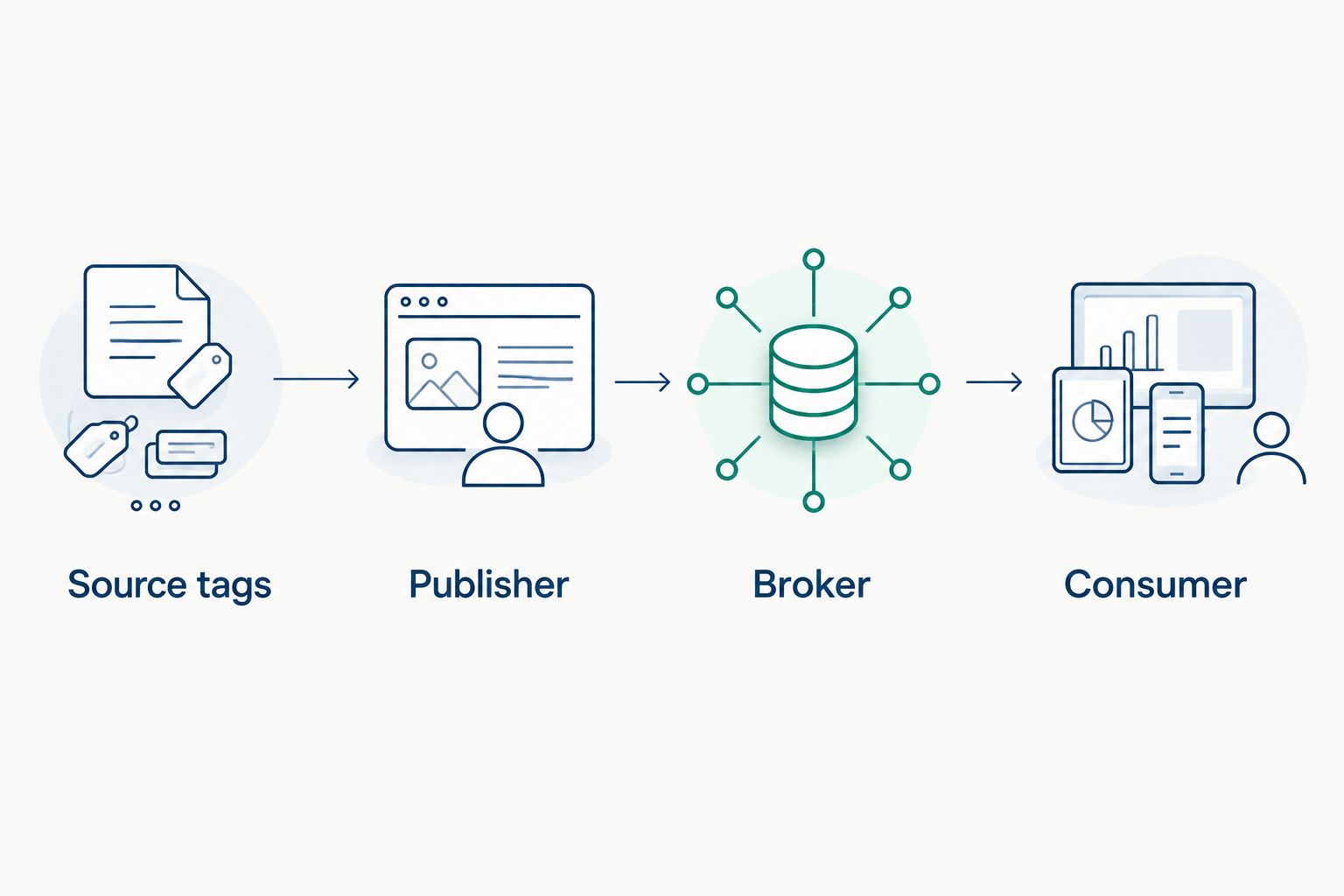
Validate each boundary independently before accepting the complete data path.
- Start the Sparkplug-aware consumer with access to the commissioning topic scope. Use a decoder that understands Sparkplug payloads; an MQTT text viewer alone is insufficient.
- Start or reconnect the publisher and inspect its birth sequence. Verify the node birth and any applicable device births, including metric names and data types.
- Confirm that the consumer establishes the metric model before interpreting subsequent updates. If updates use metric aliases, verify that the consumer resolves them against the applicable birth definitions.
- Change each test source individually. Compare the source value, decoded published metric, and application value before moving to the next tag.
- Check timestamps separately from values. Identify which timestamp represents source sampling and which reflects subsequent processing; do not label broker receipt time as source time.
- Confirm how the consumer displays a source-quality failure while the MQTT connection remains healthy. A connected publisher does not prove that every underlying device is communicating.
Expected result: the consumer displays the intended metrics with the correct types and values, and the engineering team can distinguish source validity from publisher connectivity.
Sparkplug payloads use Protocol Buffers rather than plain JSON. An unreadable payload in a text-oriented MQTT tool is therefore not evidence of corruption. Validate it with the appropriate decoder before changing the publisher.
For the 2026 commissioning record, preserve a decoded birth example and a decoded update example. Remove credentials and sensitive process information before sharing either outside the approved engineering group.
Recovery and commissioning evidence
Prove reconnect behavior
- Interrupt the publisher’s network connection in an approved test environment. Observe the broker’s handling of the configured Last Will and the consumer’s resulting node state.
- Restore connectivity. Verify that the publisher establishes its birth model again and that the consumer resumes processing updates against that model.
- Restart the consumer while the publisher remains online. Verify how the consumer obtains a current model, including the rebirth mechanism used by the selected implementation.
- Test the approved credential or certificate change procedure separately. Record the diagnostic evidence for authentication failure so operations can distinguish it from a failed source device.
- Save the final configuration and record the runtime build, broker configuration reference, topic permissions, identity assignments, and test results.
Run 2 reconnect tests: a publisher network interruption and a consumer restart. They exercise different recovery paths. Passing the first does not prove the second.
Expected result: consumers recover their metric model after either interruption, and operations can identify whether a future failure belongs to the source, connection, authorization, or consumer layer.
Do not claim historical recovery from a successful reconnect. Re-establishing current state and recovering every missed process update are different requirements. If the application needs outage backfill, define and verify that behavior separately across the publisher, broker, and destination.
Variant: publish whenever source values change
After lifecycle commissioning, apply change-driven publication to the approved tag set using the mechanisms documented for the installed publisher. Keep source acquisition, change detection, and publication behavior separate in the design.
A source polling interval controls when a value is observed. A deadband controls which observed changes qualify for reporting. Neither setting alone guarantees an end-to-end delivery time.
Change-driven updates
- Best for: Process values where meaningful changes drive downstream action
- Benefit: Avoids repeatedly sending unchanged measurements
- Limitation: Small changes can be excluded by the configured deadband
Periodic publication, where supported
- Best for: Consumers with an explicit periodic-refresh requirement
- Benefit: Provides updates on the configured publication schedule
- Limitation: Repeats unchanged values and does not itself prove source freshness
- Define meaningful change by metric, using engineering units and process requirements. Do not apply one deadband indiscriminately to Boolean states, totals, and analog measurements.
- Change the source below and above the proposed threshold. Verify both the suppressed change and the transmitted change.
- Confirm how consumers detect publisher loss independently of process changes. A steady process value is not a communication heartbeat.
- Measure the complete path under the expected workload before approving any latency requirement.
Expected result: significant changes reach the intended consumers without relying on repeated manual exports or mistaking silence for equipment failure.
Troubleshooting
MQTT connects, but the consumer shows no metrics
Check topic authorization, subscription scope, and Sparkplug decoding first. Then inspect the birth sequence. A consumer that missed the model cannot reliably interpret alias-based updates; use the documented rebirth process rather than repeatedly restarting unrelated services.
The connection repeatedly drops
Look for duplicate MQTT client identifiers in broker logs. Then inspect authentication failures, TLS negotiation, and network interruptions. Change one cause at a time so a successful reconnect has an identifiable explanation.
Metrics arrive under the wrong asset
Compare the group, edge-node, device, and metric identities against the namespace contract. Fix the mapping at the publisher rather than adding compensating renames to every consumer. Refresh the consumer model after approved identity changes.
Values update, but offline status does not
Inspect Last Will configuration, broker disconnect handling, and the consumer’s Sparkplug state implementation. Do not treat the last received value as a current measurement after publisher loss. Test unexpected connection loss separately from an orderly shutdown.
Values look correct, but timestamps or quality do not
Compare the source record with the decoded payload and destination record. Check clock synchronization and the actual timestamp and quality mappings. Correct values alone do not satisfy an application that depends on event ordering or source validity.
Customize your workflow
Expand by asset group only after the commissioning tests pass. Preserve identity ownership, topic permissions, model-change rules, and recovery evidence as the namespace grows. Adding tags without these controls creates downstream dependencies that are difficult to unwind.
For a 2026 expansion, separate three decisions: which data belongs in the shared model, which consumers can read it, and which applications require historical recovery. Software Toolbox industrial connectivity planning should start with those requirements rather than a module count.
Use Contact Us to discuss the source protocols, network zones, and consumer requirements. Provide the identity worksheet and test findings so the discussion addresses the actual deployment boundary.
FAQ
How do I set up N3uron Sparkplug B integration?
Configure the publisher identity, authenticated broker connection, source-to-metric mapping, and Sparkplug-aware consumer, then validate births, updates, and recovery. Use the documentation matching the installed N3uron build for exact configuration labels and supported settings.
Does the MQTT broker need to decode Sparkplug B?
The broker can route MQTT messages without decoding Sparkplug payloads. Sparkplug-aware consumers must interpret the payload and lifecycle behavior; broker-side Sparkplug features are a separate selection criterion.
Can I use my existing UNS topic hierarchy for Sparkplug?
Sparkplug topics must follow the Sparkplug topic structure. Map the enterprise asset hierarchy into the agreed identities and metric model instead of replacing the protocol structure with arbitrary topic paths.
Why do I see binary data instead of JSON?
Sparkplug B encodes its payload with Protocol Buffers rather than plain JSON. Use a Sparkplug-aware decoder to inspect metric definitions, values, and lifecycle messages.
Why does the consumer need birth messages?
Birth messages establish the metric model for the publisher and its devices. Consumers need that model to interpret subsequent updates, including updates that reference metric aliases.
Does a broker reconnect recover every missed value?
A reconnect does not prove historical recovery. Verify outage buffering, replay, timestamp handling, and destination behavior separately if the application requires every missed update.
Should the first deployment allow process commands?
Keep the initial deployment read-only from the process perspective. Validate telemetry and lifecycle recovery first, then assess process commands through a separate authorization and controls-safety review.
One last thing
Restart the consumer after the publisher is already running. This test exposes integrations that look correct only because every component started in a convenient order. Make it a required acceptance check before handing the 2026 workflow to operations.