Choose Software Toolbox if you need industrial connectivity plus a DataOps layer from one vendor, including TOP Server, OPC Router, N3uron and Cogent DataHub. Choose Kepware if your plant already runs on PTC and you want KEPServerEX bought and supported directly from PTC. The two are not like-for-like: Kepware is a connectivity server product line, while Software Toolbox is a portfolio that includes a Kepware-based OPC server.
TL;DR
- Software Toolbox vs Kepware in 2026: Software Toolbox covers connectivity plus DataOps; Kepware is a focused connectivity server from PTC.
- TOP Server, sold by Software Toolbox, is built on Kepware technology, so core OPC driver behavior is closely related.
- Choose Software Toolbox for OPC Router, N3uron, Cogent DataHub and Dream Report alongside OPC connectivity.
- Choose Kepware when PTC and ThingWorx are already your standard and you want a direct PTC relationship.
- Verify driver coverage for your exact devices against each vendor's current list before buying.
Why this matters
The search "software toolbox vs kepware" usually comes from an engineer who has been told to standardize on one OPC server and is not sure the two names are even competitors. They partly are, and partly are not.
Kepware's KEPServerEX is the best-known OPC server in manufacturing. Software Toolbox sells TOP Server, an OPC server built on Kepware technology, and then builds out the stack above it with data routing, a unified namespace and reporting tools. The real decision in 2026 is not which OPC server has the better driver, because the core overlaps. It is where you want to buy, who you want to support you, and what you need on top of device connectivity.
That axis drives every section below.
At a glance
Best for
- Software Toolbox: Teams that want connectivity plus DataOps from one vendor
- Kepware: Teams standardized on PTC and ThingWorx
Core connectivity product
- Software Toolbox: TOP Server (Kepware-based OPC server)
- Kepware: KEPServerEX
Scope beyond OPC server
- Software Toolbox: OPC Router, N3uron, Cogent DataHub, Dream Report, AI agent tools
- Kepware: Primarily connectivity, tied into the PTC portfolio
Device driver breadth
- Software Toolbox: 140+ drivers across the connectivity catalog
- Kepware: Broad driver library, the reference for the category
Data routing and ETL
- Software Toolbox: OPC Router for aggregation and transformation
- Kepware: Handled with other PTC products or third-party tools
Unified Namespace and MQTT
- Software Toolbox: N3uron and Cogent DataHub
- Kepware: IoT-oriented features inside the PTC stack
Support model
- Software Toolbox: Software Toolbox application engineers
- Kepware: PTC and PTC channel partners
Pricing model
- Software Toolbox: Quote-based, by product and configuration
- Kepware: Quote-based, by license and driver set
Both cover core OPC connectivity well
This is a tie, and it is the most important fact in the comparison. TOP Server from Software Toolbox is built on Kepware technology. If you need to read a PLC over a common industrial protocol and expose it as OPC UA or OPC DA, both routes get you a mature, widely deployed server.
That means driver selection should not be the tiebreaker for the common PLC families. Check the specific driver and device model you need against each vendor's current list. Do not assume a driver exists in one catalog because it exists in the other, because product versions and release timing can differ.
For IT and OT architects, the shared lineage has a practical benefit: configuration concepts such as channels, devices and tags carry over, so engineers who know one tool can read the other.
Software Toolbox offers more beyond the OPC server
This is where the two diverge. Software Toolbox sells the layers that sit above device connectivity:
- OPC Router for aggregating, transforming and sharing data across edge devices, databases and enterprise systems.
- N3uron for DataOps and Unified Namespace architectures.
- Cogent DataHub for data aggregation, tunneling and bridging between OPC, MQTT and databases.
- Dream Report for reporting and analytics.
- AI agent tools for industrial operations.
If your 2026 roadmap includes a Unified Namespace, MQTT publishing, or a historian feed, you can scope the whole path with one vendor. With Kepware, you scope the connectivity server and then pick the rest separately or from the PTC portfolio.
The tradeoff is breadth versus focus. A portfolio means more product decisions up front. A single-product purchase is simpler if all you need is a driver.
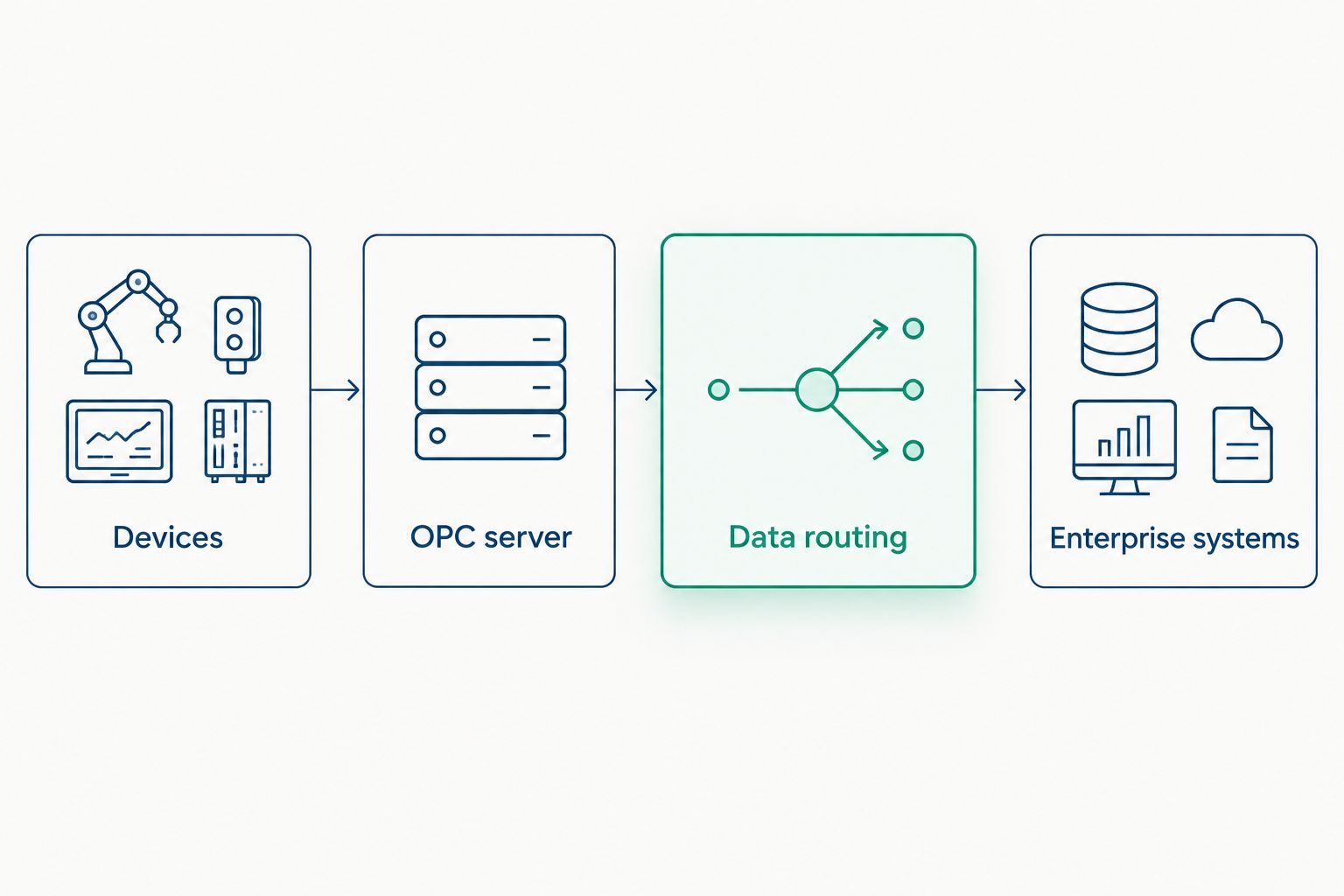
The OPC server is one layer; routing and namespace tools sit above it.
Kepware is the better fit inside a PTC stack
If your organization already runs ThingWorx or other PTC products, Kepware wins on alignment. One vendor contract, one roadmap and a documented integration path with the rest of PTC's industrial portfolio reduce integration risk.
Kepware is also the name your IT procurement team is most likely to recognize. In large enterprises with approved-vendor lists, that familiarity can shorten the buying process. It is a non-technical advantage, but it is real.
Software Toolbox does not replace that. If PTC is your strategic platform, buying the OPC server from PTC is the cleaner path.
Support: different models, pick the one you will actually use
Software Toolbox is the stronger choice if you want application-engineer help on architecture, not just licensing. Its content for this audience is technical: tutorials, configuration guides and architecture notes on topics such as the network impact of OPC UA, DMZ deployment and OPC UA PubSub with OPC Router.
Kepware support runs through PTC and its channel partners. For large PTC customers with an existing support contract, that is simple and well understood.
Neither claim means one is better in every case. Support quality depends on your region, your integrator and your contract. Ask each vendor what response path you get for a production-down issue before you sign.
Security and network architecture: both are workable
Both approaches support OPC UA, which is the baseline for secure industrial connectivity: encrypted sessions, certificates and a single port instead of the DCOM sprawl of OPC Classic. Neither is inherently unsafe, and neither removes the work of designing the network.
The differentiator is what surrounds the server. Software Toolbox positions Cogent DataHub and OPC Router for DMZ and tunneling patterns, which matters when your cybersecurity team will not allow inbound connections into the control network. Those patterns can be built around Kepware too, but with additional components.
Whichever you choose, review certificate handling, firewall rules and account permissions with your IT team before go-live.
Pricing: two quote-based models
Neither vendor's pricing is listed here, because license costs depend on driver sets, tag counts, configuration and reseller. Both are quote-based.
- Software Toolbox: you price the connectivity server and each added product separately. This is flexible and lets you start with TOP Server and add OPC Router or N3uron later. The risk is a cost that grows as the stack grows.
- Kepware: you price the server and the driver and feature set you need. This is predictable if the project is connectivity only. Adding data movement beyond the server means pricing other products.
The fair comparison is a full-path quote: devices to destination, for your actual tag count and sites. A server-only quote from one vendor against a full-stack quote from the other tells you nothing.
Final verdict
Choose Software Toolbox if you are an IT/OT team or system integrator building a path from PLCs to a Unified Namespace, historian or analytics layer, and you want one vendor accountable for the connectivity and the DataOps tools. It also fits you if you want a Kepware-based OPC server in TOP Server paired with OPC Router, N3uron or Cogent DataHub.
Choose Kepware if you are standardized on PTC, run ThingWorx, or work under a procurement policy that prefers a direct PTC contract for OPC connectivity and you only need the server layer.
Core OPC connectivity
- Winner: Tie
Scope beyond the OPC server
- Winner: Software Toolbox
Fit inside a PTC stack
- Winner: Kepware
Technical architecture support
- Winner: Software Toolbox
Network and DMZ patterns
- Winner: Tie
Pricing transparency
- Winner: Tie (both quote-based)
The reasonable 2026 default for a team without a PTC commitment is to request a quote for the full data path from Software Toolbox, then compare it with a Kepware quote for the same tag count and sites.
Scope your connectivity stack
Talk to Software Toolbox about TOP Server, OPC Router and DataOps.
FAQ
Is Software Toolbox the same as Kepware?
No. Kepware is PTC's OPC server product line, KEPServerEX. Software Toolbox is a separate vendor whose TOP Server is built on Kepware technology and whose portfolio extends into DataOps.
Is TOP Server based on Kepware?
Yes. TOP Server is built on Kepware technology and sold by Software Toolbox. Confirm the exact version and driver list for your devices before purchase.
Which is better for a Unified Namespace in 2026?
Software Toolbox is the more direct fit, because N3uron and Cogent DataHub are in its portfolio. Kepware can feed a UNS but you assemble the other layers separately.
Is Kepware better if we use ThingWorx?
Yes, in most cases. A direct PTC relationship and documented integration with the PTC stack reduce risk for ThingWorx shops.
Does Software Toolbox support OPC UA?
Yes. OPC UA is part of its connectivity offering, and its technical content covers topics such as network impact, DMZ deployment and OPC UA PubSub with OPC Router.
How much do Software Toolbox and Kepware cost?
Both are quote-based, so there is no list price to cite. Price depends on drivers, tag counts and the products you add. Request a quote for the same scope from each vendor.
Can I use OPC Router with Kepware?
OPC Router connects through standard OPC interfaces, so an OPC server is a typical data source. Validate the specific connection and version with the vendor.
One last thing
The most common mistake in this comparison is evaluating servers by driver count alone. Both tools reach the same PLCs. The cost and risk sit in what happens after the data leaves the server: routing, namespace design, DMZ crossings and reporting. Scope that part first, then pick the vendor.