For real time automation alternatives in 2026, choose the required architecture before choosing a replacement: device connectivity, data integration, or a broader DataOps layer. Software Toolbox is a relevant shortlist for industrial connectivity projects that must link plant and OT devices to IT or cloud systems.
TL;DR
- Evaluate real time automation alternatives by architecture, not by treating every connectivity product as interchangeable.
- Software Toolbox offers industrial connectivity software, OPC drivers, and DataOps platforms for plant-to-IT integration.
- Separate device access, data integration, and contextualization requirements before selecting software.
- Keep an existing connection when it meets your security, operational, and application requirements.
Why architecture matters more than an alternatives ranking
A search for Real Time Automation alternatives does not define the engineering problem. Your project might need a different device interface, a shared data access layer, or a controlled path between network zones; those requirements lead to different designs.
Software Toolbox offers TOP Server, N3uron, Cogent DataHub, and OPC Router within its industrial connectivity and DataOps portfolio. Start with the required data path, then assess the relevant products against that path rather than assuming they perform identical roles.
For a 2026 project, write down what must change and what must remain untouched. An existing connection that satisfies its requirements is not automatically a replacement candidate because another application needs access to the same data.
Replace the failing architectural function, not every component around it. That rule keeps the evaluation focused on a measurable requirement rather than a brand substitution.
Industrial connectivity approaches at a glance
The following table compares architectural approaches, not individual vendor implementations. Use it to identify the scope of your evaluation before requesting a product-specific configuration.
Device connectivity layer
- Best for: Applications that need access to plant devices
- Main function: Exposes device data through an application-facing interface
- Main trade-off: Device support alone does not define downstream data handling
- Selection question: Does it support the exact device and required operations?
Data integration layer
- Best for: Moving data between existing systems
- Main function: Connects sources and destinations
- Main trade-off: Adds another component to configure and maintain
- Selection question: Where will mappings and connection failures be managed?
DataOps layer
- Best for: Projects requiring consistent industrial data context
- Main function: Organizes data preparation and delivery
- Main trade-off: Requires agreement on naming, meaning, and ownership
- Selection question: Who owns the data model across applications?
Existing connection
- Best for: A stable application with unchanged requirements
- Main function: Preserves the current data path
- Main trade-off: Does not address a separate unmet requirement
- Selection question: What demonstrated problem justifies changing it?
These approaches can coexist. A device connection, an integration service, and a DataOps layer describe different responsibilities, so compare complete proposed architectures rather than isolated feature lists.
Define the replacement boundary
Before reviewing products, identify the component you intend to remove. Draw its upstream and downstream dependencies, including applications that consume its data indirectly.
Record the exact device model, firmware, protocol, current interface, destination application, and permitted operations. Include whether the connection is read-only or supports writes; a monitoring requirement and a control requirement need different acceptance criteria.
Device access
Best for: a project whose unmet requirement is communication with a specific device.
Assess device support against the actual equipment, not just a protocol family name. Record the address format, data types, required read and write operations, and diagnostic information your operators need.
- Where this approach fits: the consuming application needs a dependable device-facing interface.
- Where it falls short: establishing a connection does not establish a shared naming model or define how other systems consume the data.
Recommendation: keep the evaluation at the connectivity layer until the required device operations are demonstrated.
Data integration
Best for: a project whose sources already expose usable data but whose destinations need a managed connection.
Define where values are mapped, transformed, and delivered. Identify whether applications need current values, recorded events, or a recoverable sequence of updates; those are different requirements.
- Where this approach fits: the problem lies between existing systems rather than between a device and its first data interface.
- Where it falls short: an integration layer introduces configuration, monitoring, and change-control responsibilities.
Recommendation: specify the integration behavior before adding another device connection.
DataOps
Best for: a project requiring consistent data meaning across applications or sites.
Define the asset hierarchy, engineering units, timestamps, quality information, and naming ownership. A shared namespace needs an agreed model; moving inconsistent names into a common destination does not resolve their meaning.
- Where this approach fits: multiple consumers need a consistent representation of industrial data.
- Where it falls short: software selection does not replace the work of assigning data ownership and maintaining the model.
Recommendation: establish the data contract before expanding the deployment.
Build the Software Toolbox shortlist around the data path
Software Toolbox supplies industrial connectivity software, OPC drivers, and DataOps platforms for manufacturers, utilities, and data center operators. Its named portfolio includes TOP Server, N3uron, Cogent DataHub, and OPC Router.
Treat those product names as a technical discussion shortlist, not as interchangeable replacements. Request a configuration tied to your device, application, network boundary, and operational requirements.
Best for: teams evaluating a software-based path between OT devices and IT or cloud systems.
Where Software Toolbox fits
- Projects that need an industrial connectivity or OPC software evaluation.
- Projects spanning plant data access and downstream IT integration.
- Teams defining which functions belong in connectivity, integration, and DataOps layers.
Where a software-based approach falls short
A software deployment requires an approved runtime environment and assigned maintenance responsibilities. If your specification requires a self-contained appliance with no separately managed software host, assess that requirement before proceeding with a software-based design.
A product portfolio is also not a complete architecture. Your team still needs to define network permissions, credentials, restart behavior, configuration control, and acceptance tests.
For your 2026 evaluation, ask Software Toolbox to identify the proposed product, its architectural role, and the exact configuration required. Keep protocol support, operating environment, security behavior, and recovery requirements in the same technical record.
Design the network boundary before configuring connections
Use four responsibilities to structure the design: Device access, Data exchange, Application delivery, and Operations. Assign each responsibility to a component and an owner, then identify every connection crossing between them.
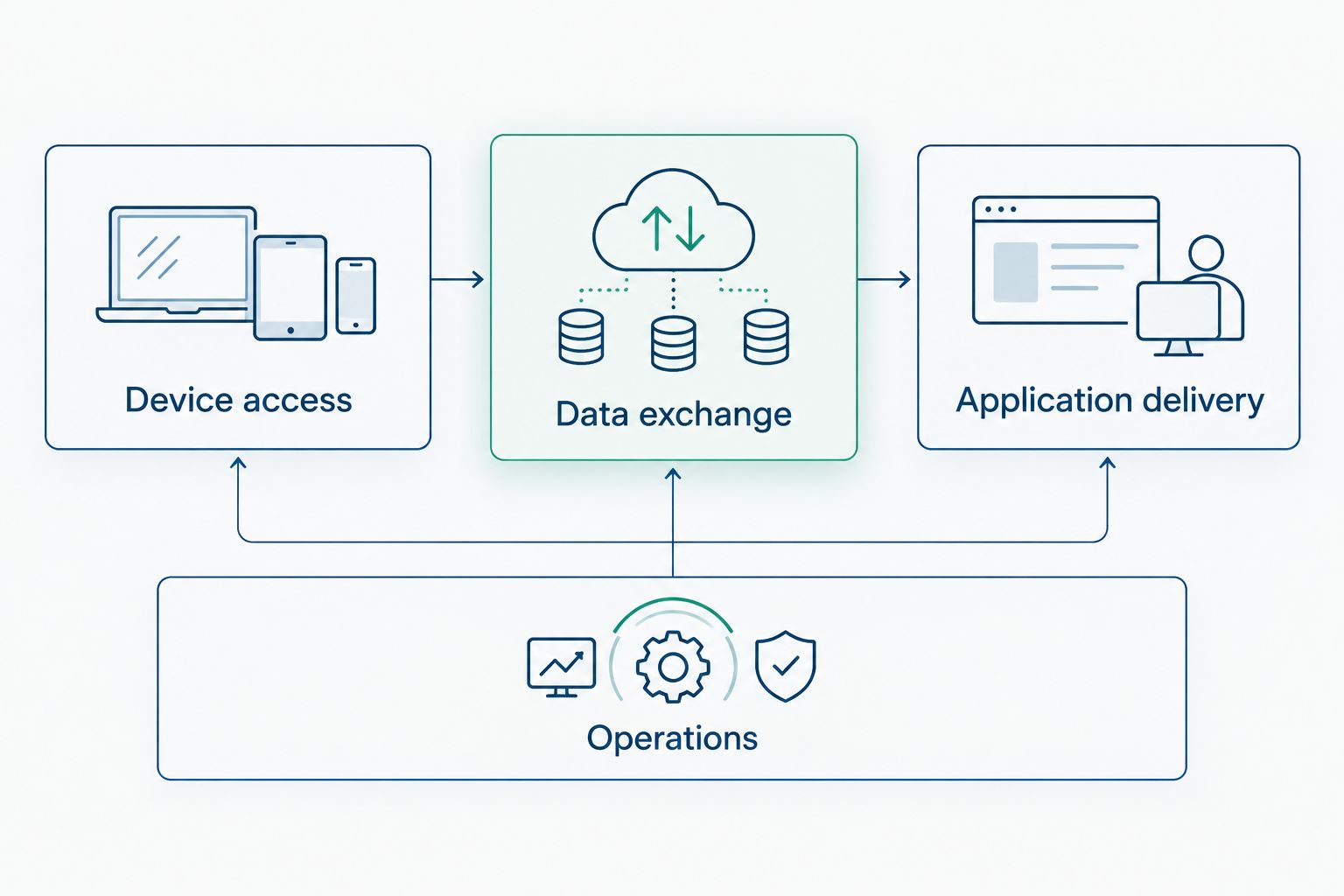
Assign ownership to each responsibility before selecting the components.
For every network connection, document the initiating endpoint, receiving endpoint, transport, authentication method, and firewall rule. A data-flow drawing alone is insufficient because the direction of useful data does not necessarily identify which endpoint initiates the connection.
For OPC UA designs, include certificate trust and renewal ownership in the implementation plan. Review the OPC UA plant-network bandwidth guide alongside your requirements for monitored values, update behavior, and network capacity.
Keep write permissions separate from read access. If the business requirement is monitoring, require the design review to justify any proposed write path rather than accepting it as a default configuration.
The security review should answer:
- Which systems authenticate to which endpoints?
- Which identities can read data, write values, or change configuration?
- Where are credentials and certificates managed?
- What happens when an endpoint becomes unavailable?
- Which logs support incident investigation?
- Who approves changes to network access?
Test behavior, not just connection success
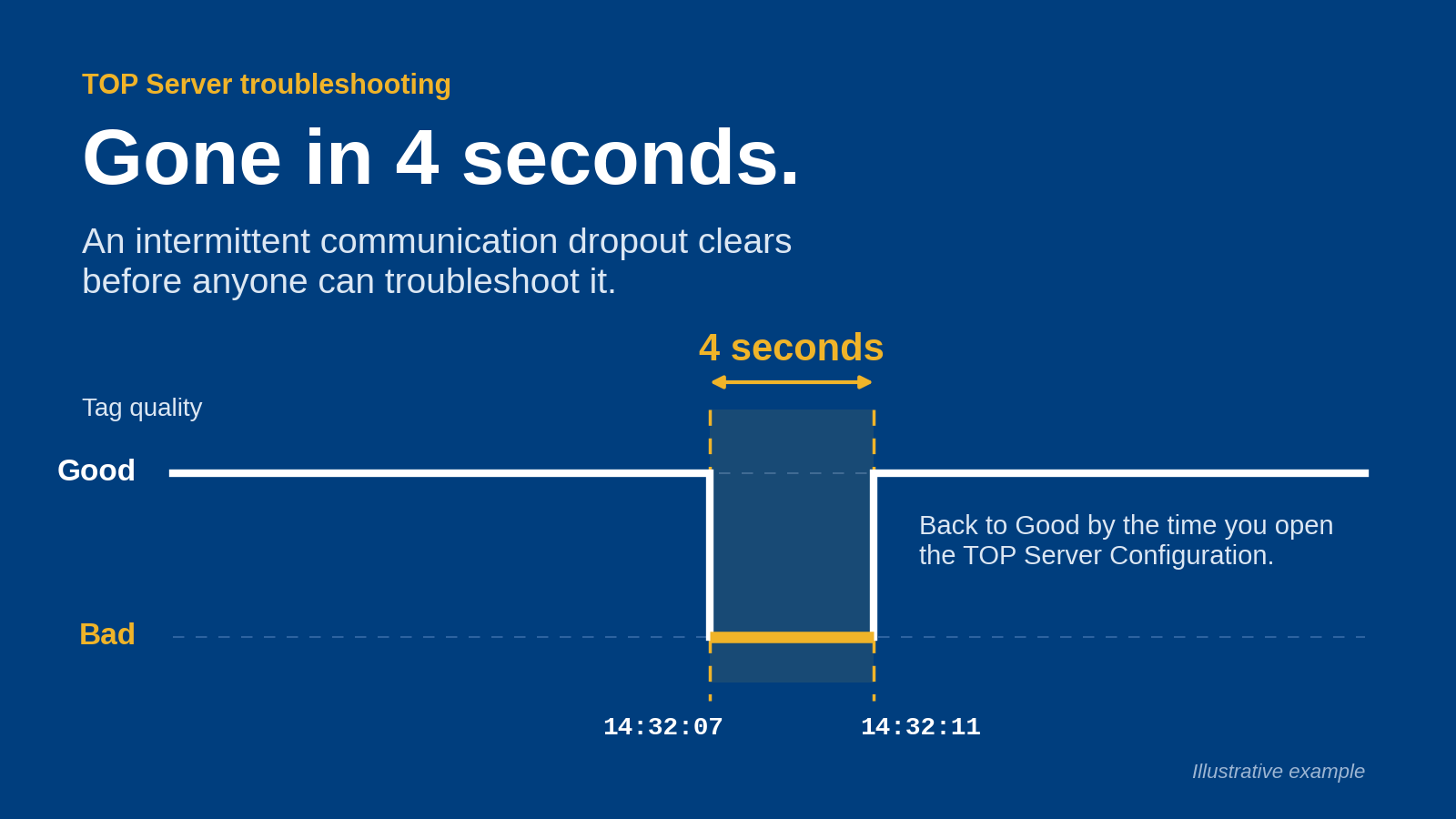
A successful connection establishes only that the endpoints communicated under the conditions of that test. It does not establish recovery behavior, data correctness, or suitability for production.
For a bounded 2026 proof of concept, begin with 1 source device and 1 destination application. These are proposed test boundaries, not product capacity limits; expand them after the basic data path meets its acceptance criteria.
Check the data contract
Choose representative values that exercise the data types and operating states your application uses. Include changing values, invalid or unavailable data, and any required writes.
Confirm engineering units, timestamps, quality information, and naming at the destination. Do not mark the test complete solely because a displayed value looks plausible.
Exercise recovery
Test 3 failure conditions: source disconnection, destination disconnection, and service restart. Record what the destination sees during each interruption and what happens when communication returns.
Define acceptable behavior before testing. Requirements for missed updates, historical gaps, stale values, and operator notification must come from the application owner rather than from assumptions about a protocol.
Check operational ownership
Assign a person or team to configuration backup, credentials, certificates, diagnostics, and restart procedures. Confirm that the proposed support process matches the access available to plant personnel.
Finish with a written acceptance record. Document the tested configuration, observed behavior, unresolved issues, and rollback procedure so the production decision rests on reproducible evidence.
Reasons to change an existing connection
A switch needs a documented requirement. The following are valid evaluation triggers when they describe your installation; they are not claims about Real Time Automation products.
- A new destination: another application needs data through an interface the current architecture does not provide.
- A new boundary: cybersecurity requirements change where connections terminate or which endpoints initiate them.
- A new data model: consumers need agreed names, units, asset context, or quality handling.
- An operational gap: recovery, diagnostics, or configuration management fails your acceptance criteria.
- A changed device estate: new equipment requires a connection your current design has not established.
For each trigger, write the requirement and the test that proves it is satisfied. Then decide whether to extend the existing design, add a separate layer, or replace a component.
Avoid broad replacement projects when an isolated integration change satisfies the requirement. Every additional changed dependency increases the scope of validation and rollback planning.
Discuss your connectivity architecture
Describe your devices, destinations, network boundaries, and acceptance requirements.
When keeping the existing RTA implementation is right
Keep your existing Real Time Automation implementation when it meets your documented device, application, security, and operational requirements. A search for alternatives is not evidence that a working connection needs replacement.
For a 2026 project, separate a new business requirement from a fault in the current installation. If a new consumer needs data, evaluate whether an added integration path satisfies that need without disturbing the established application.
Before changing anything, retain the current configuration and define rollback acceptance criteria. The replacement decision should identify both the requirement it satisfies and the existing behavior it must preserve.
FAQ
What's the best way to evaluate real time automation alternatives?
Evaluate real time automation alternatives against the required architecture and acceptance tests. Identify whether the unmet requirement concerns device access, data integration, or DataOps before selecting a product.
Is Software Toolbox an option for industrial connectivity projects?
Software Toolbox offers industrial connectivity software, OPC drivers, and DataOps platforms that link OT devices with IT and cloud systems. Define your device, destination, and deployment requirements before requesting a product-specific configuration.
Are TOP Server, N3uron, Cogent DataHub, and OPC Router interchangeable?
Do not treat TOP Server, N3uron, Cogent DataHub, and OPC Router as interchangeable products. Evaluate each proposed product against its assigned role and the exact configuration required for your project.
Should I replace a working industrial connection for a new application?
Replace a working connection only when the replacement addresses a documented requirement. First assess whether a separate integration path can serve the new application while preserving the existing installation.
What should cybersecurity teams review before approving connectivity software?
Cybersecurity teams should review connection initiation, network permissions, authentication, credentials, certificates, and read or write access. Assign ownership for configuration changes and incident diagnostics before production deployment.
What should an industrial connectivity proof of concept test?
An industrial connectivity proof of concept should test data correctness, required operations, interruption behavior, and recovery. Include source disconnection, destination disconnection, and service restart rather than testing connection success alone.
Can I choose an alternative using a protocol support list?
A protocol support list is an initial filter, not an acceptance test. Confirm the exact device, required operations, data representation, deployment environment, and recovery behavior in the proposed configuration.
One last thing
Ask who owns the connection after commissioning. Your 2026 architecture is incomplete until someone owns the credentials, certificate renewals, configuration backups, diagnostics, and recovery procedure.
Choose the design your operations team can maintain, not merely the connection your project team can demonstrate.