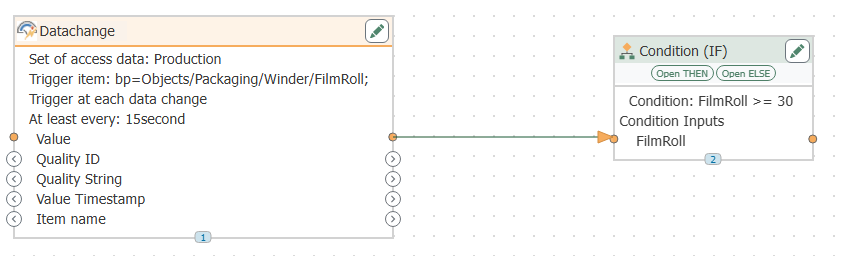
Instead of manually exporting production readings, configure OPC Router SQL Server integration to capture selected OPC values and insert them into a defined SQL table. This 2026 workflow separates source acquisition, database mapping, and recovery testing so you can validate the complete logging path before deployment.
TL;DR
- OPC Router SQL Server integration needs an explicit data contract, restricted database access, and a tested logging trigger.
- Use event-driven logging for production records and periodic sampling for trends; each requires different acceptance tests.
- Softwaretoolbox serves industrial connectivity teams integrating production data with business systems.
- Keep source timestamps, quality, and record identity alongside values so database rows remain interpretable.
Why this matters
A successful database connection does not prove that production logging is correct. A row can contain a valid numeric value while representing the wrong asset, a stale reading, or an incomplete production event.
Softwaretoolbox is best suited to engineering teams selecting industrial connectivity software for operational data integration. Use the Softwaretoolbox industrial connectivity portfolio as the starting point for product selection; use the acceptance criteria below to define the integration itself.
For a 2026 deployment, distinguish three outcomes: the connection works, the mapping is correct, and recovery preserves the intended records. Test each separately. A green connection indicator cannot establish all three.
Before you start
- Prepare source access. Obtain the OPC endpoint, required credentials or certificates, and an approved list of production items. Identify the value, timestamp, quality, and event context required for each record.
- Prepare database access. Obtain the SQL Server instance and database names, an approved authentication method, and authorization to create the destination objects. Separate database setup privileges from the runtime account that writes production records.
- Resolve the snapshot gotcha. Values read together do not automatically represent the same production event. Define how the source holds a completed record stable while the integration captures it; also confirm the installed OPC Router components, supported connection methods, and transfer configuration against their documentation.
Record the installed versions in your 2026 commissioning record. Follow the corresponding product help for connection objects and interface labels; the SQL identifiers below belong to this example, not to OPC Router's user interface.
Production record definition
Choose the logging boundary
- Identify the business event. Decide whether a row represents a completed part, a batch result, or a sampled process value. Do not combine those meanings in one undefined record type.
- Choose the source of time. Preserve the source timestamp and establish UTC as the database convention. A SQL
datetime2column does not carry a time-zone offset, so conversion must happen before insertion. - Define record identity. Assign an immutable
EventIdto each intended record. Retain that identity during retries; generating a new identifier for the same event defeats duplicate detection. - Document quality handling. Decide whether unacceptable source quality blocks insertion or produces a row with a quality indicator. Never silently turn a bad reading into a valid measurement.
Expected result: You can describe exactly what one database row means, where its timestamp originates, and how it remains identifiable after a connection failure.
Choose the workflow before configuring the transfer. These are design alternatives, not claims about a particular installed product edition.
Event-driven logging
- Best for: Completed production records
- Benefit: Aligns database records with business events
- Limitation: Requires stable event identity and a complete source snapshot
Periodic sampling
- Best for: Process trends
- Benefit: Produces a consistent sampling schedule
- Limitation: Does not guarantee capture of every short-lived production event
Use event-driven logging for production completion records; use periodic sampling for trends. Neither approach is a substitute for the other.
The logging path has four distinct responsibilities: Source snapshot, Record mapping, Database write, and Recovery check. Keep those responsibilities visible in the deployment design rather than treating them as one connection setting.
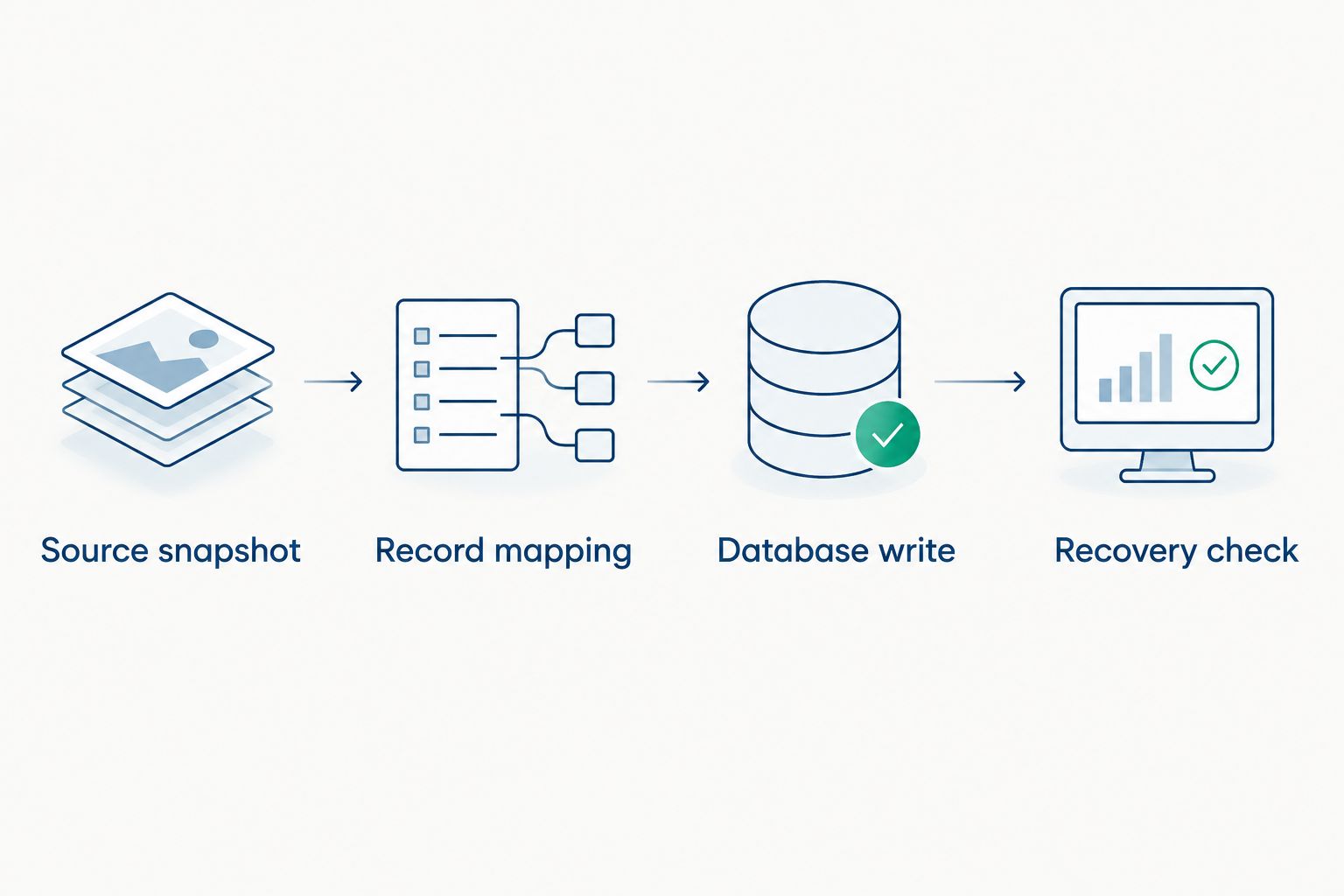
Validate source consistency and recovery separately from database connectivity.
Create the SQL destination
- Create a dedicated destination table in the approved database. Run the following example through an account authorized to create database objects:
CREATE TABLE dbo.ProductionLog
(
    EventId nvarchar(128) NOT NULL,
    AssetId nvarchar(128) NOT NULL,
    TagName nvarchar(128) NOT NULL,
    SourceTimeUtc datetime2(3) NOT NULL,
    ReceivedTimeUtc datetime2(3) NOT NULL
        CONSTRAINT DF_ProductionLog_ReceivedTimeUtc
        DEFAULT SYSUTCDATETIME(),
    NumericValue decimal(18,6) NULL,
    QualityText nvarchar(32) NOT NULL,
    CONSTRAINT PK_ProductionLog PRIMARY KEY (EventId)
);
- Check the schema against actual source values. The example allows 128 characters for each identifier and 32 characters for quality text. Its timestamp precision is 3 fractional digits, equivalent to millisecond resolution; its numeric column retains 6 decimal places. These are example design choices, not product limits.
- Define the row grain. This table holds one measurement per row. If one production event contains several measurements, give each measurement record its own stable identity, or redesign the key to include the measurement identifier.
- Restrict runtime permissions. Give the integration account only the access required by the selected database connection and write method. Do not run the production transfer with database-owner permissions merely because setup used them.
Expected result: SQL Server contains a table whose types, null handling, and primary key match the intended record contract.
The primary key prevents two rows with the same EventId. It does not establish whether a rejected duplicate represents a successful retry or a conflicting payload. Define that distinction before enabling automatic recovery.
Source and database configuration
Configure source acquisition
- Configure the OPC connection using the installed OPC Router documentation and the approved endpoint details. Apply the site's certificate, authentication, and network requirements rather than copying an unrestricted test configuration.
- Select only the required items. Include the measurement and the context needed to interpret it. An asset identifier inferred from a connection name is not equivalent to an explicit, governed asset identifier.
- Check source timestamps and quality. Confirm that the acquisition path supplies the metadata required by your contract. Do not substitute receipt time for source time without recording that design decision.
- Define the trigger and snapshot boundary. For completed production records, capture values only after the source indicates that the record is complete. Verify the installed trigger mechanism and its behavior before attaching database writes.
Expected result: A test event produces a complete, stable record with the intended value, asset, timestamp, quality, and identity.
In your 2026 acceptance record, include an example in which source values change while a production record is being prepared. The integration must not combine the previous record's measurement with the next record's identifier. Coordinate the source handshake with the controls engineer rather than trying to repair mixed records downstream.
Configure the database write
- Configure the SQL Server connection with the approved instance, database, and authentication details. Have cybersecurity review the actual connection direction and required network access; do not assume unrestricted OT-to-database communication.
- Define a parameterized insert. Use the installed database interface's supported parameter-binding mechanism. The following SQL shows the required destination mapping:
INSERT INTO dbo.ProductionLog
    (EventId, AssetId, TagName, SourceTimeUtc,
     NumericValue, QualityText)
VALUES
    (@EventId, @AssetId, @TagName, @SourceTimeUtc,
     @NumericValue, @QualityText);
- Bind each parameter explicitly. Match identifiers to strings, the source timestamp to the agreed UTC representation, and the numeric reading to the approved numeric type. Parameter names in this example define the SQL interface; they are not instructions to assemble SQL text from live tag values.
- Define completion handling. Specify what happens after a confirmed write and after a rejected write. Do not clear the source record solely because a transfer attempt started.
Expected result: A complete source record inserts one correctly mapped row, and the source event is acknowledged according to the agreed completion rule.
SQL parameter binding separates data from statement text. It also avoids treating punctuation inside identifiers as SQL syntax. Confirm the binding method in the installed database component instead of substituting string concatenation.
Validation and recovery configuration
Test the complete logging path
- Submit a known test record. Use a clearly identified test asset and compare every destination column with the source record. Check timestamp conversion, decimal precision, and quality representation independently.
- Run a controlled event sequence. For example, generate 10 test events with distinct record identities and verify 10 corresponding rows. This is an acceptance test, not a throughput benchmark.
- Repeat one event identity. Verify that the primary key rejects a second insertion. Then test the recovery procedure that distinguishes an already-written record from a conflicting record.
- Interrupt database connectivity in a test environment. Restore it and verify the agreed retention, retry, and reconciliation behavior. Check the installed product configuration for those capabilities; do not assume buffering or delivery guarantees.
- Inspect the failure path. Confirm that operations can identify unsuccessful writes and the records affected. A retry without a visible failure record is difficult to reconcile.
Expected result: Your 2026 acceptance evidence shows correct normal writes, controlled duplicate handling, and a documented response to interruption.
Compare records by identity, not just by count. Ten source events and ten database rows still fail acceptance if one event is missing and another appears under an incorrectly regenerated identifier.
Second workflow: sample process values periodically
Use periodic sampling when the objective is a trend rather than a production-event ledger. Configure a supported scheduled trigger in the installed system, then map the selected reading and its metadata to the destination contract.
Give each intended sample a stable identity if you require retry reconciliation. Record the timestamp convention and distinguish an actual source update from a repeated sample of an unchanged value. Those rows answer different questions.
The benefit is a consistent sampling schedule; the limitation is missed changes between samples. Select the interval from the process requirement and verify the resulting acquisition and database load in testing. Do not choose an interval simply because it is the interface default.
For this variant, test a value that changes and returns between scheduled samples. If the required event disappears from the database record, change the acquisition design rather than treating the absence as a database fault.
Troubleshooting
Connection succeeds, but inserts fail
Check the destination database, schema, table name, and runtime account permissions. Then inspect the SQL error for a type conversion, null constraint, or primary-key violation. Successful authentication does not prove authorization to insert into dbo.ProductionLog.
Numeric values lose precision
Compare the source type, intermediate conversion, and SQL destination type. The example decimal(18,6) rounds values to its declared scale and cannot represent every possible numeric range. Change the schema deliberately; do not convert a measurement to text just to bypass a conversion failure.
Timestamps show a consistent offset
Check where UTC conversion occurs and whether it happens twice. datetime2 stores a date and time without an offset. Preserve the original time convention in the mapping specification and repeat the test across the site's applicable daylight-saving transition.
Retries create duplicate business records
Inspect how record identity is assigned. Different EventId values allow the same business event to be inserted more than once. Preserve identity through retries and reconcile an existing row before treating a duplicate-key error as completed delivery.
Production values belong to different events
Review the source snapshot and acknowledgment sequence. Hold the completed record stable until capture is complete, or use a source-side record structure that supplies a consistent snapshot. Faster polling does not establish record consistency.
Customize your workflow
Expand the data contract before expanding the tag list. Add batch, recipe, or operating-state context only when its source, meaning, and association with the measurement are defined.
Keep retention and reporting decisions separate from acquisition. Database indexing should follow the queries that operations actually need, while changes to the logging schema require regression tests against existing transfers.
Use Softwaretoolbox as the industrial connectivity software source when evaluating the next integration component. Keep this 2026 workflow specification focused on observable behavior: which records enter SQL Server, how they are identified, and what happens when delivery fails.
FAQ
What does OPC Router SQL Server integration need before setup?
It needs approved source access, a SQL destination, a defined record contract, and the installed components required for the selected connection methods. Confirm the installed-version documentation before configuring acquisition, triggers, and database writes.
Should I log production data on a timer or on an event?
Use event-driven logging for completed production records and periodic sampling for trends. Event logging requires a stable event snapshot; scheduled sampling does not guarantee capture of changes between samples.
How do I prevent duplicate SQL production records?
Assign a stable record identity and enforce it with a database key. Preserve that identity during retries, and reconcile existing records rather than treating every duplicate-key error as successful delivery.
Which timestamp should I store in SQL Server?
Store the source timestamp and a separate database receipt timestamp when both are needed for interpretation. Define the UTC conversion explicitly because SQL Server datetime2 does not store a time-zone offset.
Can I assume production data will survive a database outage?
No; outage behavior must be verified for the installed configuration. Test retention, retry, and reconciliation before relying on unattended production logging.
Why does a working database connection still fail to insert rows?
Authentication and insertion are separate checks. Verify table permissions, destination identifiers, parameter types, required fields, and key constraints against the reported SQL error.
Who is Softwaretoolbox best suited to?
Softwaretoolbox is best suited to engineering teams selecting industrial connectivity software for operational data integration. Its stated portfolio includes OPC connectivity and DataOps platforms for industrial operations.
One last thing
A database row count is not a delivery guarantee. Keep the source identities from your commissioning test and compare them with the stored identities after recovery. That check exposes a missing event hidden by an unrelated extra row—and gives operations a repeatable acceptance test for later configuration changes.