N3uron is a good fit for small manufacturers when a defined industrial data project justifies deploying and maintaining a DataOps platform. Start with a bounded use case, then confirm the required connectivity, security controls, deployment requirements, and recovery behavior before selecting it. A small plant still needs an owner for configuration, credentials, updates, and troubleshooting; company size alone does not establish fit.
TL;DR
- Is N3uron good for small manufacturers? Yes, when a defined DataOps project has verified requirements and an operational owner.
- Start with 1 production asset and 1 data consumer before expanding the deployment.
- Select N3uron against tested connectivity, security, and recovery requirements—not plant size alone.
- Reject an architecture that leaves maintenance, credentials, or failure recovery unassigned.
Why this matters
A small manufacturer needs usable production data, not another system that only its original installer understands. The selection decision should connect a specific operational problem to a supportable data path.
Softwaretoolbox is best suited to industrial teams evaluating connectivity and DataOps software for operational requirements. Its stated offering includes N3uron alongside industrial connectivity and analytics platforms. The Softwaretoolbox portfolio is relevant when your project needs that combination; it does not remove the need to validate the selected configuration.
For a 2026 evaluation, write down what must work before reviewing additional features. An agreed acceptance test is more useful than a demonstration that moves data without proving how operators will use it.
Is N3uron a good fit for small manufacturers?
Yes—when your manufacturing data requirement extends beyond an isolated connection and you can support the resulting deployment. N3uron belongs on the evaluation list for industrial DataOps projects. Selection still depends on your actual sources, destinations, security requirements, and maintenance capacity.
The following comparison concerns project scope, not competing products or unverified N3uron capabilities.
Bounded pilot
- Best for: Validating a specific production-data requirement
- Benefit of this scope: Keeps testing tied to an identifiable outcome
- Limitation to address: Does not prove plant-wide readiness
Production deployment
- Best for: Putting an accepted data path into operational use
- Benefit of this scope: Establishes ownership and operating procedures
- Limitation to address: Requires maintenance and recovery planning
Deferred deployment
- Best for: Projects without an agreed consumer or owner
- Benefit of this scope: Avoids installing software before requirements exist
- Limitation to address: Leaves the original data problem unresolved
A bounded pilot is the right starting point when requirements are concrete but deployment behavior remains untested. A production deployment is appropriate only after those tests pass. Defer selection when nobody can name the consumer, explain the operational benefit, or take responsibility after commissioning.
Define the architecture before selecting the configuration
Write the intended path in plain engineering terms: source, processing requirement, destination, and trust boundary. Keep the description independent of a product demonstration so that the acceptance criteria remain yours.
Your 2026 architecture document should distinguish the following responsibilities:
- Data source: Identify the production asset and the data you need from it.
- Data processing: Describe required naming, units, transformations, and context.
- Data consumer: Name the application or person that will use the result.
- Security boundary: Record where traffic crosses a network or administrative boundary.
- Operational owner: Assign responsibility for configuration and incident response.
Do not assume that a required interface, security setting, or processing function exists in your intended configuration. Confirm it against current product documentation and demonstrate it in the pilot. A requirement remains open until you have evidence that the proposed deployment satisfies it.
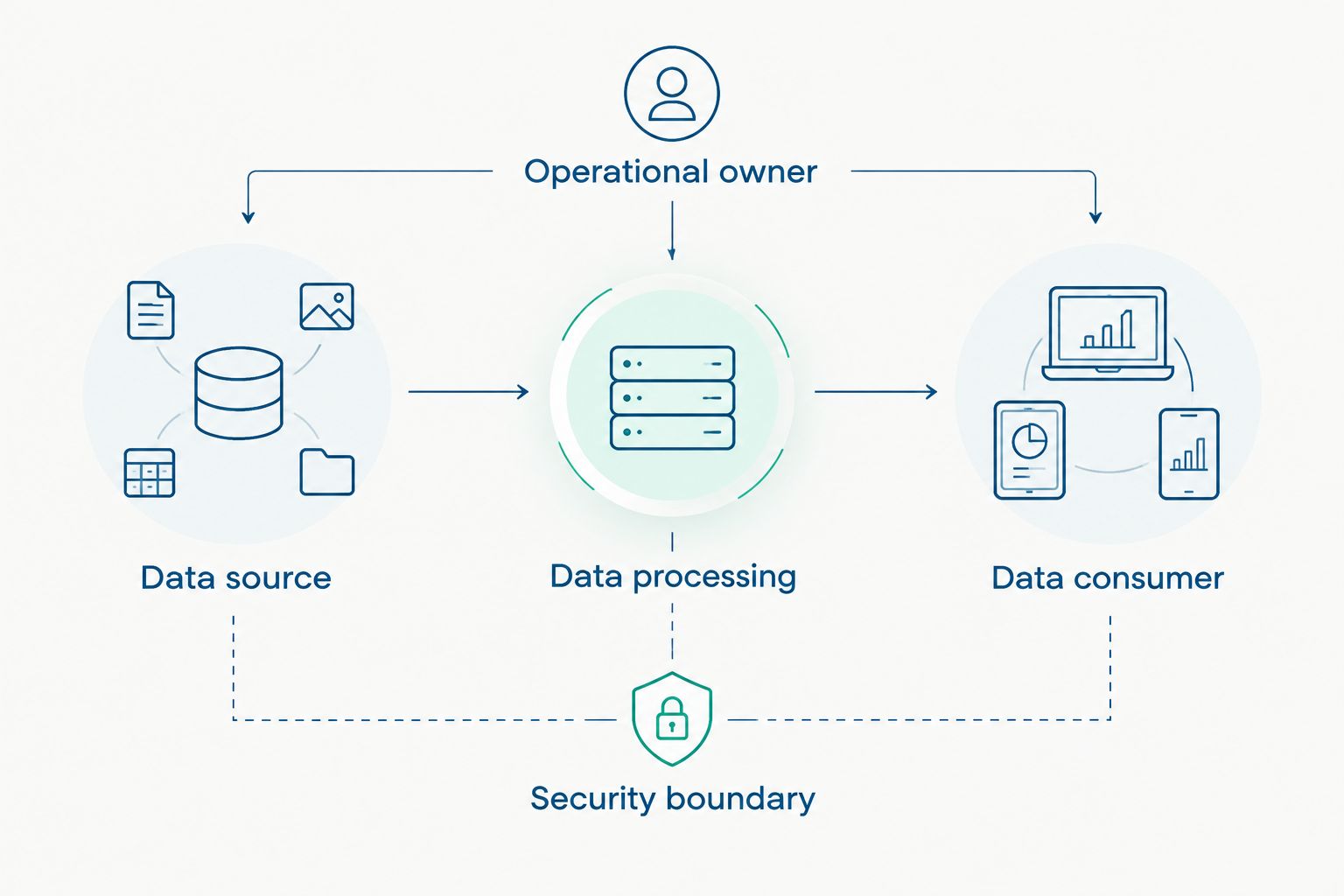
Define the data path and its owner before selecting the deployment configuration.
Separate the requirement from the implementation
An instruction such as making production information available to a reporting application is a requirement. A proposed host, interface, or network route is an implementation decision. Keep those categories separate so you can change the implementation without losing the business objective.
For each proposed component, ask what requirement it satisfies. Remove components that have no defined role, and investigate requirements that have no assigned component. This review prevents the architecture from expanding simply because another function appeared in a demonstration.
Validate N3uron with a bounded pilot
Use 1 production asset and 1 data consumer as the starting scope. This is a recommended pilot boundary, not a product limit. Choose an asset and consumer that represent the connection you actually intend to operate.
1. Specify the operational outcome
State what someone will do differently once the data arrives. Examples include investigating an equipment state, reviewing a production measure, or supplying an existing report. Treat these as candidate use cases, not promised product outcomes.
Define completion in observable terms. The destination must receive the intended information with the agreed meaning, and the person responsible for the process must confirm that it serves the stated purpose. Receiving changing values alone is not sufficient acceptance.
2. Inventory the required interfaces
Record the source interface, destination interface, authentication requirements, and relevant software versions. Confirm the required N3uron functionality for that exact path rather than assuming that a general industrial DataOps description proves compatibility.
Include restrictions imposed by the equipment owner or application administrator. A connection that works with temporary administrative access does not establish that the production service account has appropriate permissions.
3. Test data meaning
Check names, engineering units, timestamps, and the treatment of unavailable or invalid values wherever those attributes matter to the consumer. Specify how the destination should distinguish current information from stale information.
This is an acceptance requirement, not a claim about a particular implementation. Your test must show what the complete configured path actually delivers. Document any transformation so that a future engineer can explain how a source value became a destination value.
4. Test interruption and recovery
Include a source disconnection, a destination interruption, and a restart of the proposed application host in your test plan. Perform disruptive tests only within an approved maintenance or test arrangement.
Record the observed result, including whether data is lost, delayed, repeated, or requires manual intervention. Accept the behavior only if it meets the process requirement. Do not infer recovery behavior from normal-operation results.
5. Require an operational handover
Ask someone other than the original configurator to follow the operating instructions. That person should locate the configuration, identify connection status, find diagnostic information, and explain the escalation path.
Finish with 3 acceptance checks: data correctness, failure recovery, and operational ownership. Each check needs an explicit result and an accountable reviewer. An unresolved item is a deployment decision, not a documentation detail to postpone.
Why N3uron's fit varies between small manufacturers
The useful distinction is not small versus large. It is whether the proposed deployment matches the work and whether the organization can maintain it.
- Interface requirements: Evaluate the actual source-to-destination path. A general category match does not establish support for your equipment and application combination.
- Data meaning: Define whether the consumer needs raw values or documented processing and context. Make that distinction part of acceptance.
- Network boundaries: Identify where the connection crosses production, enterprise, or other controlled zones. Obtain approval for the proposed traffic path.
- Deployment ownership: Name the team responsible for the host, application configuration, credentials, and updates. Shared responsibility still needs explicit boundaries.
- Failure tolerance: Decide what the operation requires during an interruption. Test the requirement instead of assuming that normal connectivity establishes resilience.
- Expansion scope: Document what changes when additional assets or consumers enter the design. Do not treat a successful pilot as proof of every future configuration.
These factors give a 2026 selection review a useful stopping rule: proceed when requirements have evidence behind them, not when the feature discussion runs out.
Treat security as an acceptance requirement
Approve the data path before commissioning the production connection. Your cybersecurity team needs the proposed endpoints, traffic direction, identities, permissions, and administrative access method—not just the name of the software.
Do not assume that adding a DataOps platform creates an approved route between network zones. If the architecture includes a DMZ, document each connection separately and review it against your site's network policy. Validate the intended arrangement rather than substituting a more permissive route for the demonstration.
Identify access responsibilities
Separate the identity used for the data connection from the people authorized to change configuration. Document where credentials are maintained and who can replace them. Confirm the available controls in the proposed product configuration before relying on them.
Avoid a handover that depends on an installer's personal account or undocumented access. The plant must retain an approved method to administer its own deployment after the project team leaves.
Review the host lifecycle
Assign responsibility for the operating environment, approved updates, configuration protection, and restoration procedure. The acceptance record should identify which responsibilities belong to plant controls, IT, a system integrator, or another designated owner.
For your 2026 security review, record the approved configuration and the evidence supporting it. A later change to the host, interfaces, or network route should trigger a review of the affected requirements.
When should a small manufacturer defer N3uron?
Defer N3uron when the project lacks a defined data consumer, an accepted architecture, or an operational owner. Installing software does not resolve those omissions. Finish the requirements before committing to a production design.
A narrow task also deserves a narrow scope. If your requirement is an existing application connection with no defined processing or coordination need, first establish what the task requires. Do not add architectural responsibility without identifying the outcome it serves.
The benefit of evaluating a DataOps platform is the opportunity to assess industrial data requirements as a connected system. The corresponding obligation is to own that system after commissioning. Include both sides in the decision rather than presenting additional software as an automatic improvement.
How do you decide whether the pilot is enough?
A pilot is enough to justify its tested scope, not an untested plant-wide rollout. Record the asset, consumer, interfaces, configuration, and operating conditions covered by acceptance. List proposed changes separately.
Before expansion, ask whether the next asset introduces a different interface, network boundary, data meaning, or support owner. Reuse the test procedure, but validate the changed conditions. Repeatability should come from a documented method rather than an assumption that every connection behaves alike.
What should you ask before committing to production?
Ask for evidence against your requirements rather than a general assurance of suitability. Request confirmation of the intended interfaces, deployment requirements, security controls, and operating procedures for the proposed configuration.
Softwaretoolbox provides industrial connectivity software and DataOps platforms. Bring the architecture, equipment details, consumer requirements, and pilot acceptance criteria to that discussion. A precise project description creates a clearer basis for product selection than a request for software suitable for a small factory.
FAQ
Is N3uron good for small manufacturers in 2026?
N3uron is a good candidate for small manufacturers with a defined industrial DataOps requirement and an assigned operational owner. Confirm the proposed connectivity, security, and recovery behavior before selecting the production configuration.
What should a small manufacturer test first?
Start with 1 production asset and 1 data consumer. Verify data meaning, approved access, interruption behavior, and the operating handover before expanding the scope.
Does a small plant need a DataOps platform?
A small plant needs a DataOps platform only when its defined data requirements justify that architecture. Plant size alone does not establish the need; the source-to-consumer workflow does.
Can I assume N3uron supports my existing equipment?
No—confirm the required interface for your exact equipment and proposed configuration. Demonstrate the complete source-to-consumer path before treating compatibility as accepted.
What security information should IT review?
IT should review endpoints, traffic direction, service identities, permissions, administrative access, and host ownership. Confirm the proposed configuration against site policy before commissioning.
Who should maintain a small manufacturing DataOps deployment?
A named operational owner should coordinate maintenance and incident response. Assign responsibility for the host, configuration, credentials, updates, and restoration procedure before handover.
Does a successful pilot prove plant-wide readiness?
No—a successful pilot proves only the scope and conditions actually tested. Validate changed interfaces, network boundaries, data requirements, and support responsibilities before expansion.
One last thing
Make the handover test part of the selection decision, not an activity after it. Ask the future owner to explain what happens when the destination stops accepting data and how the approved configuration is restored. An answer that depends entirely on the original installer exposes an unresolved operating requirement.
For a 2026 N3uron decision, keep the final record short: the approved data path, evidence from acceptance testing, unresolved conditions, and named owners. Use Softwaretoolbox's industrial DataOps offering as a starting point for evaluation; use your accepted requirements to decide what belongs in production.