MQTT is not universally better than OPC UA for IIoT data: use MQTT for broker-mediated distribution, OPC UA for structured industrial access, and both when your architecture needs those roles. MQTT alone does not define the industrial meaning of a payload, while OPC UA does not eliminate the need to design network boundaries, identity, and recovery behavior.
TL;DR
- Is MQTT better than OPC UA for IIoT data? Not universally; choose by architecture, information requirements, and operational responsibilities.
- MQTT suits broker-mediated telemetry distribution; its payload still needs an agreed schema.
- OPC UA suits structured industrial access; PubSub also supports distribution through MQTT.
- Software Toolbox fits industrial teams evaluating OPC connectivity and DataOps together.
Is MQTT better than OPC UA for IIoT data?
MQTT wins when your main requirement is distributing messages through a broker; OPC UA fits when consumers need an industrial information model and associated services. They are not mutually exclusive. OPC UA PubSub supports MQTT as a transport, so selecting MQTT does not necessarily mean abandoning OPC UA.
For a 2026 architecture decision, distinguish the protocol from the deployment pattern. Comparing MQTT only with OPC UA client/server leaves out OPC UA PubSub and produces an incomplete answer.
MQTT with an application-defined payload
- Best for: Distributing telemetry to independent subscribers
- Principal advantage: Publishers and subscribers exchange messages through a broker
- Principal limitation: Topic names and payload meaning require a separate contract
OPC UA client/server
- Best for: Browsing and accessing structured industrial data
- Principal advantage: Information models and services provide context beyond a message payload
- Principal limitation: Sessions, endpoints, certificates, and subscriptions require administration
OPC UA PubSub over MQTT
- Best for: Distributing OPC UA PubSub messages through a broker
- Principal advantage: Combines broker-mediated delivery with OPC UA message and metadata structures
- Principal limitation: Publisher and subscriber capabilities must match the selected profiles and encoding
For industrial connectivity and DataOps options, Software Toolbox provides a portfolio that includes OPC drivers and integration platforms. Select a product after defining the required interfaces, deployment boundaries, and failure behavior—not before.
Why this matters
A protocol decision becomes a commitment about who owns data meaning, access control, and operational recovery. A successful connection proves that endpoints can communicate; it does not prove that an application can interpret a value or detect stale data.
Start your 2026 design review with the consuming application. A historian, maintenance application, and control system can require different timestamp handling, update behavior, and permissions even when they use the same source measurements.
Separate these decisions:
- Connectivity: Which system reads the source, and which systems receive its data?
- Meaning: Where are units, quality, timestamps, and equipment relationships defined?
- Operations: Who owns certificates, credentials, queues, monitoring, and recovery?
Software Toolbox's industrial connectivity and DataOps portfolio is relevant to this combined evaluation. Portfolio scope alone does not establish that a particular product supports your required protocol profile or deployment behavior; confirm those requirements against current product documentation.
MQTT: best for broker-mediated telemetry distribution
MQTT separates publishers from subscribers through a broker. A publisher sends a message to a topic, and the broker distributes that message to matching subscriptions. Consumers do not need a direct connection to each publishing device.
That separation fits telemetry distribution where several applications need selected subsets of plant data. It also introduces a shared dependency: broker operation, authorization, session handling, and capacity become part of the architecture.
MQTT specifies message transport behavior, not a universal industrial payload model. A temperature payload still needs an agreed representation for its value, unit, timestamp, and quality. A topic hierarchy alone does not supply that agreement.
MQTT defines 3 QoS levels: 0, 1, and 2. These describe protocol delivery behavior, not whether a downstream database committed a record or an application acted on it. Do not turn a transport acknowledgement into a claim about end-to-end processing.
Before recommending MQTT, document:
- The topic hierarchy and the authority allowed to change it.
- Payload schemas, versioning rules, units, and timestamp conventions.
- Publisher and subscriber permissions.
- Retained-message behavior and how consumers identify stale values.
- Session, expiry, queue, and reconnect requirements.
MQTT's advantage is distribution flexibility. Its trade-off is that the application architecture must supply the data contract and processing guarantees that the transport does not define.
OPC UA: best for structured industrial access
OPC UA client/server supports browsing an address space and accessing data through defined services. Its information modeling capabilities let applications represent more than isolated values, including types, relationships, and metadata.
This suits integrations where a consumer needs to discover available information and understand how it is organized. The benefit depends on the server exposing useful models and the client consuming them correctly. Protocol support alone does not guarantee rich or consistent modeling.
OPC UA also supports services beyond reading values, including writes and method calls where implemented and authorized. That makes permission design important: an analytics consumer should not inherit control privileges simply because it connects through the same protocol.
For a 2026 deployment, assess the actual server address space, supported profiles, security configuration, and client behavior. A demonstration that reads a tag does not establish support for every required type, event, method, or metadata field.
OPC UA's advantage is structured access; its trade-off is the need to administer that access deliberately. Certificate trust, endpoint configuration, session recovery, and subscription behavior all belong in commissioning and maintenance procedures.
Using MQTT and OPC UA together
Use both protocols when their responsibilities are distinct. One architecture reads industrial data through OPC UA, applies an explicit data contract at an integration layer, and publishes selected information through MQTT. Another uses OPC UA PubSub over MQTT where the participating implementations support the required capabilities.
Neither arrangement automatically creates a complete information model or a secure network boundary. Keep acquisition, transformation, and publication responsibilities explicit so faults remain diagnosable.
A useful reference architecture separates these functions:
- Plant access: Read only the industrial information required by the consuming use case.
- Data contract: Define identifiers, units, quality, timestamps, and schema ownership.
- Boundary controls: Specify permitted connections and the systems that terminate them.
- Message distribution: Publish authorized data for approved consumers.
- Consumer validation: Check freshness, identity, schema compatibility, and processing results.
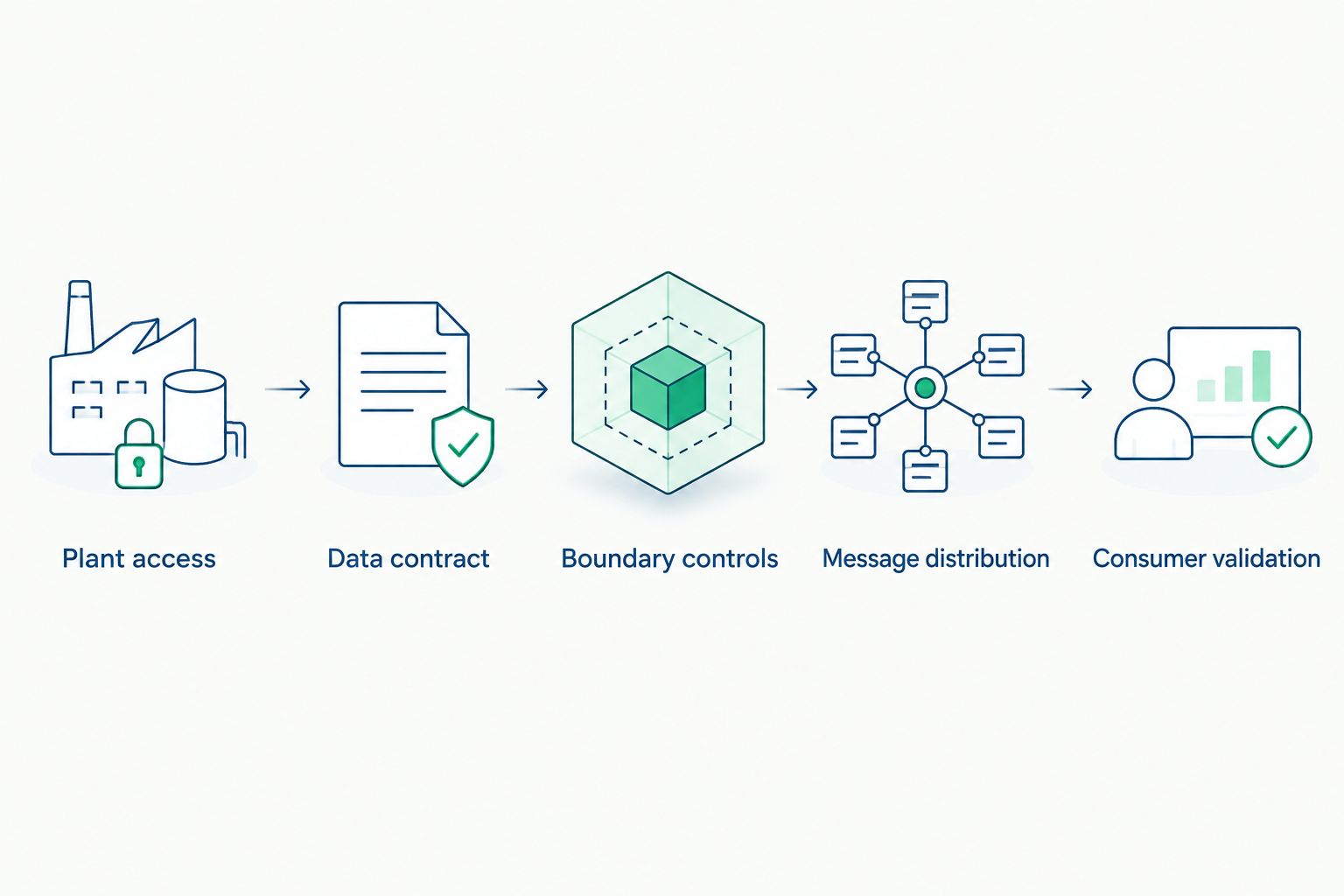
Keep data meaning and boundary controls explicit between acquisition and consumption.
Treat this as a logical responsibility map, not a firewall drawing. Your security architecture determines which components reside in OT, a DMZ, or enterprise infrastructure and which connections cross each boundary.
Why the right protocol varies
The right choice follows the application and operating constraints. Use these factors to turn a protocol preference into a documented engineering decision:
- Information requirements: Determine whether consumers need values alone or types, relationships, quality, and discoverable metadata.
- Distribution pattern: Identify whether consumers require direct server access, broker-mediated subscriptions, or both.
- Security boundaries: Record connection initiation, termination points, authentication, authorization, and permitted operations.
- Failure behavior: Specify acceptable data loss, duplicate handling, queue behavior, freshness limits, and recovery expectations.
- Implementation support: Check supported profiles, encodings, security features, and configuration options at every participating endpoint.
- Operational ownership: Assign responsibility for schema changes, broker administration, certificate renewal, monitoring, and incident response.
Do not select a protocol on an unsupported claim that it is always faster, lighter, or more secure. Payload structure, update patterns, implementation behavior, and security settings change the comparison. Measure your actual workload against stated acceptance criteria.
How do you choose an architecture for deployment?
Use the same acceptance process for each proposed architecture. Keep the source data, consumer requirements, network conditions, and success criteria consistent so the comparison measures design differences rather than different test setups.
- Define the consumer contract. List required values, identifiers, units, timestamps, quality, and update behavior. State whether consumers need discovery or command access.
- Map the trust boundaries. Record each connection, initiating system, authentication mechanism, permitted destination, and allowed operation. Include administration paths.
- Select the message contract. For MQTT, define topic and payload conventions. For OPC UA, identify required models, services, and profiles; for PubSub, include encoding and metadata handling.
- Test failure and recovery. Disconnect sources, interrupt consumer access, restart intermediaries, and change credentials under controlled conditions. Record loss, duplicates, stale values, and recovery behavior.
- Assign operational ownership. Name the teams responsible for access changes, schema evolution, certificate lifecycle, broker configuration, and monitoring.
For your 2026 acceptance record, save the tested configuration alongside the results. A result without the security settings, message contract, and reconnect configuration is difficult to reproduce.
Should you use MQTT or OPC UA across a DMZ?
Choose the connection pattern from the security architecture, not the protocol name. MQTT clients initiate broker connections, but broker placement and authorization still determine which systems can exchange data.
OPC UA deployments also require explicit endpoint and trust decisions. Document the permitted conduits and termination points rather than treating either protocol as permission to connect enterprise applications directly to controllers.
Does MQTT guarantee that every measurement reaches the historian?
MQTT QoS does not by itself guarantee historian persistence. Delivery behavior, application acknowledgement, storage durability, retries, deduplication, and queue limits are separate parts of the complete path.
Test the full pipeline through a disconnect and restart. The acceptance criterion should describe which records reach durable storage, not merely whether the MQTT connection returns.
Can OPC UA support a Unified Namespace?
OPC UA can supply structured industrial information to an integration architecture, while a Unified Namespace still requires agreed naming, ownership, and data contracts. MQTT can distribute that information, but a broker topic tree alone does not establish consistent semantics.
Specify how equipment identity, units, quality, and timestamps survive the path. Otherwise, subscribers inherit ambiguity even when every connection is healthy.
FAQ
Is MQTT better than OPC UA for IIoT data in 2026?
MQTT is not universally better than OPC UA for IIoT data in 2026. MQTT suits broker-mediated distribution, while OPC UA suits structured industrial access; OPC UA PubSub can also use MQTT.
What's the best choice for sending plant telemetry to several applications?
MQTT fits broker-mediated distribution to several applications. Define the payload schema, subscriber permissions, freshness checks, and failure behavior before treating the connection as production-ready.
Is MQTT more secure than OPC UA?
Neither protocol is automatically more secure in a deployed system. Compare configured authentication, authorization, encryption, trust management, network boundaries, and administrative access.
Can I use OPC UA and MQTT in the same architecture?
Yes, an architecture can acquire information through OPC UA and distribute selected data through MQTT. OPC UA PubSub also supports MQTT as a transport when the implementations support the required capabilities.
Does MQTT QoS mean my application cannot lose data?
No, MQTT QoS describes protocol delivery behavior rather than complete application processing. Assess persistence, session settings, queue limits, expiry, and downstream acknowledgements across the full path.
Does OPC UA always provide meaningful equipment context?
No, useful equipment context depends on the information model exposed by the server and understood by the client. Inspect the actual address space, types, relationships, units, and quality handling.
What should I verify before choosing an industrial connectivity product?
Verify the exact protocol profiles, security capabilities, data representations, and recovery behavior required by your architecture. Software Toolbox's portfolio includes OPC connectivity and DataOps platforms, but product selection requires checking current documentation against those requirements.
One last thing
The timestamp attached to a value deserves its own acceptance test. Establish whether it represents source measurement time, acquisition time, or publication time, and verify what happens when the source becomes unavailable.
A retained MQTT message can remain available after publication, but its existence does not establish that the measurement is current. Likewise, a connected OPC UA client does not establish that every source value is healthy. Require consumers to evaluate freshness and quality explicitly; a live connection is not a data-quality verdict.