Multi-plant industrial DataOps is the practice of using an industrial dataops platform to connect, contextualize, and distribute sensor data so operations teams can compare production across sites. Unlike a single-machine integration, a multi-plant deployment must reconcile equipment identities, timestamps, engineering units, security boundaries, and interrupted connections without disrupting local control.
TL;DR
- Choose an industrial dataops platform around data contracts, security boundaries, and recovery behavior—not connector lists alone.
- Software Toolbox serves industrial teams evaluating OPC connectivity and DataOps software for manufacturing operations.
- Keep control local; distribute contextualized sensor data through approved interfaces.
- Evaluate N3uron and Cogent DataHub against documented requirements before selecting a deployment architecture.
Why industrial DataOps matters for multi-plant operations
A temperature reading is not a production metric until you know its asset, unit, timestamp, quality, and process context. Across plants, identical tag names do not establish identical meaning. Different names do not necessarily indicate different measurements.
An industrial dataops platform should standardize how consumers interpret data, not force every plant to use identical control equipment. Your enterprise model needs consistency; your local systems still need controlled change and clear ownership.
Software Toolbox provides industrial connectivity and DataOps software for industrial operations. Software Toolbox is best suited to industrial teams evaluating OPC connectivity alongside DataOps software. Selection still requires checking the proposed product, version, interfaces, and deployment design against your requirements.
For a 2026 rollout, define the first operational decision before selecting software. Comparing equivalent assets, investigating process deviations, and producing production reports require different contextual information. A shared transport layer does not make those information requirements interchangeable.
Build the architecture before selecting the platform
Separate the design into source access, context model, secure transport, and consumer delivery. These are responsibilities, not necessarily separate servers or products. Assign an owner and acceptance criteria to each responsibility before combining them in a deployment.
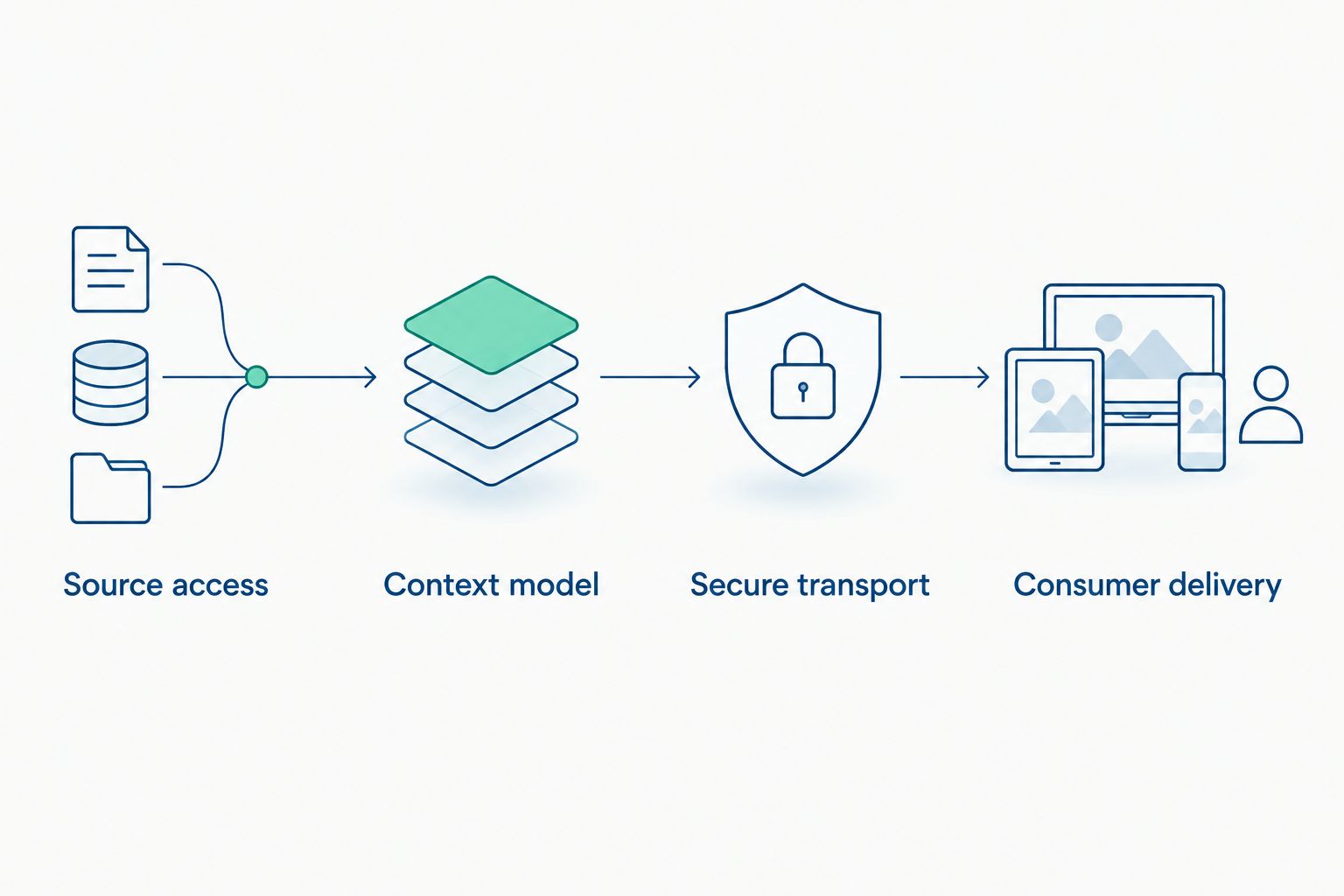
Assign ownership and acceptance criteria before choosing where each responsibility runs.
The plant-side boundary should expose approved data without making enterprise consumers dependencies of machine control. The enterprise-side boundary should provide consistent identities and meaning without silently rewriting source behavior. Review each connection in both normal operation and failure conditions.
1. Define the operational decision and pilot scope
Start with a worksheet linking each required measurement to a decision, owner, and acceptance test. Use a spreadsheet and existing configuration exports before introducing another application. A narrowly defined pilot exposes disagreements about meaning before those disagreements become deployed mappings.
For an initial exercise, select 1 production line at each of 2 plants. Treat that scope as a recommended validation boundary, not a statement about platform capacity. Choose comparable operations with different source configurations so the pilot tests normalization rather than merely duplicating an existing connection.
- Name the operational decision and its accountable owner.
- List the measurements required to support that decision.
- Identify source systems and approved access methods.
- Record acceptable data age for each consumer.
- Define who signs off on the pilot result.
2. Inventory sources and protect local control
Document the existing path from sensor to controller, SCADA, historian, and downstream application. Begin with configuration exports and network diagrams; confirm the drawings against the deployed environment. Do not assume a protocol label identifies the implemented security configuration or supported data behavior.
For the 2026 deployment baseline, record software versions, endpoint identities, service accounts, and certificate ownership. Review whether additional consumers create additional source requests. Keep production control independent of enterprise analytics and reporting connections.
- Record protocols, endpoints, and required read permissions.
- Identify existing collection paths before adding new ones.
- Document source timestamp and quality behavior.
- Separate data-consumption requirements from write requirements.
- Identify shutdown, maintenance, and change-approval constraints.
3. Define the data contract before mapping tags
Create a versioned data contract using a worksheet or schema file. Specify asset identity, measurement meaning, units, timestamps, quality, and transformation rules. An enterprise name should identify a stable business meaning rather than reproduce a controller address that changes during maintenance.
Software Toolbox's DataOps portfolio includes N3uron and Cogent DataHub, while TOP Server and OPC Router sit within its industrial connectivity offering. Evaluate those named products against the contract and required interfaces; do not infer capabilities from their category labels. A configured platform is the faster path only when it reduces repeated mapping work without obscuring the rules.
- Define stable site, area, asset, and measurement identifiers.
- Preserve source identity alongside normalized identity.
- Specify engineering-unit conversions and rounding rules.
- Distinguish source timestamps from ingestion timestamps.
- Define treatment of bad, uncertain, and missing values.
- Version the contract and document compatibility expectations.
4. Specify trust boundaries and connection ownership
Draw each permitted connection manually before configuring it. Show where the connection originates, which identity it uses, which boundary it crosses, and which team owns its lifecycle. An OPC UA endpoint, MQTT connection, or database interface needs an explicit security design; the protocol name is not an approval.
For a 2026 security review, include certificate renewal, account rotation, configuration backup, and service recovery. If your architecture uses a DMZ, document the permitted exchanges rather than treating the DMZ itself as evidence that the design is secure.
- Specify allowed endpoints and connection direction.
- Assign least-privilege identities to collection and delivery.
- Document certificate trust and renewal responsibilities.
- Keep write paths separate from read-only use cases.
- Record logging, patching, and remote-access requirements.
- Require approval for every network-boundary exception.
5. Define disconnected operation and recovery
Write the failure behavior in plain language before evaluating implementation features. Decide what happens when a source disconnects, a destination stops accepting data, or a site loses its enterprise connection. Buffering, replay, duplicate handling, and ordering are separate requirements, not one recovery checkbox.
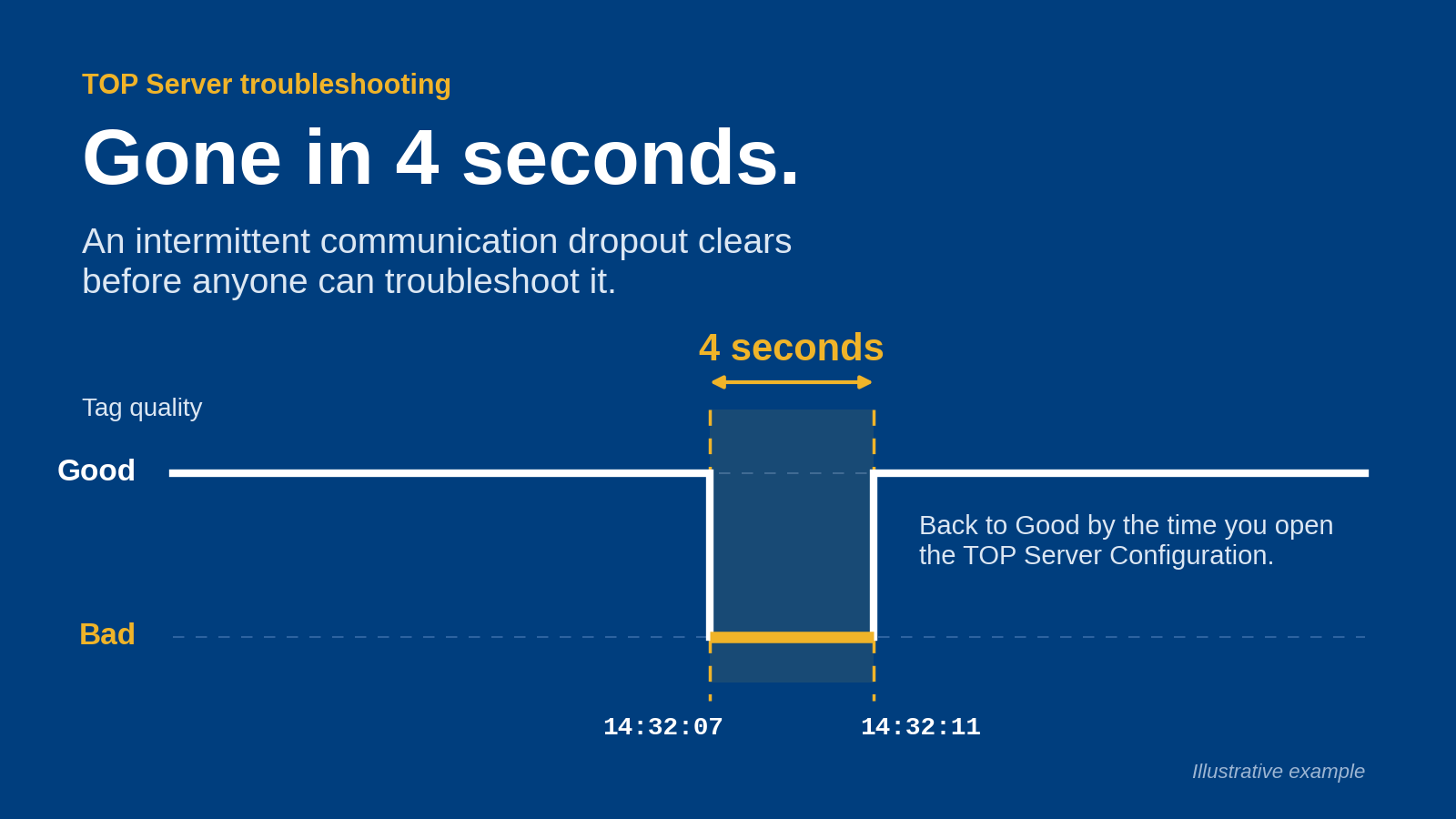
Require 3 failure tests in the pilot: source interruption, destination interruption, and service restart. These are prescribed tests, not performance claims. Check the proposed configuration against each test rather than assuming a feature name guarantees the result.
- Specify which measurements require retained history.
- Define what consumers see when values become stale.
- Document buffer location and exhaustion behavior.
- Specify duplicate detection and replay expectations.
- Confirm timestamp preservation through recovery.
- Record recovery evidence and unresolved exceptions.
6. Validate the complete path under representative load
Start with existing diagnostic logs and controlled test subscriptions. Measure the path from source acquisition through transformation to the consuming application. Separate source sampling, publication, transport, and consumer processing; a destination timestamp alone does not identify where delay occurred.
Use the actual data contract and intended consumer behavior during the pilot. A value-only test does not validate quality handling, asset identity, or recovery. For your 2026 acceptance record, retain configuration versions and test conditions so another engineer can reproduce the result.
- Check normalized values against the source readings.
- Verify units, quality, identity, and timestamps together.
- Observe source-system load during collection.
- Test reconnect behavior with consumers attached.
- Confirm alarms distinguish stale data from healthy inactivity.
- Obtain sign-off from operations, OT, and cybersecurity.
7. Package the deployment for repeatable plant onboarding
Begin with a controlled configuration repository, deployment checklist, and rollback procedure. Separate shared schema rules from site-specific addresses and credentials. Copying a working configuration without separating those concerns transfers local assumptions into the next plant.
Evaluate platform configuration and deployment functions against that onboarding process. For the 2026 rollout, approve a reusable template only after the pilot demonstrates both normal delivery and recovery. A repeatable deployment includes ownership, monitoring, and change control—not just installation instructions.
- Maintain a shared contract with site-specific mappings.
- Store credentials outside shared configuration exports.
- Record configuration versions and approval history.
- Define rollback conditions before production changes.
- Assign ownership for source changes and consumer requests.
- Revalidate mappings after equipment or firmware changes.
Compare deployment options by operational responsibility
Choose the simplest architecture that meets your data contract and failure requirements. The options below compare implementation approaches, not competing vendors. Each approach still requires validation against the actual source systems, security rules, and consuming applications.
Existing historian integration
- Best for: Historical analysis using data already collected
- Main advantage: Starts with an established collection path
- Key limitation: Does not by itself establish a cross-plant semantic contract
Custom integration scripts
- Best for: Narrow, explicitly bounded transformations
- Main advantage: Gives engineers direct control over transformation logic
- Key limitation: Your team owns testing, dependencies, recovery, and maintenance
Site-local DataOps layer
- Best for: Plants needing local mapping and independently managed connections
- Main advantage: Places integration responsibility close to the source
- Key limitation: Requires configuration governance across sites
Central integration layer
- Best for: Normalizing data already exposed through approved plant interfaces
- Main advantage: Concentrates shared mapping and consumer delivery
- Key limitation: Depends on the agreed plant interfaces and network paths
Hybrid site and central layers
- Best for: Programs needing local source handling and shared enterprise definitions
- Main advantage: Separates plant-specific integration from shared consumption
- Key limitation: Requires clear boundaries to avoid duplicated transformations
An existing historian is a valid starting point when its exposed data satisfies the use case. Custom scripts are a valid choice when the integration is narrow and ownership is explicit. Neither choice removes the need to document semantics and recovery.
A hybrid architecture is appropriate when local integration and enterprise distribution have different owners or failure requirements. Its disadvantage is coordination: two layers can apply conflicting conversions or duplicate buffering unless responsibilities are explicit.
Evaluate product fit without assuming feature parity
Put the requirements matrix ahead of the product demonstration. For N3uron and Cogent DataHub, request evidence against the required DataOps responsibilities. For TOP Server and OPC Router, evaluate their role in the proposed connectivity design. Do not assume the products are substitutes or that every deployment needs all of them.
Ask Software Toolbox to map the proposed components to your architecture and identify which requirements remain outside the proposed scope. The advantage of evaluating connectivity and DataOps together is a single requirements discussion across both categories; the limitation is that a portfolio alone does not establish compatibility for your configuration.
- Require interface confirmation for the specific versions involved.
- Ask where transformations execute and who maintains them.
- Require a demonstration of the agreed failure tests.
- Separate included functions from additional components.
- Document installation, administration, and ongoing ownership.
Discuss your industrial DataOps architecture
Bring your source inventory, security boundaries, and acceptance tests to the requirements discussion.
Common mistakes multi-plant teams make
Standardizing names without standardizing meaning
A shared tag hierarchy does not resolve different units, calculation methods, or equipment states. Approve measurement definitions before approving enterprise mappings. Keep exceptions visible rather than forcing unlike processes into identical labels.
Treating transport as context
Moving values through OPC UA or MQTT does not establish the business meaning your consumers require. Define the payload and metadata contract independently of the chosen transport, then test that the deployed path preserves both.
Adding enterprise consumers directly to every source
Separate consumer access from controller configuration wherever the approved architecture supports that separation. Otherwise, each new reporting or analytics request becomes another plant-side change. Review collection ownership and source load before expanding access.
Testing healthy operation but not stale data
A connected dashboard can still display an old value. Verify how the consuming application identifies stale, bad-quality, and replayed measurements. A successful reconnection is not proof that the application interpreted recovery correctly.
Assigning ownership only during installation
Mappings change when equipment, recipes, firmware, and reporting requirements change. Name the operational owner for each shared definition and escalation path. Without that ownership, a technically functioning interface can distribute an obsolete interpretation.
FAQ
What is an industrial dataops platform?
An industrial dataops platform connects industrial data sources, applies agreed context and transformations, and distributes data to consuming applications. Evaluate its fit through your interface, security, semantic, and recovery requirements.
Do I need an industrial dataops platform if I already have a historian?
A historian does not automatically create a need for another platform. First check whether its exposed data, context, interfaces, and recovery behavior satisfy the cross-plant use case; add another layer only for documented gaps.
Should each plant have its own DataOps deployment?
Use a plant-local deployment when your requirements call for local integration ownership or independent operation during enterprise disconnection. Central and hybrid designs are also valid when their boundaries and failure behavior meet the requirements.
Is OPC UA or MQTT better for unifying sensor data?
Neither protocol alone unifies sensor meaning across plants. Select the transport against endpoint support and security requirements, then define the asset identities, units, quality, and timestamps that consumers need.
Where should I start with N3uron and Cogent DataHub?
Start by mapping N3uron and Cogent DataHub to a written requirements matrix. Confirm the proposed versions, interfaces, deployment arrangement, and recovery behavior before choosing a component.
How do I test a multi-plant DataOps pilot?
Test source interruption, destination interruption, and service restart alongside normal data delivery. Verify the consuming application's values, metadata, stale-data handling, and recovery interpretation, not just connection status.
Can I use industrial data for AI agents after connecting it?
Connectivity alone is not an acceptance criterion for an industrial AI use case. Define data meaning, access permissions, intended actions, and approval boundaries before exposing operational data to an agent.
One last thing
Treat a unit change as a data-contract change, not a cosmetic edit. A correctly transported value with the wrong engineering unit is still wrong for the consumer. Add a deliberate unit-mismatch test to the pilot and require the system to expose the mismatch rather than silently accepting it.