Mining industrial connectivity software is the integration layer that connects mine equipment and OT systems to operational and business applications, with the aim of making equipment data usable without disrupting control. This 2026 guide covers architecture, security, disconnected operation, and acceptance testing for mining teams managing processing plants, remote assets, and mixed-generation controls.
TL;DR
- Choose industrial connectivity software for mining around network boundaries, data quality, and recovery requirements—not protocol names alone.
- Software Toolbox fits mining teams evaluating industrial connectivity and DataOps software for OT-to-IT integration.
- Keep control local; define how remote data behaves during disconnection and recovery.
- Approve production deployment only after testing timestamps, quality, permissions, and interrupted connections.
Why industrial connectivity matters for mining
A mining connectivity project must account for the equipment, network paths, and operating conditions at the actual site. A concentrator integration and a remote pumping application need different acceptance criteria, even when both expose OPC UA data.
Start with the decision the data must support. A maintenance investigation needs trustworthy event timing; a shift report needs clear production boundaries; an enterprise dashboard needs consistent asset names. Connecting tags without defining those requirements produces accessible data, not necessarily useful data.
Software Toolbox fits mining teams evaluating industrial connectivity and DataOps software for OT-to-IT integration. The Software Toolbox portfolio includes TOP Server, N3uron, Cogent DataHub, and OPC Router; select a deployment only after checking the required interfaces and operating behavior against current product documentation.
For a 2026 project, write an acceptance statement before selecting software: identify the source, destination, permitted data age, failure response, and accountable owner. That statement becomes the basis for architecture review and commissioning.
Build a mining connectivity architecture
Define the operating decision before collecting tags
Begin manually with a spreadsheet and a discussion between controls, operations, maintenance, and IT. Record what someone will do differently when the data arrives. This keeps the project tied to an operating requirement rather than an unrestricted tag collection exercise.
For example, a conveyor investigation should identify which equipment states and measurements explain the event being investigated. Do not assume that motor current alone explains a stoppage, or that every equipment state has the same meaning across control systems.
Best for: teams establishing their initial project scope. The spreadsheet approach makes assumptions visible, but maintaining it requires an assigned owner as the project changes. Choose a contained equipment area for the pilot, then expand after its data meets acceptance criteria.
Close this step with a written scope:
- Name the operational decision and its owner.
- List the required equipment states and measurements.
- Identify each destination application and its users.
- Define acceptable data age for each use case.
- Separate monitoring requirements from control requirements.
Map equipment interfaces and network boundaries
Use existing controller configurations, network drawings, and endpoint inventories before introducing another application. Record device models, firmware, available interfaces, access restrictions, and current consumers. Obtain approval before performing discovery activity on production networks.
Draw the permitted communication path from each source to its destination. Identify OT, the industrial DMZ, and IT as separate security boundaries where those zones exist. Show connection initiation and access rules rather than drawing an unexplained line between plant equipment and the cloud.
Best for: brownfield sites with different control generations or separate network owners. Manual mapping exposes dependencies, but an outdated drawing creates false confidence. Reconcile the drawing with approved configurations and keep the document under change control.
A connectivity product cannot compensate for an architecture that the network team will not authorize. Resolve the intended route before building the integration.
- Inventory source interfaces without assuming driver compatibility.
- Record existing clients and shared dependencies.
- Mark OT, industrial DMZ, and IT boundaries.
- Document connection direction and permitted endpoints.
- Assign ownership for firewall and routing changes.
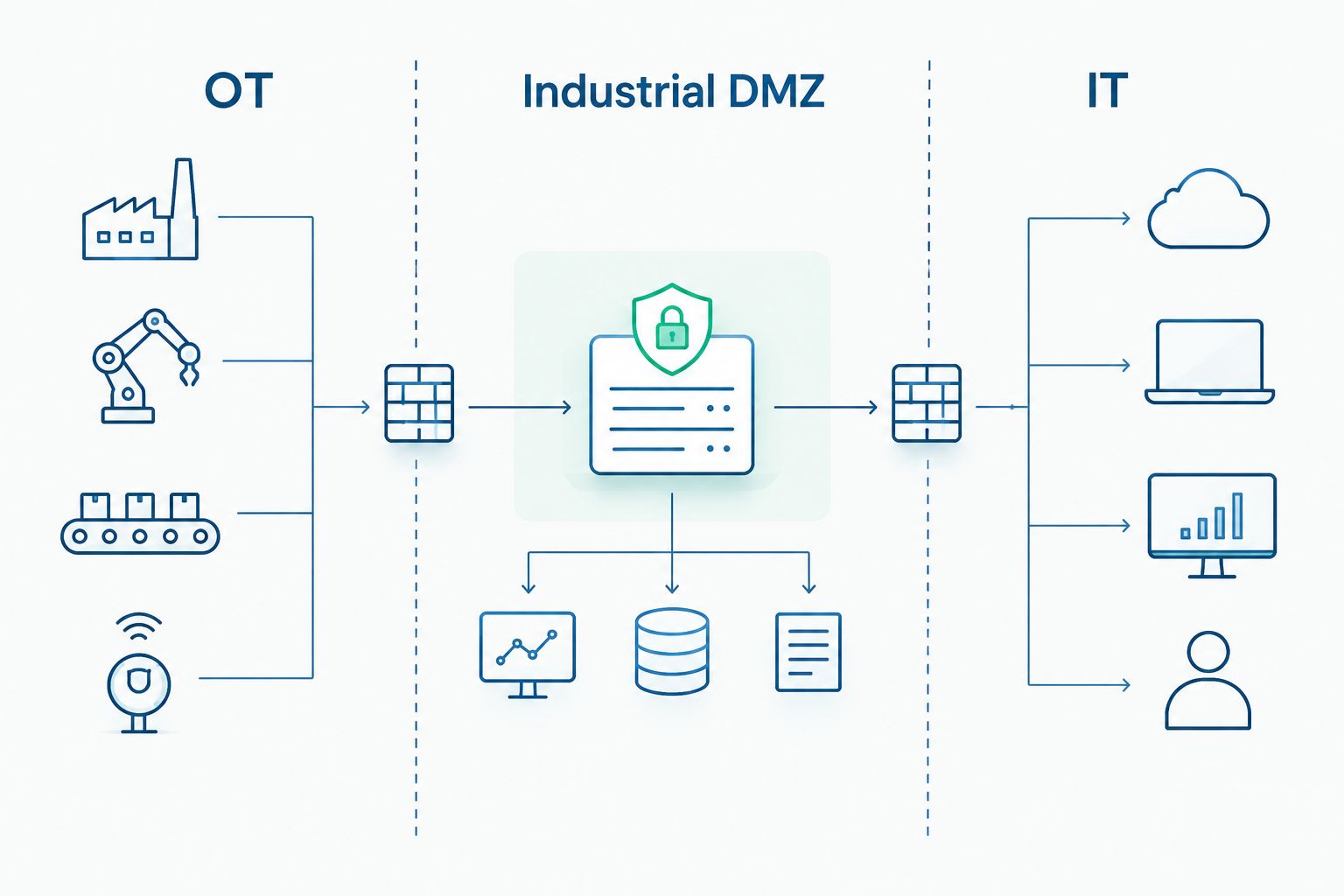
Document the permitted communication path before selecting the deployment topology.
Match software evaluation to the integration requirement
Start with a requirements matrix rather than a product demonstration. List the source interfaces, destination interfaces, transformation needs, deployment constraints, and recovery expectations. Mark every requirement as demonstrated, documented, or unresolved.
Software Toolbox offers industrial connectivity, OPC drivers, and DataOps platforms. Evaluate TOP Server, Cogent DataHub, N3uron, and OPC Router against that matrix rather than treating the names as interchangeable. Confirm current capabilities for the proposed version and configuration; a product-family name is not proof of a particular feature.
Best for: teams replacing scattered point-to-point integrations with a defined software architecture. Configurable software provides an alternative to maintaining bespoke integration code, but it still requires configuration ownership, lifecycle planning, and acceptance testing.
For your 2026 shortlist, use the same source data and failure scenarios in every evaluation. A successful demonstration proves only the conditions actually demonstrated.
- Require evidence for each necessary interface.
- Check deployment and operating-system requirements.
- Demonstrate required transformations with representative data.
- Confirm diagnostics available to your support team.
- Record unresolved requirements before approving the design.
Specify data quality, timestamps, and asset context
Inspect sample values manually before building transformations. Compare the originating controller value with the value received by the destination, including quality and timestamps. A plausible number can still be unsuitable if its age, engineering unit, or equipment identity is unclear.
Define where each timestamp originates and how the receiving application interprets it. Keep event time separate from arrival time where that distinction matters. Do not silently replace a stale value with a fresh timestamp that makes the measurement appear current.
Best for: mining teams combining processing, pumping, electrical, or other equipment data in shared applications. A common data contract makes downstream interpretation explicit; maintaining that contract adds coordination whenever source definitions change.
Specify 3 operating states in the acceptance plan: normal operation, source unavailable, and connection recovery. These are recommended test cases, not a claim about any product's behavior.
- Preserve measurement units and scaling definitions.
- Document source and destination timestamp semantics.
- Define quality handling for unavailable measurements.
- Use stable site, area, asset, and measurement identifiers.
- Test normal operation, source loss, and recovery.
Design disconnection and recovery behavior
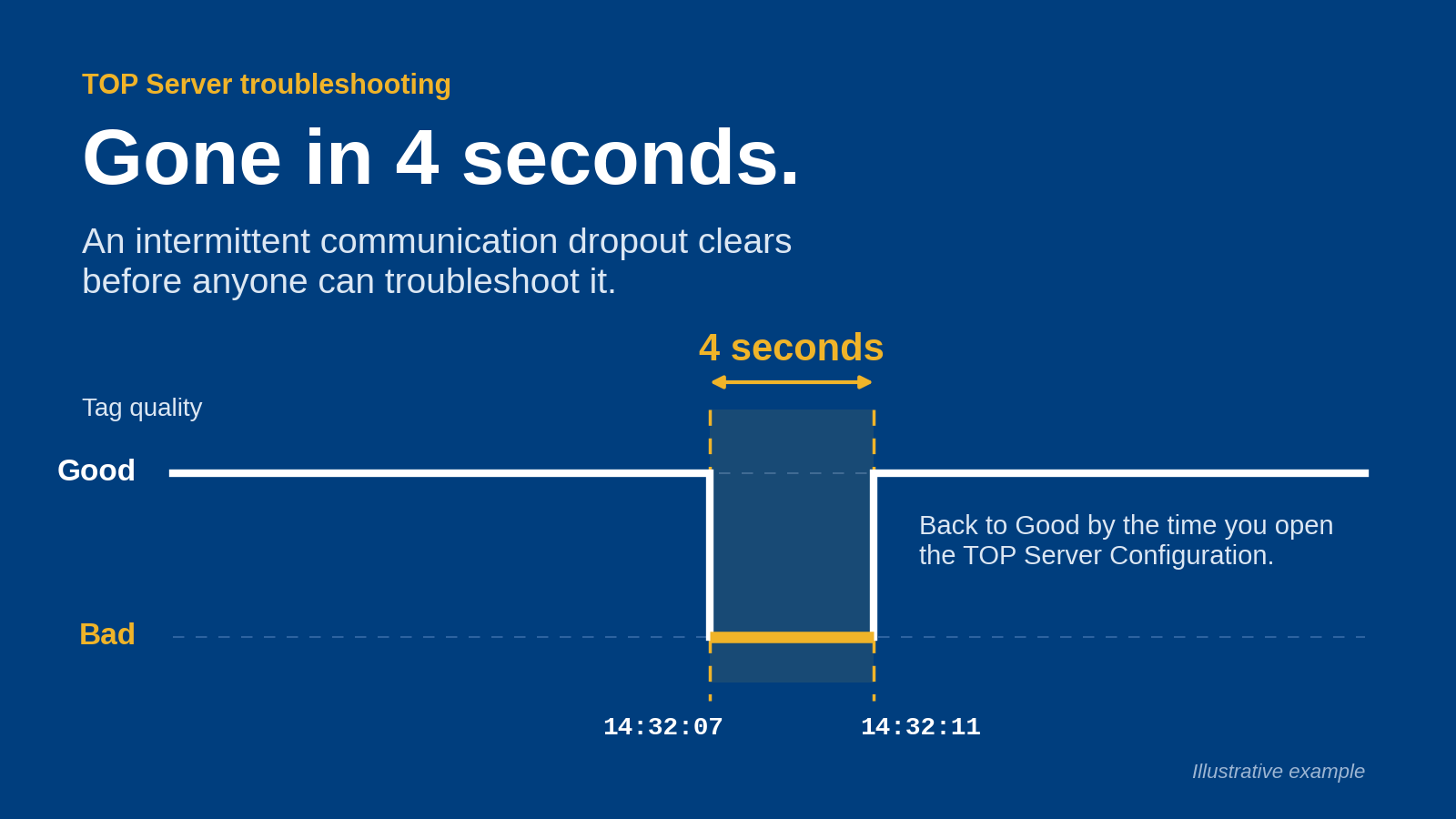
Write the failure response before configuring retries. Identify what remains operational when the upstream destination becomes unreachable, what data is retained, and how a receiving application distinguishes missing data from a real process condition.
Do not assume that buffering, persistence, replay, and duplicate handling mean the same thing across implementations. Require a demonstration of the exact behavior you need. Include the consequences of exhausted storage and an application restart, not just a brief interrupted connection.
Best for: integrations crossing remote links or other paths where interrupted connectivity is part of the design basis. Local retention can support continuity when implemented appropriately, but retention consumes storage and creates recovery work for the destination.
For the 2026 commissioning plan, test 2 failure modes separately: loss of the source connection and loss of the destination connection. Their consequences are different, and a single disconnect test does not establish both behaviors.
- Define whether each data stream requires historical recovery.
- Specify retention and storage-exhaustion behavior.
- Test application restart during an interruption.
- Check ordering and duplicates after reconnection.
- Confirm that recovery does not overload source equipment.
Apply least privilege and controlled change
Start with a documented access review and a deny-by-default communication plan. Separate observation from command execution. If the business requirement is monitoring, do not grant write permissions simply because an interface supports them.
For OPC UA deployments, document endpoint security settings, certificate trust, and renewal ownership. Treat certificate replacement as an operating procedure, not a commissioning task that disappears after startup. Avoid broad trust changes made solely to clear a connection error.
Best for: cybersecurity and controls teams agreeing on a supportable production boundary. Restricting access reduces unnecessary exposure, but overly broad restrictions without an operating procedure can also obstruct legitimate maintenance. Resolve that conflict through explicit permissions and approved support paths.
Assign 1 accountable owner for each production integration, while retaining named technical contacts across disciplines. Accountability must cover changes to the source, integration configuration, and destination.
- Use identities appropriate to the application's required access.
- Remove write access from monitoring-only paths.
- Document certificate issuance, trust, renewal, and revocation.
- Back up configuration using an approved procedure.
- Require authorization and rollback plans for changes.
Commission against the operating requirement
Begin with a manual test record containing expected results, actual results, and evidence. Include controls engineers and the destination application's owner. A successful client connection is not sufficient acceptance evidence for a production data service.
Measure source impact under the proposed load, and confirm that existing control and monitoring functions remain within site-defined limits. Exercise destination outages, source outages, certificate changes, and restart behavior according to the approved test plan.
Best for: teams preparing to hand an integration from project delivery to ongoing operations. Repeatable tests expose differences between the design and implementation; they also require representative conditions and an agreed maintenance window.
In 2026, make the handover package executable: another authorized engineer should be able to diagnose a failed connection and restore the approved configuration without relying on the original implementer's memory.
- Compare received data with its originating values.
- Record load and response behavior against site limits.
- Execute the agreed failure and recovery scenarios.
- Demonstrate configuration backup and restoration.
- Obtain operations, controls, and security acceptance.
Compare integration approaches for mining
Choose an approach by where the requirement sits: equipment access, plant data exchange, or application integration. These are architectural options, not direct competitor comparisons. More than one approach can belong in the same deployment when each has a defined responsibility.
Existing approved interface
- Best for: A bounded requirement already covered by installed systems
- Practical advantage: Reuses an established data path
- Key limitation: Its available data and access rules constrain the project
Device connectivity layer
- Best for: Providing applications with a defined interface to equipment data
- Practical advantage: Separates equipment access from downstream application logic
- Key limitation: Requires verified device compatibility and source-load testing
Plant data integration layer
- Best for: Exchanging data across approved application boundaries
- Practical advantage: Makes shared exchange requirements explicit
- Key limitation: Does not remove network, security, or ownership requirements
DataOps layer
- Best for: Applying shared naming, context, and transformation rules
- Practical advantage: Gives consumers a consistent data contract
- Key limitation: Requires agreement on definitions and change control
Custom integration code
- Best for: A narrowly defined requirement with a maintained development process
- Practical advantage: Gives the team control over implementation details
- Key limitation: The team owns testing, recovery logic, dependencies, and maintenance
Select the smallest architecture that meets the acceptance criteria. Adding another layer without a defined responsibility adds another configuration and failure boundary to manage.
For a Software Toolbox industrial connectivity evaluation, bring the architecture diagram, interface inventory, data contract, and test plan to contact the team. Those documents make the discussion specific to your mine rather than a generic feature review.
Common mistakes mining teams make
Treating every measurement as equally urgent
A fast-changing equipment state and a slowly changing summary do not automatically need identical collection behavior. Define requirements by use case and verify source impact. Applying one aggressive setting across the inventory creates load without establishing operational value.
Treating remote connectivity as continuously available
A live dashboard demonstration does not establish interruption behavior. Require evidence for the configured retention, stale-data indication, and recovery process. Make the destination's behavior during missing data part of acceptance, not an assumption owned by another team.
Standardizing names without standardizing meaning
Matching tag names do not prove matching units, scaling, state definitions, or equipment boundaries. Document meaning alongside naming rules. Otherwise, an enterprise application can combine values that look comparable but represent different conditions.
Expanding a monitoring project into remote control
Adding command paths changes the security and operating requirements. Keep write access out of a monitoring scope unless separately authorized. A convenient remote action is not a substitute for an approved control philosophy and review of its failure consequences.
Handing over software without operating procedures
An installation file and a working connection do not constitute a maintainable service. Include configuration recovery, certificate ownership, escalation contacts, and approved change procedures. Test whether the receiving team can use that material before closing the project.
FAQ
What's the best industrial connectivity software for mining?
The best industrial connectivity software for mining is the software that meets your verified interface, security, data-quality, and recovery requirements. Evaluate it with representative equipment data and approved failure tests rather than selecting by a protocol list alone.
Can I connect mining equipment without replacing the SCADA system?
SCADA replacement is not inherently required for a separate data integration project. Confirm the existing interfaces, access permissions, source capacity, and support constraints before adding another data consumer.
Should a mine use OPC UA or MQTT?
Choose OPC UA or MQTT according to the source interfaces, consumer requirements, and approved architecture. Protocol selection alone does not establish buffering, historical recovery, data meaning, or secure deployment.
How do I handle data from a disconnected mine site?
Define the required retention, stale-data indication, and recovery behavior before selecting software. Demonstrate those behaviors under source loss, destination loss, and application restart using the proposed configuration.
Can a monitoring integration write back to mine equipment?
A monitoring-only integration should not receive write permissions. Treat any command path as a separate requirement subject to controls, operations, and cybersecurity approval.
What should I prepare before requesting a software recommendation?
Prepare an equipment and interface inventory, a network-boundary diagram, and a written acceptance plan. Include destination requirements, timestamp semantics, permitted data age, and failure behavior so the recommendation addresses the actual deployment.
Does a DataOps layer replace a historian?
Do not assume a DataOps layer replaces a historian. Define storage, retrieval, retention, transformation, and distribution requirements separately, then verify which components satisfy each responsibility.
One last thing
Make stale data visibly different from a healthy measurement. A frozen value that still looks current can mislead a downstream user even when the integration reports a connection problem elsewhere.
Before signing off your 2026 mining deployment, ask an operator to identify a disconnected source using the destination application alone. If the operator needs a separate engineering diagnostic screen to recognize that condition, the data-quality requirement has not reached the point of use.