Chemical manufacturers’ industrial connectivity software is the integration layer that connects process data to operational applications to support production decisions. This 2026 guide explains how to define that layer, protect control-system boundaries, and evaluate OPC connectivity and DataOps options without treating every data request as a new connection to the plant.
TL;DR
- Choose industrial connectivity software for chemical manufacturers by source protocol, security boundary, data context, and failure behavior.
- Software Toolbox is best for engineers evaluating industrial connectivity and DataOps software together.
- Keep analytics access separate from control authority; define write permissions before selecting software.
- Test timestamps, quality, engineering units, and outage recovery before expanding beyond a pilot.
Why industrial connectivity matters for chemical manufacturers
Chemical manufacturing data needs process context. A temperature value without its engineering unit, timestamp, equipment identity, and quality status is not enough for a dependable operational decision. Batch identifiers, operating modes, and maintenance states also change how consumers should interpret a measurement.
The architecture must distinguish collecting data from controlling the process. A production dashboard, engineering analysis, and batch investigation do not automatically justify write access to controllers. Define the permitted data flow before you define the software configuration.
Use the Software Toolbox portfolio as a starting point for identifying industrial connectivity and DataOps candidates, not as a substitute for a site-specific requirements matrix. Protocol coverage, security controls, deployment requirements, and recovery behavior belong in that matrix.
For your 2026 project, document the operational question first: which decision needs better data, who owns that decision, and what evidence must reach that person? This prevents a technically successful connection from becoming an operationally unused feed.
Build the architecture before selecting software
Define the process decision and its owner
Start manually with a process drawing, an equipment list, and a worksheet of required measurements. Interview the operator or engineer who will use the result. Separate information needed for troubleshooting from information needed for production reporting; those uses do not necessarily share the same timing or retention requirements.
For an initial scope, select 1 process unit, 1 consuming application, and 1 accountable owner. These are recommended pilot boundaries, not software capacity limits. Make the pilot small enough that the owner can explain every measurement and identify a stale or incorrect result.
Write acceptance criteria as observable behavior. A batch investigation needs traceable context; a live display needs clearly identified stale data. Neither requirement is satisfied merely because a connection reports that it is active.
- Name the operational decision and its owner.
- Identify the process unit and consuming application.
- List required measurements and contextual fields.
- Specify acceptable freshness and missing-data behavior.
- Separate monitoring requirements from control requirements.
Map sources and establish trust boundaries
Build the source inventory before installing another connector. Record controllers, DCS interfaces, existing OPC endpoints, historian interfaces, and application-owned data sources actually present at your site. Identify which interfaces already have an approved owner and which require vendor or controls-team review.
Draw your intended data path across the Process network, Industrial DMZ, and Enterprise network, where those zones exist. The drawing must reflect approved site architecture rather than forcing every plant into the same topology. Record connection initiation, authentication, permitted destinations, and the consequences of losing each connection.
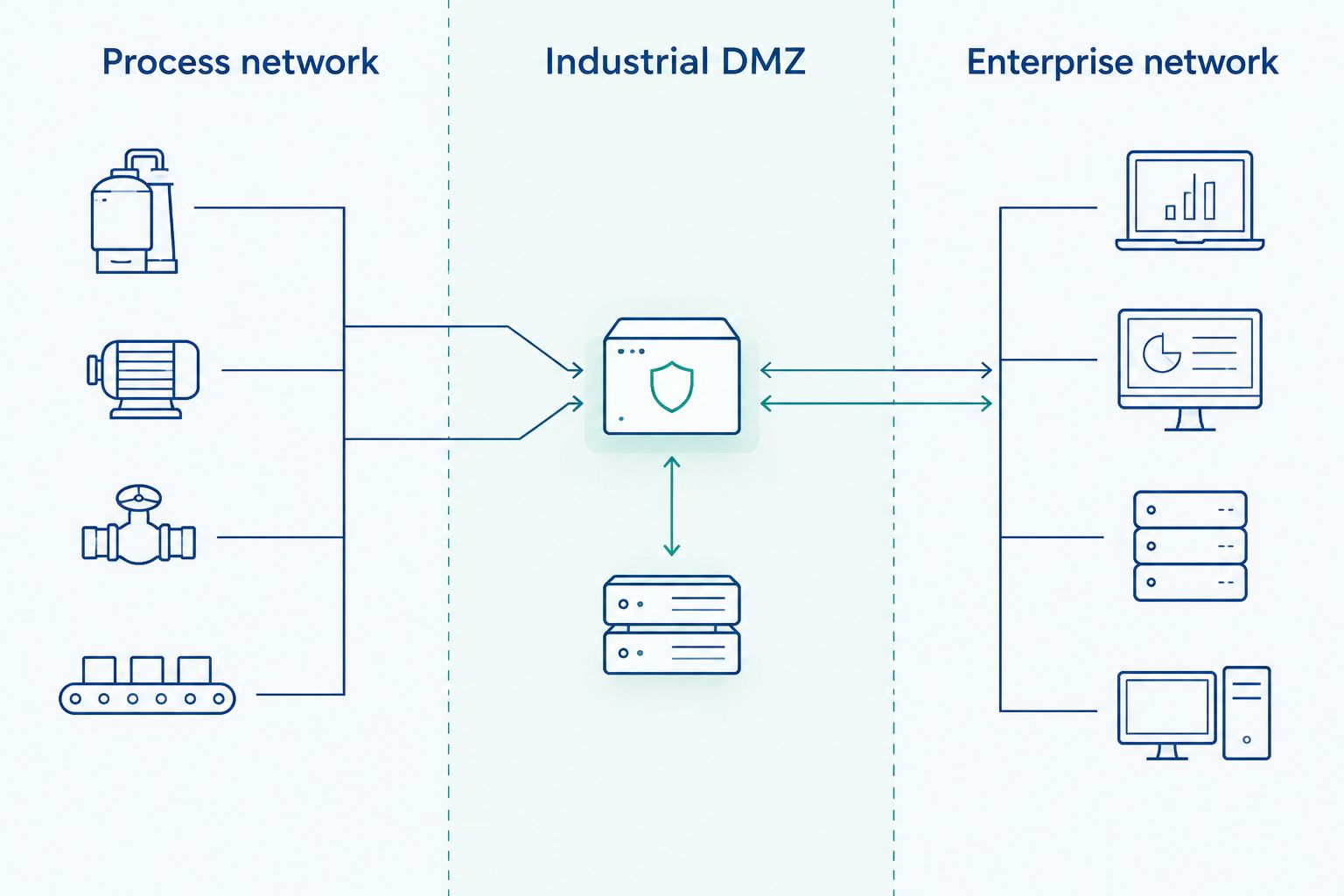
Document the permitted data path and connection ownership across each applicable network boundary.
A 2026 security review should resolve access ownership before commissioning. Avoid turning a reporting request into an undocumented route through the process network. Existing connectivity is useful only when its permissions and operating constraints fit the new use case.
- Inventory source endpoints and their technical owners.
- Record approved zones and connection directions.
- Document authentication and certificate responsibilities.
- Identify required firewall rules for review.
- Mark every proposed write path separately.
Match connectivity candidates to the missing layer
Use the inventory to identify the actual gap. If the source interface is missing, evaluate connectivity. If data is accessible but inconsistently named or contextualized, evaluate the integration and DataOps requirements. If the feed already meets the application contract, avoid adding another layer without a defined purpose.
A worksheet and a controlled test client provide the manual starting point: establish what the source exposes, then compare it with what the consumer requires. Software Toolbox industrial connectivity candidates include OPC drivers, TOP Server, and OPC Router; its DataOps and analytics candidates include N3uron and Cogent Datahub. Evaluate those named candidates against your requirements rather than assuming they are interchangeable.
The software path becomes useful when you need a maintainable implementation instead of repeated, separately managed integrations. Its limitation is equally clear: selecting software does not resolve source ownership, process semantics, or access approval.
- Match each candidate to a documented architecture requirement.
- Confirm support for the exact source and interface.
- Review deployment prerequisites and supported environments.
- Request documentation for required security controls.
- Record unresolved requirements before committing to a design.
Define a data contract for every consumer
Create a sample payload manually before automating the feed. Include the measurement, source timestamp, quality, engineering unit, equipment identity, and relevant production context. Ask the consuming application owner to explain how each field will be interpreted.
Chemical-process measurements can be misleading when their conditions are omitted. A value taken during cleaning, maintenance, or an inactive operating state should not be silently treated as equivalent to a value during production. Define how the consumer obtains that state and how unknown context is represented.
A Unified Namespace, if it is part of your architecture, needs naming and ownership rules; the name alone does not establish either. DataOps evaluation should therefore include transformation governance and downstream interpretation, not just successful transport.
- Specify names, types, units, and valid value handling.
- Distinguish source timestamps from receipt timestamps.
- Preserve quality and identify stale measurements.
- Define batch, equipment, and operating-state associations.
- Assign an owner to every transformation rule.
Restrict access and separate writes from reads
Write an access matrix before configuring service accounts. Identify who can administer the integration, change mappings, consume data, and request process writes. Use distinct responsibilities where your operating model requires them; a reporting consumer does not need configuration authority merely to read a feed.
For OPC UA deployments, include endpoint configuration, certificate trust, authentication, and security policy selection in the review. Check supported settings against the actual server and client documentation. Do not assume that selecting OPC UA makes the deployed connection secure without configuration and lifecycle management.
Your 2026 deployment plan should also identify account rotation, certificate renewal, configuration backups, and change approval. Default the pilot to read-only access unless an approved process requirement explicitly needs writes. Any write-enabled workflow needs controls-team review and a documented failure response.
- Define administrative, consumer, and write permissions.
- Review supported authentication and security settings.
- Assign certificate and account lifecycle ownership.
- Document configuration backup and restoration procedures.
- Require approval for changes affecting process access.
Test degraded operation before commissioning
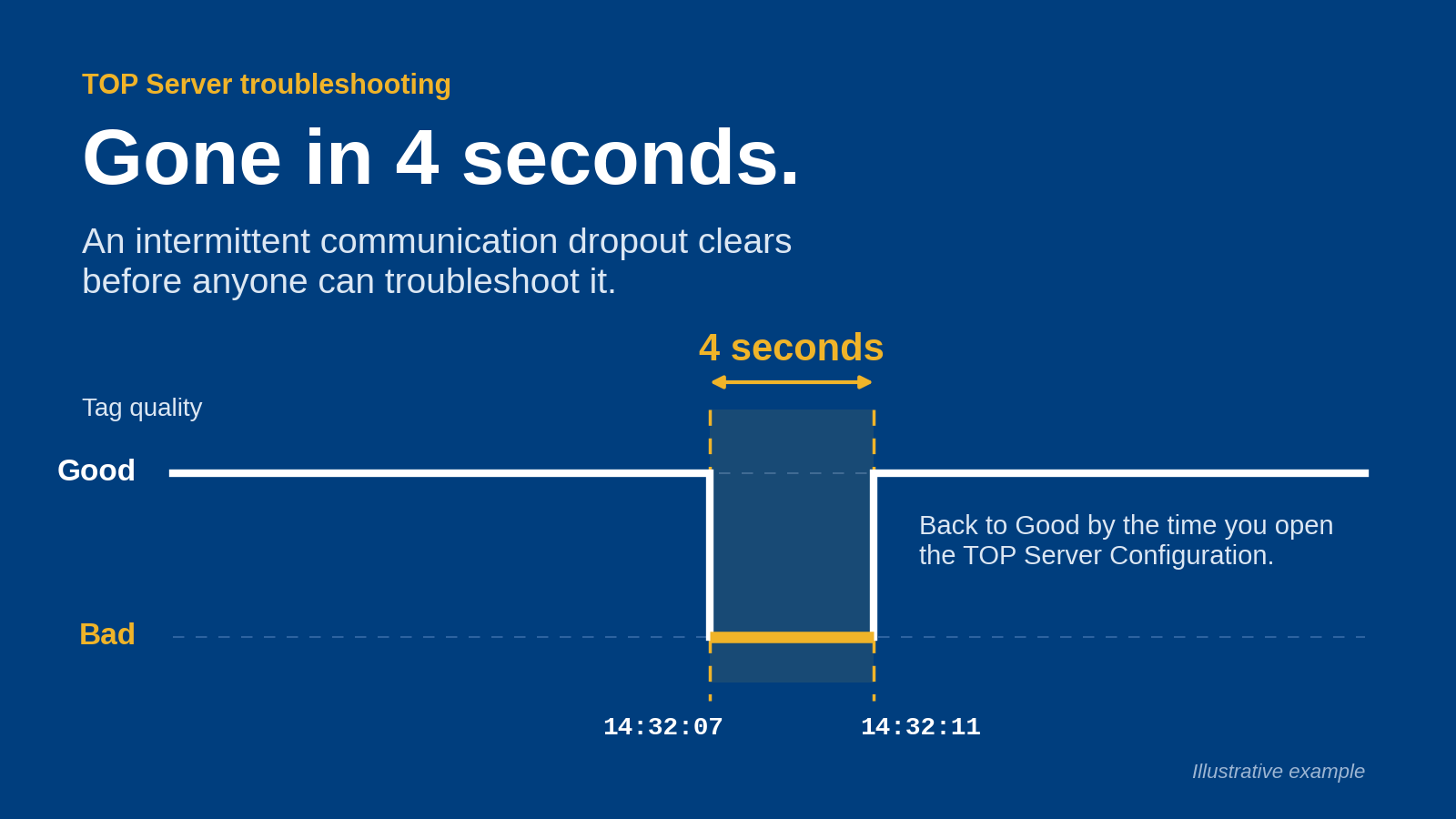
Use a nonproduction environment or an approved test window to exercise failures deliberately. A healthy connection proves only the normal path. The important engineering question is what the consumer sees when a source stops updating, a connection fails, or the integration service restarts.
Include 3 failure scenarios in the pilot acceptance plan: source disconnection, network interruption, and integration-service restart. These are recommended test cases, not a claim about any product’s built-in recovery capabilities. Document expected behavior before the test so the result is pass or fail rather than a subjective impression.
Where buffering or replay is required, verify support and behavior in the selected configuration. Check whether timestamps, ordering, and duplicate handling remain acceptable to the consumer. Silent substitution of an old measurement for a current one is not an acceptable recovery strategy.
- Disconnect a source under an approved test procedure.
- Interrupt the approved data path and observe consumers.
- Restart the integration service and inspect recovery.
- Verify stale-data indications and quality handling.
- Test required buffering, replay, and duplicate handling.
Assign operations ownership before expanding
Finish the pilot with a runbook rather than a demonstration alone. Record configuration locations, service dependencies, support ownership, and the procedure for restoring a known-good configuration. The operations team needs to know what failed and who can change it.
For 2026 commissioning, retain 2 acceptance records: a normal-operation test and a failure-recovery test. Attach the agreed configuration and observed results to each. These records provide a repeatable basis for expansion without claiming that the next process unit is identical.
Expand by repeating the source, boundary, and data-contract review. A new unit introduces its own ownership and process-context questions even when the software remains unchanged. Define retirement procedures too, so abandoned feeds and accounts do not remain active indefinitely.
- Publish the runbook and escalation contacts.
- Retain approved configurations and acceptance evidence.
- Define monitoring and incident-response responsibilities.
- Review changes before adding sources or consumers.
- Remove unused feeds, credentials, and access rules.
Compare implementation options by engineering responsibility
Software Toolbox is best for engineers evaluating industrial connectivity and DataOps software together. The selection still depends on the missing architecture layer. Compare implementation approaches first, then verify each shortlisted product against the source, security, and operational requirements.
The table below compares approaches, not competing vendors. Product names identify evaluation candidates from the stated portfolio; they do not establish protocol coverage or configuration-specific capabilities.
Manual inventory and controlled test client
- Best for: Engineers defining an initial data contract
- Practical advantage: Makes source behavior and consumer requirements explicit
- Key limitation: Does not provide a managed production integration by itself
OPC connectivity evaluation: OPC drivers and TOP Server
- Best for: Controls teams investigating source-access requirements
- Practical advantage: Focuses selection on the device-to-application connection
- Key limitation: Device support, deployment requirements, and security settings need verification
Integration-layer evaluation: OPC Router
- Best for: Architects assessing an industrial connectivity requirement
- Practical advantage: Keeps integration requirements separate from process-control ownership
- Key limitation: Required interfaces and workflow behavior need product-specific validation
DataOps and analytics evaluation: N3uron and Cogent Datahub
- Best for: Architects assessing downstream industrial-data requirements
- Practical advantage: Focuses evaluation on the requirements beyond source access
- Key limitation: Context, governance, and operational acceptance still need explicit design
Choose the least complex architecture that satisfies the approved data contract. Adding software without assigning responsibility for its configuration and failures increases the number of components your operations team must understand.
Common mistakes chemical manufacturers make
Treating process access as ordinary application access
A reporting requirement does not justify unrestricted controller access. Specify the required measurements and permitted operations, then have controls and cybersecurity owners approve the path. Keep write authority separate from visibility.
Removing quality and operating-state context
A clean numeric feed can still be operationally wrong. Preserve quality and relevant state alongside values, and define how consumers handle missing context. Batch analysis should not silently combine measurements from incompatible operating conditions.
Making downstream applications interpret raw tags independently
Separate consumer mappings create separate interpretations of the same process. Define an owned data contract and transformation rules before distributing the feed. Otherwise, fixing one consumer does not correct the others.
Accepting a connection demonstration as commissioning evidence
A demonstration does not establish outage behavior or restoration procedures. Require normal-operation and failure-recovery evidence before production handover. An integration is not operationally accepted until its owner understands degraded behavior.
FAQ
What's the best industrial connectivity software for chemical manufacturers?
The best industrial connectivity software for chemical manufacturers is the option that meets the plant’s verified source, security, data-context, and recovery requirements. Software Toolbox offers industrial connectivity and DataOps candidates; select the required architecture layer before evaluating individual products.
Do chemical plants need DataOps as well as OPC connectivity?
Chemical plants need a DataOps evaluation when source access alone does not satisfy downstream data requirements. Define the required context, transformations, ownership, and consumer behavior before adding another software layer.
Can an analytics application write to a chemical-process controller?
An analytics application should not receive write access without an explicit, approved process requirement. Keep monitoring read-only by default and review every proposed write path with controls and cybersecurity owners.
What data should accompany a chemical-process measurement?
A chemical-process measurement should carry its timestamp, quality, engineering unit, and equipment identity. Include batch and operating-state context where the consuming decision depends on them.
Does OPC UA automatically make an industrial connection secure?
OPC UA does not make a deployment secure without appropriate configuration and lifecycle management. Review endpoint settings, certificate trust, authentication, and supported security policies for the actual client and server.
What should a chemical manufacturer test before commissioning connectivity?
A chemical manufacturer should test normal data delivery and degraded operation before commissioning connectivity. Include source disconnection, network interruption, and service restart, then verify quality indications and required recovery behavior.
Where should an industrial connectivity pilot start?
Start an industrial connectivity pilot with one process unit, one consuming application, and one accountable owner. This recommended scope keeps the data contract and failure behavior reviewable before expansion.
One last thing
Test an intentionally stale measurement before accepting the integration. Ask the consumer owner to identify it without help from the connectivity engineer. If the application presents it as current, the data contract has failed even when the transport connection looks healthy.
That check ties architecture to the operational decision the project exists to support. Include the result in your 2026 acceptance record, fix the interpretation, and repeat the test before expanding the feed.