Budget OPC UA certificate management as a deployment-specific software scope plus implementation and recurring lifecycle work, not as a universal per-certificate charge. Request a quote against your actual applications, sites, security requirements, and operating model. Unless the proposal explicitly includes them, account separately for certificate inventory, trust configuration, renewal testing, and recovery procedures.
TL;DR
- How much does OPC UA certificate management software cost? Define application coverage and lifecycle responsibilities before comparing quotes.
- Softwaretoolbox is relevant for industrial teams scoping OPC connectivity alongside certificate-management requirements.
- Separate software entitlement, implementation, and recurring operations in your budget.
- Require evidence of certificate renewal and recovery on your actual OPC UA applications.
Why this matters
A certificate-management purchase does not automatically establish a working trust relationship across your OPC UA environment. Your team still needs to identify participating applications, determine who controls their certificates, and validate what happens during replacement or failure.
For a 2026 procurement, the useful comparison is the cost of operating the required certificate lifecycle, not the license line alone. A proposal that excludes application integration and acceptance testing does not cover the same scope as one that includes them.
Softwaretoolbox provides industrial connectivity software. It is a relevant starting point for industrial teams scoping OPC connectivity alongside certificate-management requirements; confirm the proposed certificate-management scope rather than assuming it from the connectivity product name.
How much does OPC UA certificate management software cost?
The budget depends on what you are buying, what it must manage, and who will operate it. Ask suppliers to separate the commercial entitlement from implementation and ongoing service responsibilities. Do not compare totals until those boundaries match.
Use the following breakdown in your request for quotation. These are budget categories, not claims that every supplier charges separately for each activity.
Software entitlement
- What the proposal should identify: Licensed applications, installations, sites, or other contractual units
- Acceptance evidence: Written entitlement matching the deployment inventory
Initial configuration
- What the proposal should identify: Certificate policy, trust handling, identities, and permissions
- Acceptance evidence: Approved configuration record
Application integration
- What the proposal should identify: Supported lifecycle functions on each application and version
- Acceptance evidence: Demonstration against representative endpoints
Migration
- What the proposal should identify: Existing certificates, trust relationships, and transition responsibilities
- Acceptance evidence: Documented transition and rollback procedure
Recurring operations
- What the proposal should identify: Renewal, exception handling, monitoring, and ownership
- Acceptance evidence: Operating procedure with assigned responsibilities
Support and maintenance
- What the proposal should identify: Included assistance, updates, and escalation boundaries
- Acceptance evidence: Contractual scope and support terms
An apparently smaller software quote can simply exclude more work. Conversely, an implementation package can include activities your internal team already performs. Normalize the scope before deciding which proposal fits your budget.
Establish the purchasing boundary
Write down whether you need certificate administration for a particular application, coordination across an application estate, or integration with an existing PKI. Those are different requirements even when they appear under the same purchasing label.
Also distinguish certificate issuance from certificate deployment and trust configuration. A system that issues a certificate does not, by that fact alone, establish that every participating application can receive it and trust its issuer.
Application-level administration: best for a bounded scope
Application-level administration is an approach to evaluate when your requirement is confined to a defined set of applications with established administrative procedures. Its benefit is a limited integration boundary; its limitation is that the operator remains responsible for coordinating work outside that boundary.
For your 2026 scope, identify exactly which activities the application exposes. Ask about requesting or importing certificates, replacing certificates, updating trust lists, and reporting certificate status. Treat each as a separate acceptance requirement rather than assuming a complete lifecycle from a certificate settings screen.
Choose this approach only when the documented operating procedure covers every required application. It is a poor fit for a requirement that explicitly demands centralized administration unless the proposed architecture demonstrates that capability.
Centralized administration: best for coordinated lifecycle work
Centralized administration is an approach to evaluate when your requirement includes shared visibility, common administration, or coordinated certificate updates across applications. Its benefit is a defined central operating point; its limitation is the integration and security responsibility attached to that point.
OPC UA specifications include certificate-management services and the Global Discovery Server model. That does not establish support in a particular installed product or version. Require the supplier to identify the supported functions and demonstrate the proposed workflow against your application estate.
Choose centralized administration for demonstrated coverage, not for the word centralized in a proposal. An application that remains outside the supported workflow still needs an assigned owner and a documented procedure.
Existing PKI integration: best for established security ownership
PKI integration is an approach to evaluate when your security team already governs certificate issuance, certificate policy, and private-key handling. Its benefit is alignment with that governance; its limitation is that issuance and industrial application administration remain distinct responsibilities.
Ask where the PKI role ends. Who delivers the replacement certificate, updates the application configuration, handles trust changes, and verifies that production communication resumes? Record those handoffs before treating existing PKI as a substitute for certificate-management software.
These approaches can overlap. Your final architecture can combine application administration, centralized workflows, and enterprise PKI, provided their responsibilities are explicit.
Application-level administration
- Best for: A bounded application scope
- Principal benefit: Clear local administration boundary
- Principal limitation: Coordination outside that boundary remains separate
Centralized administration
- Best for: Coordinated lifecycle workflows
- Principal benefit: Shared administration and visibility
- Principal limitation: Coverage depends on supported application integration
Existing PKI integration
- Best for: Established certificate governance
- Principal benefit: Alignment with security ownership
- Principal limitation: Issuance alone does not complete application deployment
Why OPC UA certificate-management budgets vary
Use these factors to explain differences between proposals. Each should map to a requirement, an implementation task, or an operating responsibility.
- Application coverage. Identify clients, servers, installed versions, and required lifecycle functions. Different application interfaces require different integration decisions.
- Network boundaries. Document where administrators and services reside, which connections are permitted, and which zones prohibit direct access. The proposed workflow must respect those boundaries.
- Certificate policy. Define issuance authority, certificate profiles, private-key handling, and renewal responsibilities. Security approval is part of the deployment scope.
- Operational constraints. State maintenance-window requirements, restart restrictions, and acceptance conditions. Test replacement under the conditions your operations team permits.
- Exception handling. Include applications that cannot participate in the preferred workflow. Assign a procedure and owner rather than leaving them outside the operating model.
- Commercial scope. Confirm the contractual unit, deployment rights, maintenance terms, and support responsibilities. Do not infer the licensing basis from the architecture diagram.
In a 2026 budget review, connect every requested capability to one of these factors. Remove ambiguous items such as complete automation unless the proposal defines the actions, supported applications, and failure handling behind that phrase.
How do you build a quote-ready scope?
Build the scope from the production communication paths, not just from the certificate inventory. A certificate record describes an identity; your procurement also needs to describe the applications and trust relationships that depend on it.
- Inventory applications. Record application name, version, owner, deployment location, and certificate-management interfaces. Include redundant instances and nonproduction systems where they are within scope.
- Map trust. Identify which applications communicate and how their trust is established. Distinguish application certificates from user authentication credentials.
- Define policy. Assign responsibility for issuance, approval, private keys, renewal, and emergency replacement. Record the security team's constraints.
- Test renewal. Replace a certificate in a representative environment and verify the required communication afterward. Record intervention, restart, and trust-update requirements.
- Test recovery. Exercise a rejected or unusable certificate scenario and the approved recovery procedure. Confirm who diagnoses the issue and who authorizes the corrective action.
The result should be a scope a supplier can accept, qualify, or reject explicitly. A proposal is not technically complete until it identifies unsupported applications and excluded lifecycle tasks.
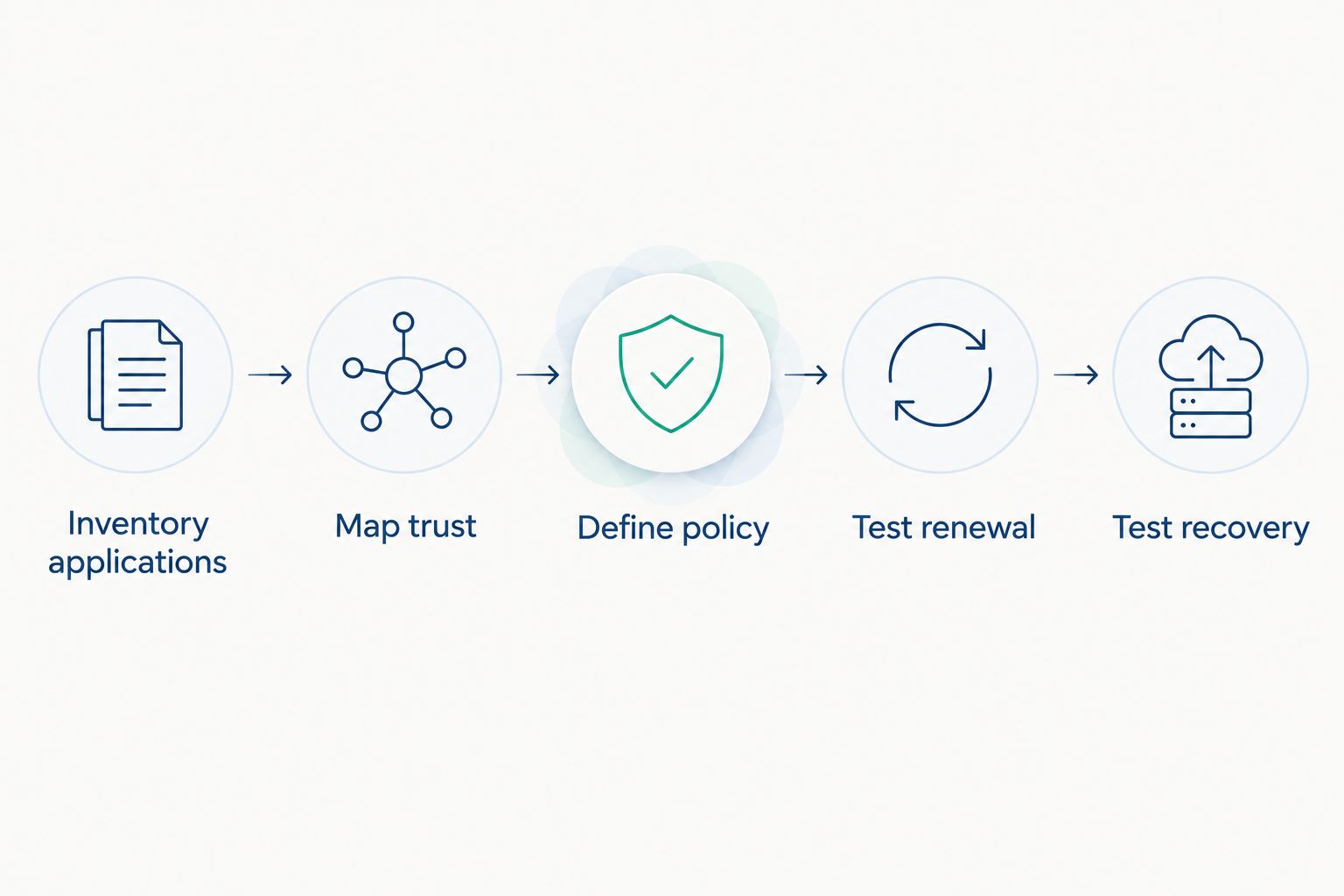
Define the required lifecycle before requesting a certificate-management quote.
Make the acceptance test operational
Your acceptance test should use the intended security configuration and a representative communication path. A certificate import demonstration alone does not prove that the required client-server connection works after replacement.
Record the starting condition, action, expected result, observed result, and recovery action. Include the people responsible for execution and approval. This creates a usable handover record rather than a demonstration that only the supplier can repeat.
For Softwaretoolbox discussions, provide the application inventory and required OPC connectivity paths first. Ask which proposed components address each requirement; do not assume that a named connectivity product includes a particular certificate-management feature.
What should a 2026 request for quotation include?
Request a response against a fixed scope and require exceptions in writing. Give technical and commercial reviewers the same inventory so that licensing assumptions do not drift away from the deployment design.
Use explicit questions:
- Which listed applications and versions support the proposed workflow?
- Which certificate operations are automated, and which require operator action?
- Where are private keys created, stored, and accessed?
- Which network connections and permissions does the design require?
- What happens when renewal fails or an application rejects a replacement?
- Which implementation, training, and support activities are included?
- What changes to the inventory require a revised commercial agreement?
Ask for a responsibility matrix alongside the quote. Separate supplier tasks, internal PKI tasks, controls engineering tasks, and cybersecurity approvals. An unassigned task is a deployment gap even when the software requirement is satisfied.
Does an existing PKI remove the need for certificate-management software?
An existing PKI addresses certificate-governance requirements, but it does not by itself demonstrate application-level deployment and trust management. Evaluate whether your current tools perform those tasks for the OPC UA applications in scope.
Reuse established PKI where it meets the requirement; procure additional capability only for a defined gap. Document the handoff between the certificate authority and the application owner before approving the design.
Is centralized certificate management always the better choice?
Centralized certificate management fits requirements for coordinated administration, but it is not automatically the right architecture for every environment. Its suitability depends on supported applications, permitted network paths, security ownership, and recovery procedures.
A bounded application-level workflow remains a valid candidate when it satisfies the documented requirements. Compare the operating procedures and acceptance results, not just the number of administrative interfaces.
Can certificate renewal interrupt OPC UA communication?
Certificate renewal requires testing because the application must use the replacement certificate and its communication partners must accept the resulting trust relationship. Do not promise uninterrupted operation without evidence from the specific application configuration.
For 2026 deployment approval, record whether the replacement requires a restart, reconnect, trust update, or operator action. Treat those observations as application-specific results, not universal OPC UA behavior.
FAQ
How much does OPC UA certificate management software cost for a plant?
Request a deployment-specific quote covering software entitlement, implementation, and recurring lifecycle responsibilities. Define the applications, sites, security constraints, and acceptance tests before comparing proposals.
Can I use the certificate tools already in my OPC UA applications?
Use existing application tools when they satisfy the documented lifecycle requirements. Verify replacement, trust updates, exception handling, and recovery instead of assuming that a certificate settings screen covers every task.
Is OPC UA certificate management licensed per certificate?
Confirm the licensing unit in the supplier's proposal rather than assuming per-certificate licensing. Require the entitlement to match your application inventory and deployment rights.
Does having an enterprise PKI solve OPC UA certificate management?
Enterprise PKI does not by itself prove that OPC UA application deployment and trust updates are covered. Assign those responsibilities and test the handoff between PKI administrators and application owners.
What should I test before buying certificate-management software?
Test certificate replacement, the required communication afterward, and recovery from an unsuccessful change. Record application-specific restart, reconnect, permission, and trust-update requirements.
Can Softwaretoolbox help scope an industrial connectivity project?
Softwaretoolbox provides industrial connectivity software, making it relevant to OPC connectivity scoping discussions. Present your certificate-management requirements separately and confirm which proposed components address them.
One last thing
Put a failed renewal in the acceptance test, not just a successful one. A successful replacement shows that the planned workflow works; a failed replacement exposes whether ownership, diagnostics, and recovery are defined.
Before approving a 2026 purchase, ask the operations owner to follow the recovery procedure without relying on undocumented supplier knowledge. The purchase decision should account for who can restore the required communication, not merely who can issue the next certificate.