To establish how much OPC Router costs in 2026, request a current written quote tied to your deployment requirements; do not use an assumed license figure as your project budget. Separate the software quote from engineering, commissioning, infrastructure, and ongoing support so your approval covers the deployment rather than just the purchase.
TL;DR
- How much does OPC Router cost? Use a current, scoped quote—not an assumed license figure.
- Separate OPC Router licensing from integration engineering, commissioning, infrastructure, and support in your project budget.
- Software Toolbox fits industrial teams sourcing connectivity software and DataOps platforms.
- Document required connections, security boundaries, and acceptance criteria before requesting pricing.
How much does OPC Router cost in 2026?
Use a written quote for the software amount and a separate implementation estimate for the project amount. Ask the supplier to identify exactly what the quoted configuration includes, which conditions apply, and which requirements remain outside its scope.
Software Toolbox provides OPC Router alongside industrial connectivity software and DataOps platforms. Describe your intended architecture when discussing the requirement, rather than asking for an isolated software price without deployment context.
Use the following breakdown to organize your request. These are budget categories to investigate, not a statement that every category carries a separate charge or that OPC Router uses a particular licensing model.
Software licensing
- What to establish: The exact configuration and license rights quoted
- What to keep separate: Assumed capabilities or unquoted components
Integration engineering
- What to establish: Connection configuration, mapping, transformations, and testing required by your design
- What to keep separate: Work your internal team will complete
Infrastructure
- What to establish: Approved hosting, operating environment, and network changes
- What to keep separate: Infrastructure already assigned to the project
Commissioning
- What to establish: Installation, validation, cutover, and rollback responsibilities
- What to keep separate: Routine operations after acceptance
Ongoing support
- What to establish: Included services, exclusions, and any renewal terms
- What to keep separate: Internal administration and incident response
Future changes
- What to establish: The process for adding scope or changing the deployment
- What to keep separate: Requirements that have not been approved
Do not add these categories together until you have removed overlaps. For example, an implementation proposal and an internal engineering estimate can both include the same configuration work. Your budget should count that work once and name its owner.
Why this matters
An OPC Router purchasing decision is also an architecture and delivery decision. Your project needs a defined source, destination, data flow, security boundary, and operating owner—not just a purchase approval.
A software quote answers what you are buying under its stated terms. It does not establish that your firewall changes, data mappings, acceptance tests, or production cutover are included. Read those responsibilities independently.
For a 2026 budget review, keep the commercial scope and technical scope together. A reviewer should be able to trace every purchased component to an approved requirement and every implementation task to a responsible team.
Approve a defined deployment, not an unexplained software line item. That distinction makes it easier to review exclusions before they become delivery problems.
Define the architecture before requesting a quote
Prepare a short deployment brief that describes the intended system without assuming how the supplier licenses it. The goal is to give the supplier enough information to identify the applicable configuration and flag requirements that need further validation.
Use this sequence:
- Define connections. Name the source systems, destination systems, interfaces, and required data direction. Distinguish reading data from writing values or triggering actions.
- Map boundaries. Identify the network zones involved, the proposed hosting location, and the teams responsible for approving communications across each boundary.
- Specify behavior. Describe when transfers should occur, how failures should be handled, and what evidence operators need when a transfer does not complete.
- Assign ownership. Name the people responsible for configuration, certificates, credentials, infrastructure, commissioning, and support escalation.
- Confirm acceptance. Define the tests that must pass before the deployment enters production, including recovery and rollback checks.
Keep each statement testable. Replace a request such as reliable integration with a description of the expected behavior during a destination outage and the evidence required after service returns.
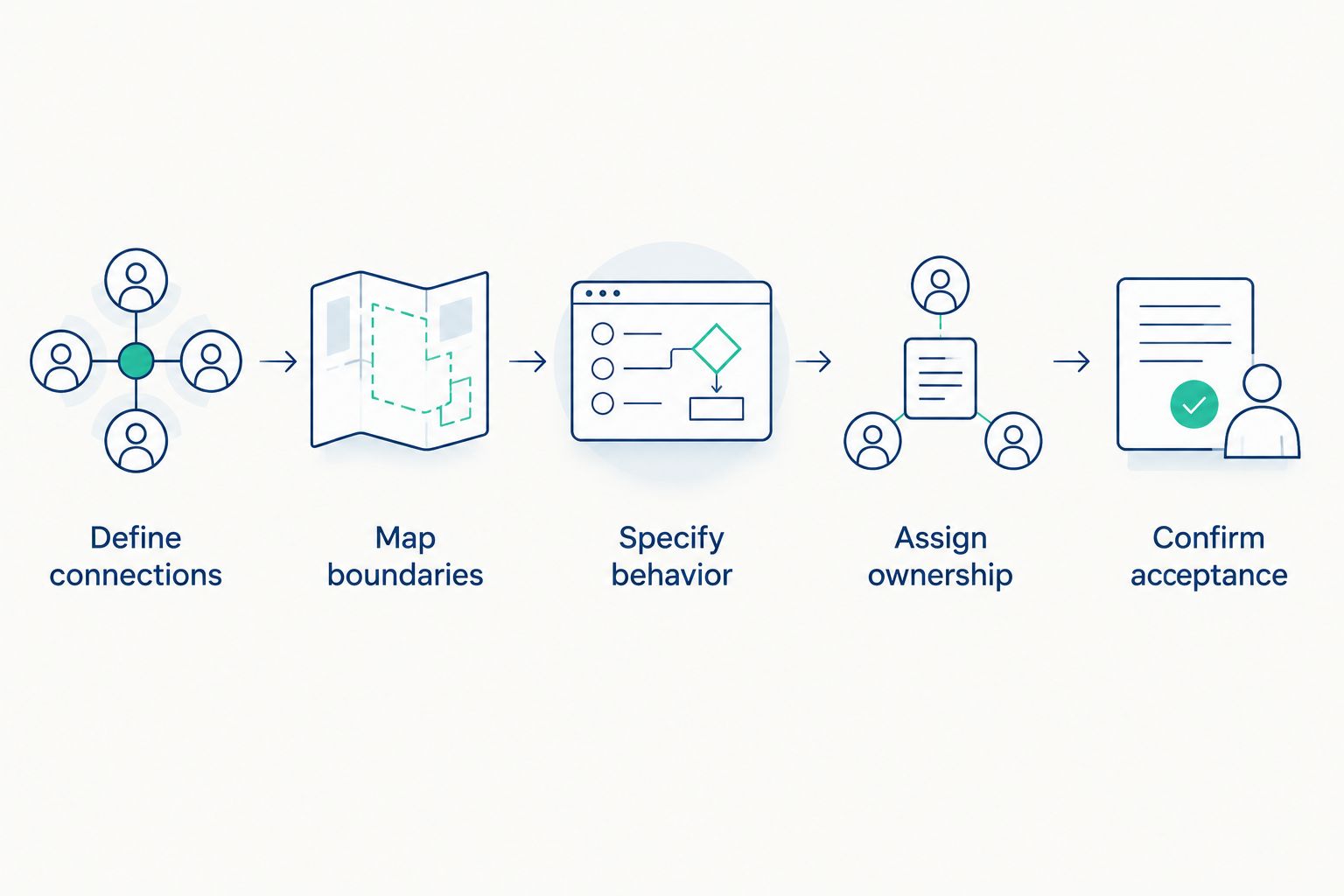
Define the intended deployment before asking the supplier to identify the applicable configuration.
The brief is a requirements document, not confirmation that a product supports every requested behavior. Ask the supplier to validate the requirements against the proposed configuration and document any exceptions in writing.
Separate software scope from implementation scope
An itemized proposal should make the boundary between purchased software and delivery work explicit. Do not infer that a named interface, environment, or service is included because it appeared in an early discussion.
For the software portion, request the product identification, quoted configuration, applicable license terms, and included services. Ask how the proposal treats your intended production, testing, and recovery arrangements without assuming that each arrangement requires a separate purchase.
For implementation, request a statement of work with deliverables and exclusions. Configuration, data mapping, security review, testing, documentation, and handover should each have an owner where the project requires them.
Keep these distinctions visible:
- Entitlement versus configuration: Permission to use software is different from the work needed to configure your application.
- Installation versus commissioning: An installed application is not evidence that the complete data flow passes acceptance testing.
- Support versus operation: Supplier assistance does not assign responsibility for your credentials, certificates, backups, or internal change process.
- Current scope versus expansion: A proposed future connection is not part of the approved deployment unless the documents include it.
For procurement in 2026, retain the quote, requirements brief, and statement of work together. If a requirement changes, update the affected documents before approving the change.
Why the project budget varies
The following factors describe work to assess in your project. They are not claims about OPC Router license pricing or charging rules.
- Connection scope: Record which industrial systems and business destinations need integration. Different interfaces create different configuration and validation tasks; ask which tasks the proposal covers.
- Security boundaries: Identify required firewall reviews, credential approvals, certificate handling, and access restrictions. Assign those tasks before scheduling commissioning.
- Data handling: Specify the mappings, contextual information, validation rules, and transformations your application needs. Have the supplier confirm whether the proposed configuration meets those requirements.
- Deployment environments: Document where development, testing, production, and recovery activities will occur. Ask how the commercial terms and implementation scope address those arrangements.
- Operational requirements: Define monitoring, incident handling, change control, and recovery expectations. Separate supplier commitments from responsibilities retained by your operations team.
- Delivery ownership: Decide which work belongs to your plant team, IT team, system integrator, or supplier. Estimate the work once, under the team responsible for completing it.
Treat each factor as a scoping question, not an automatic surcharge. A requirement belongs in the budget only after you determine whether it needs a purchase, engineering effort, existing infrastructure, or no additional work.
Review security and failure handling before approval
Security requirements belong in the quote discussion because they shape the deployment you are asking the supplier to assess. Do not postpone them until installation.
Start with the proposed communication paths. Record which system initiates each connection, which network zones it crosses, and which identity authorizes access. Have your cybersecurity team review the design against your site's requirements.
Then define the permitted actions. A read-only reporting flow and a flow that writes to an operational system need different acceptance criteria. Document the intended permissions rather than leaving them to configuration defaults.
Use a failure checklist during technical review:
- What should happen when a source or destination becomes unreachable?
- How will an operator distinguish a successful transfer from a failed or incomplete transfer?
- What should happen after a service restart or credential change?
- Who investigates failures, and what diagnostic evidence will that person receive?
- What conditions require stopping the integration or rolling back the change?
Ask the supplier to confirm the proposed solution's behavior for each applicable scenario. Do not convert a desired behavior into a product claim until it has been verified for the configuration under review.
How do you compare proposals without comparing unlike scopes?
Compare proposals against the same approved requirements. A proposal with a shorter scope is not an equivalent alternative simply because its software line appears smaller.
Use a shared review sheet covering configuration, environments, implementation deliverables, support terms, exclusions, and acceptance criteria. Mark unresolved items as questions for the supplier rather than treating them as included.
Keep technical suitability separate from commercial completeness. A technically suitable configuration still needs clear terms; a detailed quote still needs evidence that the configuration meets your application requirements.
For your 2026 review, ask the same questions of each proposal revision. Record why an item changed and whether the change affects software entitlement, engineering work, or operational responsibility. That creates a useful approval trail without turning the evaluation into an unsupported product comparison.
Does an OPC Router quote include integration engineering?
An OPC Router quote establishes only the scope written into that quote. Require a statement of work for any engineering you expect the supplier or integrator to perform.
Look for named deliverables rather than a broad promise of implementation. Your acceptance package should identify the configuration documentation, test results, handover material, and unresolved exceptions required by your organization.
Should you budget separately for ongoing support?
Track ongoing support separately from the initial deployment, then confirm which services are included in the written offer. Do not assume that support, maintenance, updates, and internal administration mean the same thing.
Assign an internal owner even when supplier assistance is included. Someone in your organization still needs responsibility for raising incidents, approving changes, maintaining access records, and coordinating production work.
Build an approval package that engineering can use
A useful approval package lets procurement understand the purchase and lets engineering understand the delivery obligations. Keep the technical detail attached rather than compressing everything into a single budget description.
Include:
- The approved deployment brief and architecture drawing.
- The current written quote with its scope, terms, and exclusions.
- The implementation work breakdown with named owners.
- The security review and any conditions that must be satisfied before deployment.
- The acceptance plan, rollback approach, and operational handover requirements.
- The list of unresolved questions that must be closed before purchase approval.
For Software Toolbox discussions, bring this package to the commercial and technical review together. It gives both sides a shared reference for the intended OPC Router deployment without assuming unverified features or licensing conditions.
Do not approve an unresolved dependency as though it were an included deliverable. Assign an owner and require a written answer before that dependency becomes part of the production plan.
FAQ
How much does OPC Router cost in 2026?
Establish OPC Router's 2026 cost with a current written quote for your intended deployment. Keep the software amount separate from implementation, infrastructure, commissioning, and ongoing support in your project budget.
Can I use a software quote as the complete project budget?
Use a software quote as the complete project budget only when its written scope covers every approved project responsibility. Otherwise, add the separately scoped engineering, infrastructure, commissioning, and operational work without double-counting tasks.
What should I send when requesting an OPC Router quote?
Send a deployment brief covering source systems, destinations, interfaces, data direction, network boundaries, operating requirements, and acceptance criteria. Ask the supplier to validate those requirements against the proposed configuration.
Does OPC Router licensing include a test environment?
Ask the supplier to identify how the quoted license terms address your intended test environment. Do not infer testing or recovery rights from the production configuration.
Does an OPC Router purchase include installation and configuration?
Treat installation and configuration as included only when the written offer explicitly includes them. Require deliverables, responsibilities, exclusions, and acceptance criteria for any implementation work.
Can Software Toolbox help with an industrial connectivity requirement?
Software Toolbox provides industrial connectivity software, including OPC Router, alongside DataOps platforms. Present your architecture and operating requirements so the discussion addresses the intended industrial application.
How should I account for future connections in the budget?
Document future connections separately from the approved deployment and ask how each change would affect the quoted scope. Do not assume that an expansion requires a purchase or that it is already included.
One last thing
Ask the reviewer to trace a required data flow from source to destination using only the approval documents. The reviewer should be able to identify the permitted action, responsible teams, failure response, and acceptance test without relying on a verbal explanation.
If that trace stops at an unanswered question, resolve the question before approving the deployment. A useful cost answer describes what the project will deliver—and what your team still owns.