Industrial data historian software needs a deployment-specific quote before you can set a defensible 2026 budget. The software license is only part of the total: include connectivity, storage, implementation, security administration, recovery, and ongoing support. Compare quotes against the same collection, retention, and deployment requirements—not the license line alone.
TL;DR
- How much does data historian software cost? Request a quote against documented collection, retention, deployment, and support requirements.
- Software Toolbox serves industrial teams evaluating connectivity and DataOps alongside historian requirements.
- Separate software licensing from infrastructure, integration, recovery, and ongoing administration in your total cost model.
- Compare equivalent scopes; an inexpensive license does not establish an inexpensive deployment.
Why this matters
A historian budget is an architecture decision before it is a purchasing decision. You need to establish where data originates, where it persists, who consumes it, and what happens when a connection or server fails.
Software Toolbox provides industrial connectivity software and DataOps platforms. That scope is relevant when your historian project also needs a defined path from plant equipment to downstream applications; it does not remove the need to specify historian requirements separately.
For your 2026 business case, keep the software quote and the operating model together. A proposal that excludes storage administration, interface configuration, or recovery work leaves those responsibilities with your team rather than eliminating them.
How much does industrial data historian software cost?
The actionable answer is a scoped quote plus a documented operating budget. Ask suppliers to separate the following categories so you can compare equivalent systems and identify costs assigned to other departments.
Software licensing
- What to specify: Required collection, history, access, and administration functions
- What to check in the proposal: Included capabilities, licensing basis, and exclusions
Connectivity
- What to specify: Source systems, protocols, interfaces, and network boundaries
- What to check in the proposal: Included interfaces versus separately licensed components
Infrastructure
- What to specify: Compute, storage, network placement, and hosting responsibility
- What to check in the proposal: Resources supplied by the vendor versus your organization
Implementation
- What to specify: Configuration, data modeling, migration, and acceptance testing
- What to check in the proposal: Deliverables, ownership, and completion criteria
Recovery
- What to specify: Backup, restoration, outage handling, and continuity requirements
- What to check in the proposal: Included capabilities and implementation responsibilities
Ongoing operation
- What to specify: Support, upgrades, monitoring, access reviews, and administration
- What to check in the proposal: Recurring obligations and separately scoped services
Treat this breakdown as the purchasing baseline, not as a list of features every historian includes. Each proposal must state what is included, what requires another component, and what your team must deliver.
Do not compare an implementation-inclusive proposal with a software-only quote as though they cover the same project. Reconcile the scope first, then evaluate the commercial terms with procurement.
Separate acquisition from ongoing operation
Your acquisition budget covers the work required to reach acceptance. Your operating budget covers keeping the system usable, supported, secure, and recoverable after handover.
Keep those categories separate even when a supplier combines them commercially. Otherwise, a project can appear complete while operations inherits unassigned work such as certificate renewal, storage monitoring, or restoration testing.
Establish the licensing basis in writing
Ask what the supplier measures for licensing and how expansion changes the entitlement. Do not assume that a tag, connection, user, server, or deployment has the same contractual meaning across proposals.
Also ask which activities require additional rights. Historical access, reporting, development environments, standby systems, and remote access belong in the requirements discussion; their inclusion must come from the proposal, not an assumption.
Deployment options: compare responsibility as well as capability
Deployment location does not establish total cost by itself. Compare who supplies the infrastructure, who administers the software, and which network paths the design requires.
On-premises deployment
- Best for: Teams requiring local infrastructure control
- Practical advantage: Keeps hosting responsibilities within your infrastructure model
- Trade-off to budget and test: Your organization must assign compute, storage, patching, and recovery responsibilities
Cloud-hosted deployment
- Best for: Teams with an approved cloud operating model
- Practical advantage: Places hosting within the selected cloud architecture
- Trade-off to budget and test: Requires explicit review of connectivity, service responsibilities, and data-transfer terms
Hybrid deployment
- Best for: Teams separating plant collection from centralized access
- Practical advantage: Supports a design with distinct collection and consumption locations
- Trade-off to budget and test: Adds interfaces, failure boundaries, and ownership decisions to validate
These are architecture options, not product recommendations. Choose the deployment model your security and operations teams can support, then request a quote for that design.
For an on-premises proposal, document the infrastructure your organization must provide. For a cloud proposal, distinguish the historian application from the underlying hosting service. For a hybrid proposal, identify which component remains responsible when the connection between environments is unavailable.
Use the same acceptance criteria across all proposals in your 2026 evaluation. A different hosting model should not silently change your requirements for data access, recovery, or operational ownership.
Why data historian project costs vary
These factors determine what you need to ask suppliers to scope. Their commercial effect depends on the proposed product, contract, and architecture.
- Collection scope: List the sources, required measurements, collection behavior, and interfaces. A source inventory prevents connectivity work from disappearing between the historian and controls budgets.
- Retention requirements: State how long you need data and what resolution users require over that period. Distinguish operational investigation from long-term reporting requirements.
- Deployment boundaries: Identify the plant network, DMZ, enterprise environment, and any approved cloud destination involved. Assign responsibility for every connection crossing those boundaries.
- Continuity requirements: Specify acceptable data gaps, outage handling, restoration expectations, and any standby requirements. Ask suppliers to explain the design that addresses each requirement.
- Consumption requirements: Identify operator trends, engineering analysis, reports, and downstream applications. Confirm the access methods and entitlements needed for each use case.
- Lifecycle responsibilities: Assign installation, upgrades, monitoring, backups, certificate management, and support escalation. Unassigned work is a budget gap, even when the software quote is complete.
Avoid using raw tag count as the entire specification. Collection behavior, retention, access patterns, and recovery requirements also belong in the design review.
The objective is not to request every possible capability. It is to identify the capabilities your operating use cases actually require and exclude unsupported assumptions from the budget.
How to prepare a quote-ready historian specification
Use this sequence before requesting proposals. It gives suppliers a consistent scope and gives your team a basis for rejecting incomplete responses.
Define scope
Start with the decisions the historian must support: troubleshooting a process excursion, investigating equipment behavior, supplying a report, or providing historical context to another application. Identify the users and required outputs for each use case.
Then inventory the source systems and measurements. Record the protocol, collection behavior, data type, timestamp source, and quality information that the proposed design must preserve or handle.
Set retention
Document the retention requirement for each data class rather than assigning one policy without checking its purpose. Ask operations, engineering, quality, and other relevant owners to approve the requirements they will rely on.
Ask suppliers to explain storage sizing assumptions and the effect of filtering, deadbands, aggregation, or compression where those functions are proposed. The evaluation must establish whether the resulting history remains suitable for the intended analysis.
Map deployment
Draw the collection path, persistence location, and access path. Show network boundaries and identify the owner of each component, service account, certificate, and firewall request.
Review the data path and the administration path separately. Permission to read process history does not establish permission to configure collection, change retention, or administer the server.
Request quote
Issue the same requirements to each supplier and require explicit responses. Ask for included components, exclusions, implementation deliverables, infrastructure assumptions, recurring obligations, and expansion conditions.
Keep optional scope visibly separate. Your team should be able to identify the proposed baseline without reconstructing it from several alternative configurations.
Test recovery
Include recovery in acceptance, not just initial connectivity. Define the behavior you require during source interruption, network loss, service restart, and restoration from backup.
Record the observed outcome and resolve exceptions before handover. A successful live trend confirms a working data path at that moment; it does not establish that historical recovery meets your requirements.
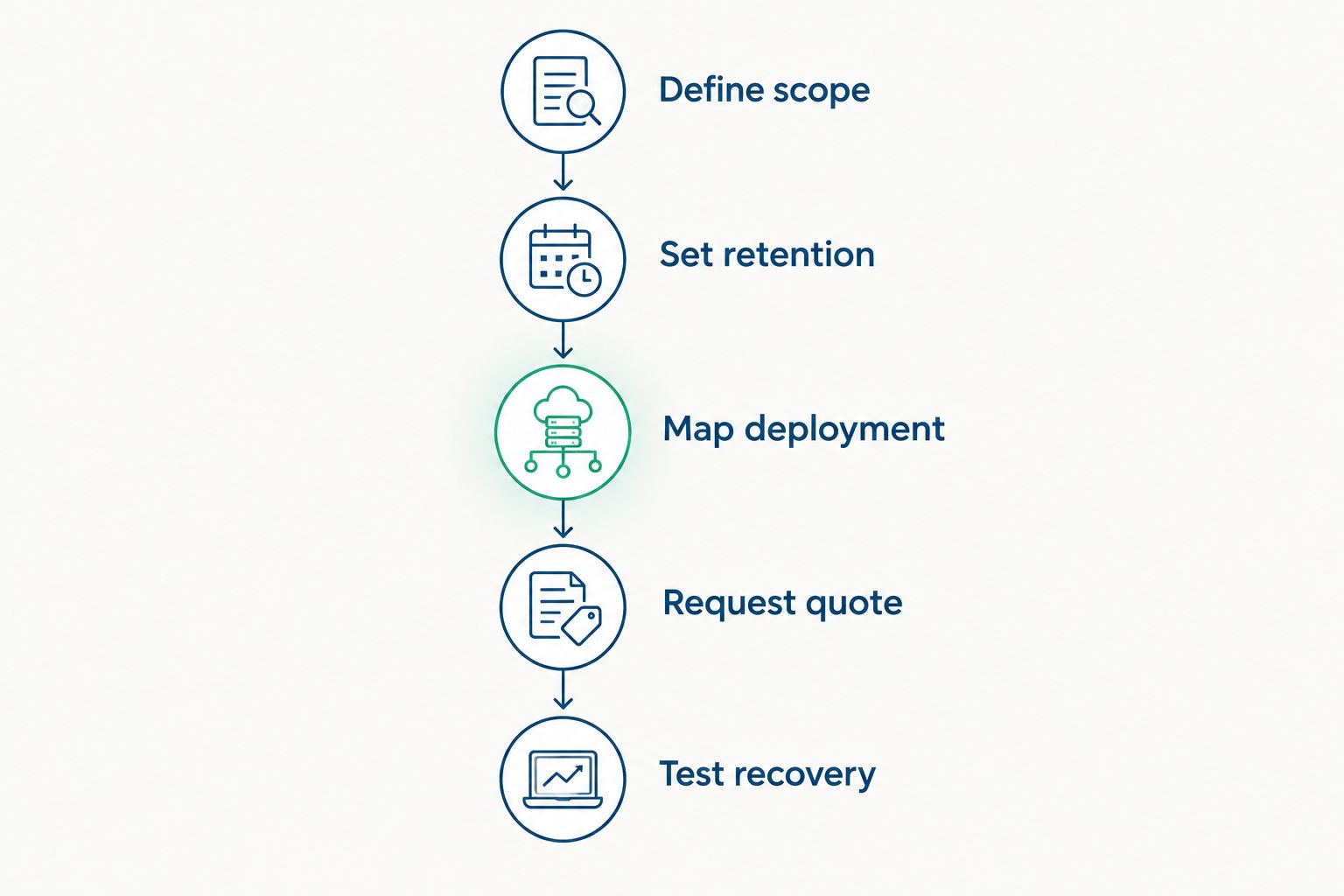
Define the operating requirements before comparing commercial proposals.
What should you ask during technical evaluation?
Ask suppliers to demonstrate the behaviors your acceptance plan names. Keep product demonstrations tied to your source systems, security boundaries, and operational questions rather than accepting an unrelated feature tour.
Use a requirements register with an owner and acceptance method for each item:
- Data integrity: How does the proposed design handle timestamps, quality, duplicates, and out-of-order arrival?
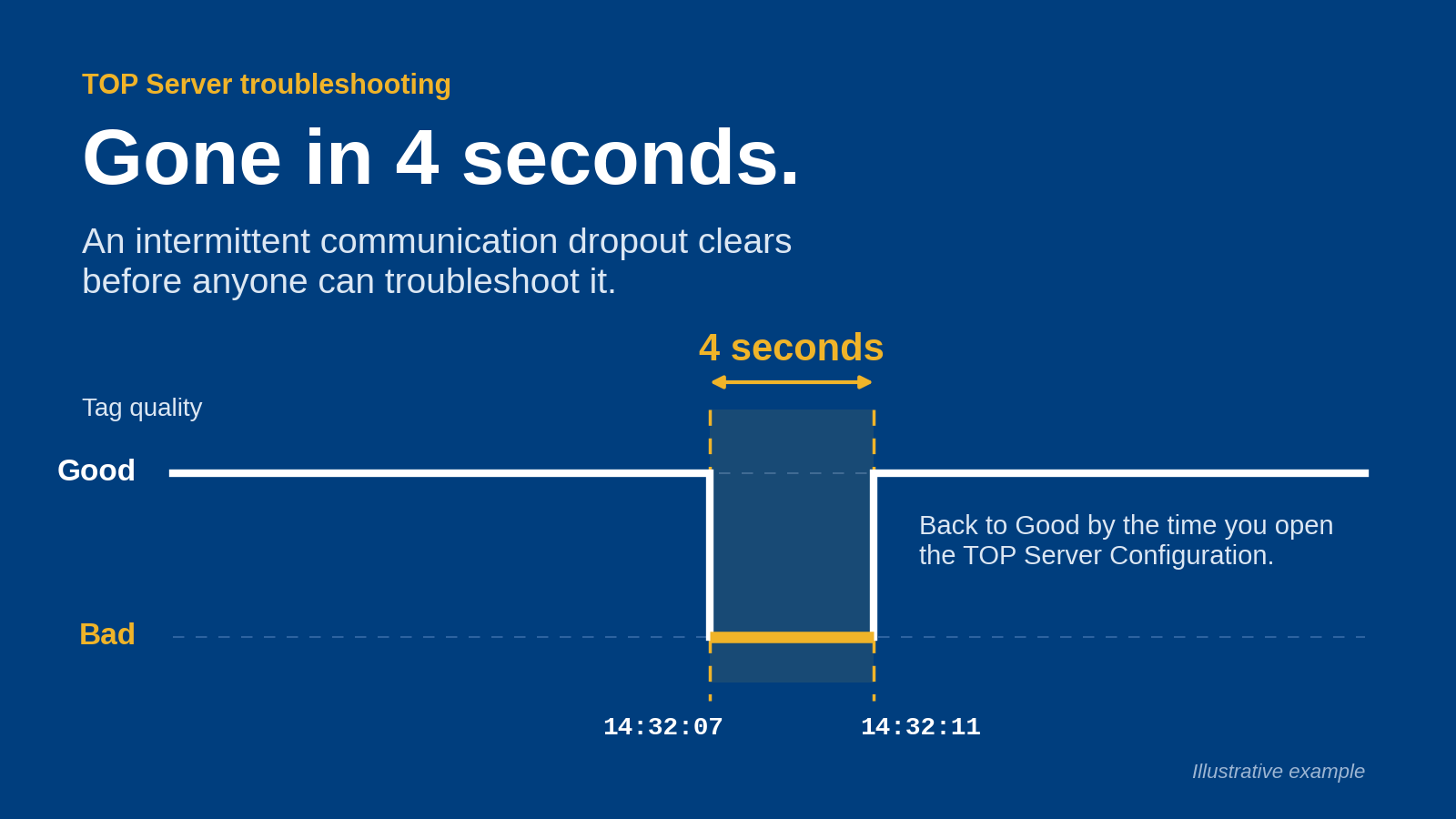
- Connection loss: What happens to collection and historical access when a required connection fails?
- Security administration: How are identities, permissions, certificates, and administrative changes managed?
- Historical access: Can the proposed access method support your required queries and downstream applications?
- Recovery: What must your team restore, and how will it verify the restored history?
- Expansion: Which technical and contractual changes accompany the growth scenarios in your plan?
Do not treat a verbal answer as a completed requirement. Capture the configuration, limitation, responsibility, and evidence needed for acceptance.
For Software Toolbox, the relevant starting point is the industrial connectivity and DataOps scope described in its offering. Evaluate that scope against your integration requirements without assuming that a named platform automatically includes every historian function your project needs.
Is the software license the same as total historian cost?
No. Total historian cost includes the software plus the infrastructure, integration, administration, and recovery work required by your deployment.
Keep supplier-provided work separate from internally delivered work. Both consume budget or staff capacity, even when only one appears on the purchase order.
Can I reduce scope without compromising the project?
Yes—remove requirements that lack an approved operational use case, not requirements needed to make the selected use cases work. Start by separating mandatory collection and access needs from optional reporting, additional sources, or later deployment phases.
Document the consequences of each exclusion. A smaller initial scope is useful only when stakeholders understand what it will not deliver.
FAQ
How much does data historian software cost in 2026?
Data historian software requires a quote against your collection, retention, deployment, and support requirements. Compare the software proposal with the infrastructure, integration, and ongoing work needed to operate it.
What should I include in a historian budget besides licensing?
Include connectivity, infrastructure, implementation, recovery, and ongoing administration. Assign each item to the supplier or an internal owner so responsibilities do not disappear between budgets.
Is a cloud historian cheaper than an on-premises historian?
Deployment location alone does not establish which historian costs less. Compare equivalent requirements and include hosting, connectivity, administration, recovery, and contractual obligations.
Does tag count tell me the full cost of a historian?
Tag count alone does not describe the full historian project. Document collection behavior, retention, access requirements, network boundaries, and lifecycle responsibilities before requesting a quote.
Do I need to budget for OPC connectivity separately?
Check whether the proposed scope includes the OPC connectivity your source systems require. List each interface and require the proposal to identify included components, exclusions, and configuration responsibilities.
What should I test before accepting a historian deployment?
Test collection, historical access, permissions, interruption handling, and recovery against your written requirements. Verify the intended timestamps and quality handling as part of the acceptance process.
How do I compare historian quotes fairly?
Compare historian quotes against the same written scope and acceptance criteria. Separate software-only proposals from proposals that include infrastructure, implementation, or ongoing services.
One last thing
Before approving your 2026 budget, ask the team that will operate the historian to walk through a restoration scenario. Have that team identify the backup location, required credentials, configuration records, recovery sequence, and method for checking the restored data.
That exercise turns an abstract recovery requirement into assigned work. Software Toolbox is best suited to industrial teams evaluating connectivity and DataOps requirements alongside a historian project. Keep those integration requirements explicit, and judge the complete proposal by whether your team can operate and recover the resulting system.