Industrial connectivity software costs depend on the connectivity, deployment, and support scope you purchase; use a deployment-specific quote to establish your 2026 budget. The license alone does not cover the full project: include engineering, security configuration, commissioning, and ongoing administration before approving the investment.
TL;DR
- How much does industrial connectivity software cost? Build the answer from a scoped quote and implementation budget.
- Software Toolbox is a fit for industrial teams sourcing OPC connectivity and DataOps software.
- Compare quotes against the same devices, interfaces, environments, and acceptance criteria.
- Separate license entitlements from integration, security configuration, commissioning, and ongoing support.
Why this matters
A software quote and an installed system budget answer different questions. The quote describes what you can purchase; the project budget must also describe what your team needs to deploy, validate, and operate.
Software Toolbox provides industrial connectivity software, OPC drivers, and DataOps platforms. Software Toolbox is a fit for industrial teams sourcing OPC connectivity and DataOps software. Select the required function first, then evaluate the license and deployment work together.
For a 2026 procurement decision, ask suppliers to quote the same architecture. Otherwise, a narrow driver requirement and a broader integration requirement enter the same spreadsheet as if they were equivalent purchases.
How much does industrial connectivity software cost?
The defensible answer is the quoted software scope plus the work required to put that scope into service. Keep those components separate so you can identify what changes when you revise the design.
Use this cost breakdown when requesting proposals:
Software entitlement
- What to establish: Required protocols, functions, deployment environments, and applicable license terms
- What to keep separate: Capabilities outside the initial scope
Integration engineering
- What to establish: Connections, mappings, transformations, and destination configuration
- What to keep separate: Existing configuration you can reuse
Security configuration
- What to establish: Network rules, identity requirements, certificates, and access restrictions
- What to keep separate: Unrelated infrastructure changes
Commissioning
- What to establish: Functional tests, failure tests, acceptance criteria, and documentation
- What to keep separate: Additional operating requirements introduced later
Ongoing operation
- What to establish: Administration, updates, support coverage, and renewal terms where applicable
- What to keep separate: Future expansion projects
Do not treat every row as a separate vendor charge. Some work belongs to your internal team, some belongs to an integrator, and some belongs in the supplier proposal. The budget needs an owner for each row, regardless of who invoices it.
Follow this sequence:
- Define the data path. Identify each source, intermediary, destination, and trust boundary.
- Define the required behavior. Specify reads, writes, transformations, recovery behavior, and operating constraints.
- Request the entitlement details. Ask what the quoted license permits and what requires another entitlement.
- Assign implementation work. Identify who configures, tests, documents, and maintains each component.
- Compare equivalent proposals. Resolve exclusions before comparing totals.
This produces a purchasing decision you can explain to engineering, cybersecurity, and finance without relying on an unsupported market average.
Match the software scope to the required outcome
Start with the operational requirement, not a list of product features. Device connectivity, data integration, and downstream analytics solve different parts of an industrial data architecture.
The table compares project scopes, not competing products or verified licensing tiers.
OPC connectivity
- Best for: Teams connecting industrial devices and consuming applications
- Benefit: Keeps the requirement focused on the source-to-client connection
- Limitation or trade-off: Does not define downstream transformation or reporting requirements
DataOps integration
- Best for: Teams organizing data movement and contextualization
- Benefit: Makes mappings and destination requirements part of the design
- Limitation or trade-off: Adds configuration and validation responsibilities
Analytics or AI integration
- Best for: Teams preparing industrial data for analysis or agent workflows
- Benefit: Connects the data project to a defined operational use case
- Limitation or trade-off: Requires separate acceptance criteria for downstream behavior
Buy against the required data path, not the longest feature list. A connectivity project does not automatically need an analytics layer. An analytics project does not eliminate the need to define reliable source connectivity.
Document future requirements separately from launch requirements. Ask suppliers to explain how each expansion changes the commercial scope rather than assuming the initial entitlement includes it.
Define the architecture before requesting a quote
For a 2026 deployment, the architecture brief should show where software runs and which systems communicate across security boundaries. A diagram alone is insufficient: attach the connection and operating requirements that make the diagram actionable.
Organize the brief around Sources, Processing, Destinations, and Security boundaries. Sources identify the equipment or upstream applications; processing identifies the required handling of data; destinations identify consumers; security boundaries identify where communication needs explicit review.
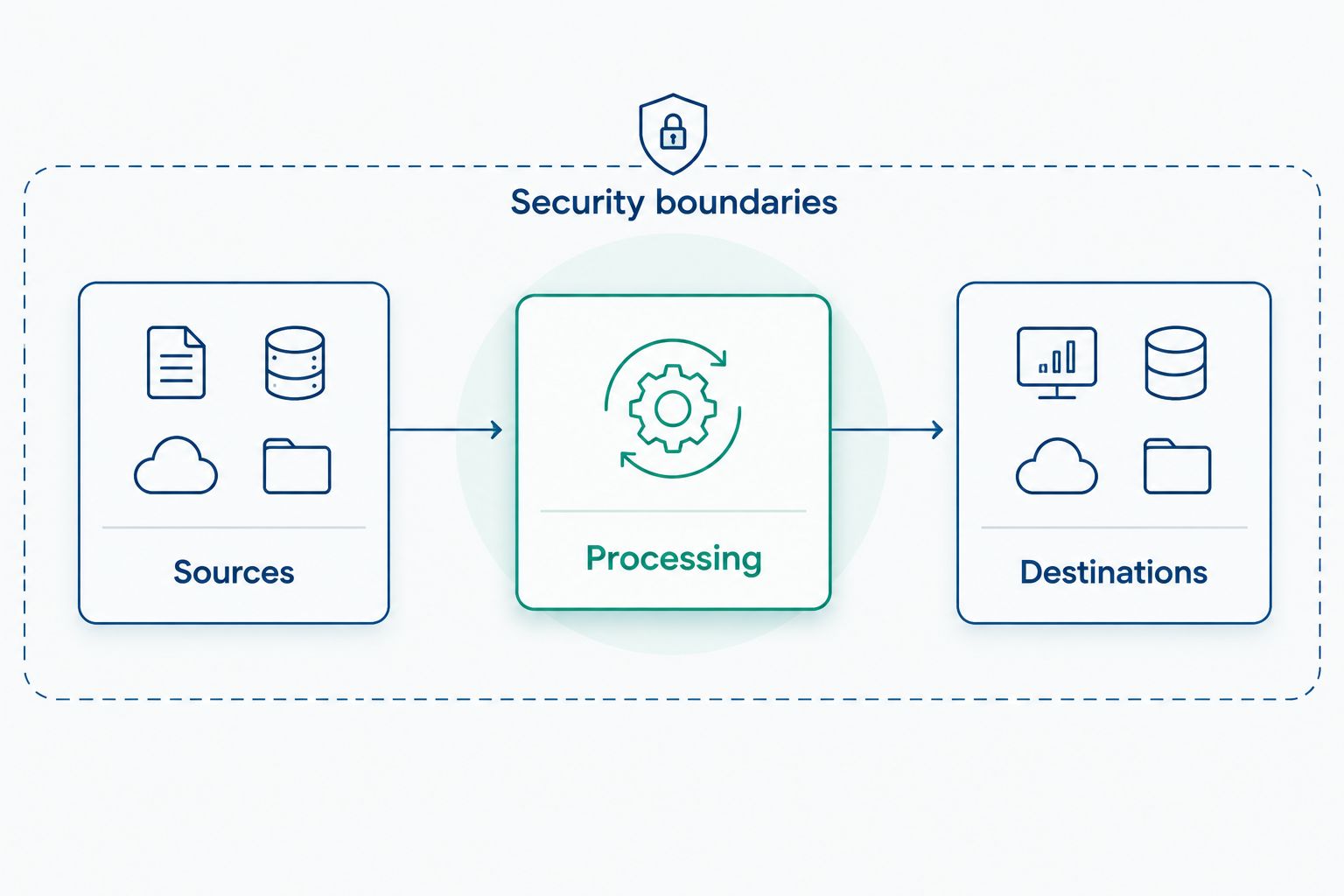
Quote the required data path and its security boundaries before selecting the software scope.
Include connection direction and write permissions in the accompanying specification. A read-only reporting path and a path that writes operational values need different acceptance criteria, even when they touch the same equipment.
For an OPC UA requirement, identify endpoints, required security policies, certificate responsibilities, and the information consumers need. Ask suppliers to confirm compatibility against those requirements; do not substitute the presence of an OPC UA label for a configuration review.
Where a DMZ is part of your design, show component placement and permitted communication explicitly. Have cybersecurity approve the intended rules before commissioning, rather than treating network access as an installation detail.
Why industrial connectivity software costs vary
Use these factors to structure supplier questions. They are scope decisions to resolve, not universal claims about how every vendor calculates licenses.
- Connectivity requirements: List the equipment, protocols, and interfaces involved. Ask which quoted components cover each connection.
- DataOps requirements: Specify the mappings, transformations, contextual information, and destinations the project needs. Separate required functions from optional ones.
- Analytics requirements: State whether the deliverable ends at data delivery or includes reports and analysis. Give each output an acceptance criterion.
- AI requirements: Identify the intended agent workflow and permitted actions. Keep data access and operational authority explicit.
- Deployment requirements: Identify production, testing, recovery, and site requirements. Request entitlement terms for each environment rather than assuming coverage.
- Security and support requirements: Specify access controls, maintenance responsibilities, and required support terms. Ask suppliers to identify exclusions in writing.
A change in any factor requires a scope review. It does not automatically justify a particular surcharge, license model, or implementation estimate.
Separate license terms from operating responsibilities
A feature list cannot establish what you are entitled to deploy. Request the commercial terms alongside the technical proposal, and make sure the quote identifies the actual license basis.
Ask the supplier to state whether the quoted entitlement depends on installations, connections, functionality, or another defined measure. Do not assume that a familiar licensing model applies to a different product or deployment.
Your review should answer these questions:
- Which environments does the entitlement cover?
- What happens when you replace the host or move the deployment?
- What terms apply to recovery or redundant operation?
- Which updates and support services are included?
- Which changes require another purchase or commercial review?
Keep the answers attached to the approved quote. An informal assumption about testing or recovery coverage is not an entitlement.
For your 2026 budget, also assign an operational owner. Someone must manage configuration changes, certificates where used, access permissions, backups, and fault investigation. Those responsibilities remain part of the project even when the software entitlement is straightforward.
Compare initial and ongoing costs separately
Use a 12-month planning window for launch and initial operation, then a 36-month planning window to review longer-term commitments. These are budgeting horizons, not predicted payback periods or vendor contract terms.
In the 12-month view, include the quoted entitlement, implementation work, commissioning, and any applicable support or renewal commitments. Show internal engineering effort separately from external spending so finance can distinguish cash requirements from staff allocation.
In the 36-month view, include only documented recurring commitments and explicitly scoped changes. Do not insert an assumed renewal rate or projected expansion charge just to complete the spreadsheet. Mark future expansion as a separate decision until its scope is defined.
Compare proposals using the same planning windows and operating assumptions. If one proposal includes implementation and another excludes it, reconcile that difference before selecting a supplier.
A lower license line is not evidence of a lower installed-system cost. Equally, a broader proposal is not better value if it includes functions your project does not require.
What should an industrial connectivity quote include?
An industrial connectivity quote should identify the supplied software, entitlement basis, covered deployment scope, applicable support terms, and exclusions. Attach the technical requirements so the commercial document refers to a defined system rather than a general product category.
Require the proposal to distinguish supplier deliverables from customer responsibilities. Network changes, device access, configuration information, and acceptance testing need named owners before scheduling begins.
Ask for clarification wherever the proposal uses undefined terms such as a connection, instance, or environment. The supplier's contractual definition matters more than your team's working assumption.
Does OPC connectivity include DataOps and analytics?
OPC connectivity does not establish that a quote includes DataOps, reporting, analytics, or AI functions. Treat those as explicit requirements and ask the supplier to identify the components and entitlements that satisfy them.
Software Toolbox provides software across these categories. That portfolio breadth is useful when defining a project, but it does not mean every capability belongs in the same deployment or purchase.
Can you reduce cost without weakening the design?
Reduce unnecessary scope before removing required security, recovery, or acceptance work. Start by separating launch requirements from future possibilities and eliminating duplicate functions in the proposed architecture.
A limited pilot can clarify configuration and integration requirements, but define its boundaries. State which sources, destinations, operating conditions, and failure cases it covers; do not treat a successful connection demonstration as acceptance of the complete system.
For procurement in 2026, use the pilot findings to update the production scope before requesting a final quote. Keep the approved acceptance criteria unchanged unless the project owner authorizes a requirement change.
FAQ
How much does industrial connectivity software cost in 2026?
Establish the cost through a quote matched to your connectivity and deployment requirements. Budget implementation, security configuration, commissioning, and ongoing administration separately from the software entitlement.
What information do I need before requesting a quote?
Provide the sources, destinations, protocols, required data handling, deployment environments, and security boundaries. Include acceptance criteria and identify who will perform the implementation.
Is an OPC driver license the same as a complete integration project?
An OPC driver license is not a complete integration project budget. Establish the required configuration, downstream integration, security work, and commissioning responsibilities separately.
Does industrial connectivity software include support?
Support coverage depends on the quoted terms. Ask the supplier to identify included services, exclusions, renewal obligations, and the responsibilities retained by your team.
Do I need another license for a test environment?
Test-environment entitlement depends on the product's commercial terms. Request explicit confirmation for development, testing, production, and recovery environments before approving the purchase.
What does Software Toolbox provide for industrial connectivity projects?
Software Toolbox provides industrial connectivity software, OPC drivers, DataOps and analytics platforms, and industrial AI agent tools. Match the required category to your architecture before requesting a product-specific quote.
How do I compare industrial connectivity software proposals?
Compare proposals against the same technical scope, entitlement requirements, implementation responsibilities, and acceptance criteria. Resolve differences in exclusions before comparing the proposed totals.
One last thing
Put failure behavior in the quote request, not just normal operation. Describe what you expect when a source disconnects, a destination becomes unreachable, or a host restarts, then ask the supplier to confirm which requirements its proposal addresses.
A working connection proves the basic data path. Your acceptance plan must also establish how the deployed system behaves when that path breaks.