An OPC server license does not have a single standard cost: use a current supplier quote tied to your required connectivity and deployment architecture. For a 2026 budget, separate the software entitlement from implementation, support, maintenance, and any additional deployment requirements; the license line alone does not define the project budget.
TL;DR
- How much does an OPC server license cost? Request a current quote for your defined connectivity and deployment scope.
- Softwaretoolbox is best for industrial teams sourcing OPC connectivity alongside DataOps platforms.
- Specify production, recovery, and engineering environments before comparing license proposals.
- Keep software entitlement, support, and integration work separate in your budget.
How much does an OPC server license typically cost?
Treat OPC server licensing as a scoped procurement decision, not a generic unit purchase. Start with the devices you need to connect, the applications consuming their data, and the environments where the software must run. Then ask the supplier to identify the entitlement that covers that architecture.
For industrial OPC connectivity and DataOps software, Softwaretoolbox provides a relevant starting point. Evaluate the quoted software against your requirements rather than treating a product category name as proof that the required connectivity, deployment rights, or support are included.
Use this sequence to obtain a proposal you can approve:
- Define connectivity. List device manufacturers, models, firmware, communication protocols, and required data access.
- Define deployment. Identify production hosts, engineering environments, recovery arrangements, and network boundaries.
- Define entitlement. Ask the supplier to map each requirement to the proposed license and identify exclusions.
- Define support. Request written terms for assistance, updates, maintenance, and version changes.
- Validate acceptance. Agree on the checks that demonstrate the proposed configuration satisfies your requirements.
A usable quote connects technical scope to commercial scope. If the proposal lists software without identifying what it permits you to deploy and operate, return it for clarification before issuing a purchase order.
Why this matters
An OPC server sits between industrial data sources and consuming applications. Your procurement decision therefore needs to account for both connectivity and the way that connection fits into plant operations. A license description cannot replace an architecture review.
The practical objective is straightforward: procure an entitlement that matches the approved design. Keep the commercial review and technical review connected, so a deployment change does not pass unnoticed after the purchase decision.
For your 2026 project plan, retain the architecture diagram, supplier proposal, entitlement terms, and acceptance checklist together. These documents answer different questions. The architecture describes what you intend to run; the terms establish what you are entitled to run.
Define the OPC server architecture before requesting a quote
Begin with the data path. Identify the industrial source, the server host, the consuming application, and each trust boundary between them. Record whether the application needs read access, write access, or both.
Do not describe the requirement simply as OPC connectivity. Specify the interface the consuming application expects and the communication protocol used by the source equipment. An OPC interface requirement and a device communication requirement describe different sides of the connection.
Define connectivity
Document the device details that a supplier needs to assess compatibility. Include firmware where it affects your configuration, and identify any existing gateways or intermediate systems. Preserve the distinction between a device connected directly and a device reached through another service.
State the operational use case as well. Monitoring, reporting, and supervisory writes require different acceptance checks, even when they use the same data source. Your specification should explain what the application needs to accomplish without assuming a particular licensing model.
Define deployment
List every environment in the proposed design, including environments that do not normally carry production traffic. Identify where you intend to install the software, where you intend to activate it, and how you intend to recover it.
For virtual infrastructure, ask how the quoted entitlement applies to your planned host changes and recovery process. Do not assume that a technically possible move is automatically permitted by the license terms. Obtain the supplier's written answer for the actual arrangement you intend to use.
Define entitlement
Ask the supplier to identify which quoted items cover your required connections and environments. Request an explicit statement of any applicable limits and of any separately licensed functionality needed by the design.
This is also the point to distinguish software capability from permission to deploy it. A feature description answers what software does. The entitlement answers what your organization is authorized to use under the proposed terms.
Define support
Identify who will troubleshoot the connection after commissioning: plant controls, IT, an integrator, or a shared team. Ask which support arrangements apply to those users and how they should report an issue.
For your 2026 handover, document the support owner and the records that owner will need. Include configuration backups, entitlement records, software versions, and the approved recovery procedure. These are operational requirements, not substitutes for the supplier's support terms.
Validate acceptance
Define acceptance around the intended use, not merely successful installation. Verify that the required application receives the required data and that the configuration behaves as intended under the conditions your team has approved.
Keep production safety requirements in control of write testing and interruption testing. Procurement acceptance must not authorize uncontrolled changes to equipment. Agree on a safe test environment or an approved plant procedure before executing those checks.
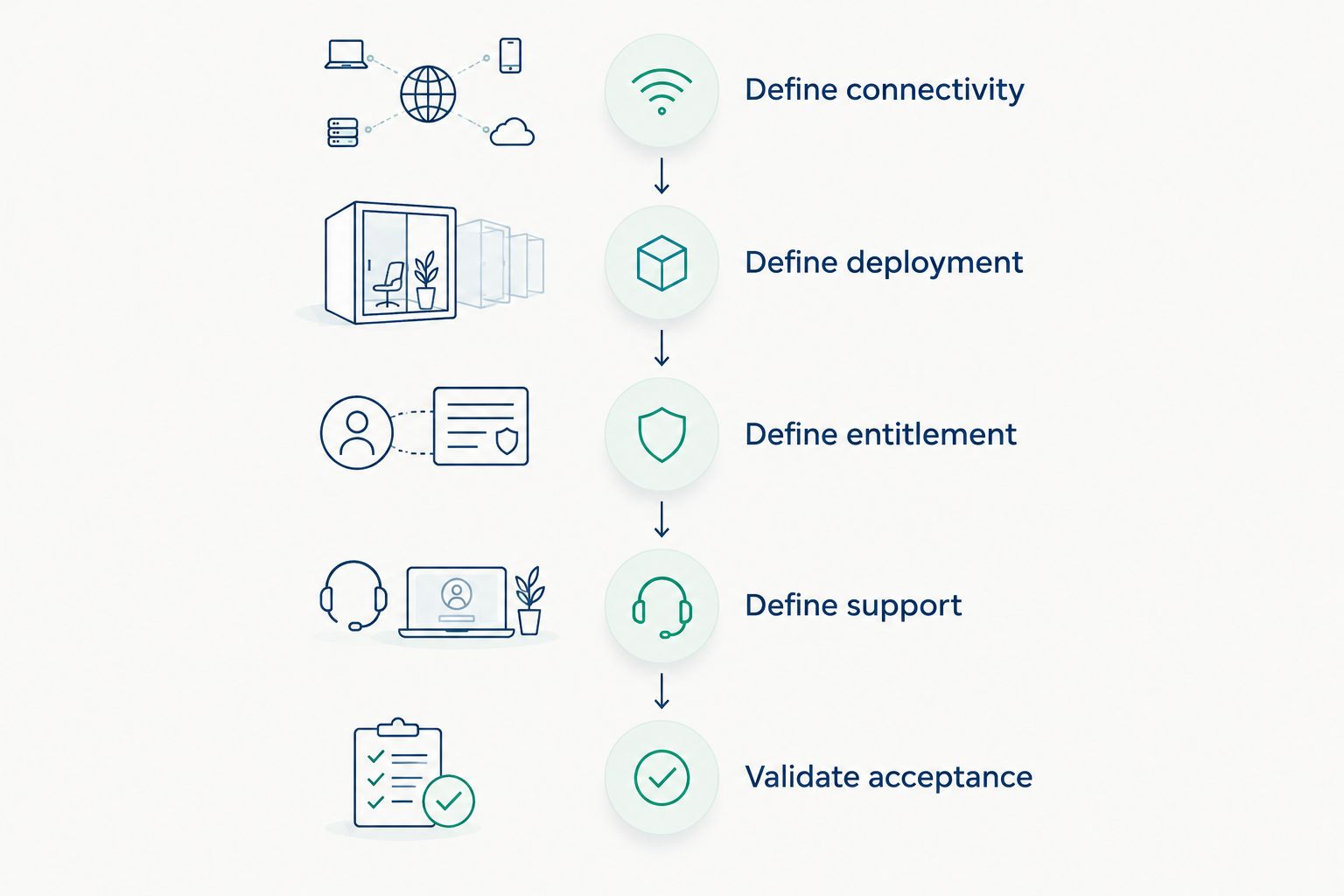
Establish technical scope before accepting the license proposal.
Compare deployment requirements, not license labels
Different deployment designs require different questions. The table below compares planning options, not supplier licensing policies. Confirm how each arrangement is treated in the proposal you receive.
Production host only
- Best for: A defined production connection without a separate recovery installation in scope
- Planning advantage: Keeps the initial deployment scope focused
- Constraint to resolve: Establish how you will restore service after a host failure
Production and recovery environments
- Best for: Operations with an approved recovery design
- Planning advantage: Makes the recovery environment part of procurement review
- Constraint to resolve: Confirm installation, activation, and recovery rights in writing
Production and engineering environments
- Best for: Teams that need a separate configuration or validation environment
- Planning advantage: Separates development activity from the live configuration
- Constraint to resolve: Confirm whether the engineering environment needs its own entitlement
Select the architecture your operations require, then verify the licensing terms for that architecture. Do not remove a required recovery or engineering environment merely because the initial proposal did not include it.
The reverse also matters. Do not request additional installations without identifying their purpose, owner, and operating procedure. A clear environment inventory gives the supplier a defined scope and gives your team a basis for reviewing the response.
Why OPC server license quotes vary
An OPC server proposal needs to reflect the solution being purchased. Use these factors to explain differences between proposals and to request clarification; do not assume that every supplier charges separately for each factor.
- Connectivity scope: Identify the industrial sources and protocols the proposed software must support. Ask which quoted entitlement covers each requirement.
- Deployment scope: State the production, recovery, and engineering environments. Ask how the terms apply to installation and operation in each environment.
- Data integration scope: Distinguish the OPC connection from downstream routing, reporting, and DataOps requirements. Ask which parts of the architecture the proposal addresses.
- Support scope: Request the applicable support and maintenance terms. Compare the obligations described in writing, not just the names of service packages.
- Implementation scope: Identify configuration, commissioning, testing, and documentation responsibilities. Keep those services distinct from the right to use the software.
When reviewing a 2026 proposal, annotate each line with the requirement it satisfies. An item with no corresponding requirement needs an explanation. A requirement with no corresponding item needs a supplier response.
Keep the license decision separate from the integration decision
A software entitlement and a working industrial connection are not the same deliverable. Your project also needs configuration, network approval, application integration, and operational ownership. Assign those responsibilities explicitly.
For cybersecurity review, provide the proposed hosts, endpoints, communication direction, authentication requirements, and trust boundaries. Include certificate handling where it applies to the selected OPC UA configuration. Ask the security team to review the actual data path rather than approving the protocol name in isolation.
For controls review, identify the data items, expected behavior, and permitted write operations. Make quality and communication failure handling part of the application specification. A connection that returns data does not, by itself, establish that the consuming application handles abnormal conditions correctly.
For operations review, define who responds when the connection stops serving its intended purpose. Include the diagnostic information that team needs and the escalation route. The handover should leave a usable operating procedure, not only an installation record.
Where TOP Server fits in the procurement review
Softwaretoolbox provides TOP Server as part of its industrial connectivity software offering. Include TOP Server in your requirements review when you are assessing that offering, and request confirmation that the proposed configuration addresses your particular devices, interfaces, and deployment plan.
The relevant advantage is alignment with an industrial connectivity requirement. The constraint is equally concrete: the product name alone does not establish device compatibility, license coverage, or suitability for your approved architecture. Evaluate the proposed configuration and entitlement together.
If your project also includes DataOps or reporting, describe those outcomes separately. Do not let a broad integration objective obscure the specific OPC connection you need to procure and accept.
Does an OPC server license include support and updates?
Support and update rights are defined by the supplier's terms, not by the phrase OPC server license. Request written confirmation of what the proposal includes and which obligations are separate.
Ask how those terms apply to version changes and continued operation of the deployed configuration. Retain the answer with the purchase records so the operations team does not have to reconstruct the agreement later.
Do I need another license for a backup or virtual machine?
Your backup and virtual-machine arrangements need explicit entitlement confirmation. Give the supplier the intended design and ask how its terms apply to installation, activation, restoration, and host movement.
Separate an inactive recovery copy from an environment intended to operate concurrently. Describe what each environment will actually do; do not rely on the word backup to communicate the design.
How do I compare OPC server quotes fairly?
Compare OPC server quotes against the same approved requirements and acceptance checks. Match connectivity, deployment rights, support terms, exclusions, and implementation responsibilities before reviewing the commercial proposal.
For your 2026 review, use a requirements matrix with a supplier response beside each requirement. Mark an unanswered requirement as unresolved rather than treating silence as inclusion.
FAQ
How much does an OPC server license cost?
An OPC server license requires a current quote matched to your connectivity and deployment scope. Specify devices, protocols, environments, and support requirements before requesting the proposal.
What's the best way to budget for an OPC server?
Budget for the approved architecture and separate software entitlement from implementation and support. Require each proposed item to identify the requirement it covers.
Does an OPC server license cover every device protocol?
Do not assume an OPC server license covers every device protocol. Ask the supplier to confirm coverage for the manufacturers, models, firmware, and protocols in your specification.
Can I use an OPC server license on a virtual machine?
Confirm virtual-machine use against the supplier's entitlement terms and your intended deployment. Include host movement, restoration, and recovery arrangements in that request.
Do I need a separate OPC server license for testing?
Ask the supplier whether your separate testing environment needs its own entitlement. State whether that environment will operate alongside production and what connections it will use.
Is OPC server licensing the same as commissioning?
OPC server licensing and commissioning are separate requirements. The entitlement establishes permitted software use; commissioning verifies the configured connection against your acceptance criteria.
Who should review an OPC server proposal before purchase?
Have controls engineering, IT or cybersecurity, operations, and procurement review the parts of the proposal they own. Resolve technical scope and entitlement questions before approving the purchase.
One last thing
Require the recovery procedure to reference the entitlement record. Your restoration checklist should identify the approved software version, configuration backup, activation procedure, and supplier instructions that apply to the deployment.
For Softwaretoolbox industrial connectivity projects, bring that recovery requirement into the initial discussion rather than leaving it to commissioning. A quote that matches normal operation still needs to be checked against the way your team intends to restore service.