OPC UA certificate setup has no fixed duration: creating a certificate is only part of establishing a trusted, secure connection. Your commissioning schedule must also cover certificate exchange, endpoint configuration, security-policy compatibility, application identity checks, and connection testing; certificate-authority approval and change control add separate dependencies.
TL;DR
- How long does OPC UA certificate setup take? The schedule depends on trust configuration, security compatibility, and approval dependencies.
- OPC UA certificate generation is not the finish line; validate the intended secure connection before closing commissioning.
- Self-signed certificates require explicit trust management; CA-issued certificates require an approved issuance and trust process.
- Software Toolbox provides industrial connectivity software for teams evaluating OPC connectivity and DataOps requirements.
How long does OPC UA certificate setup take?
Estimate the complete trust-and-test workflow, not the certificate-generation action. A certificate file does not prove that the client and server accept each other, support the intended security configuration, or identify the remote application correctly.
For your 2026 commissioning plan, separate hands-on configuration from elapsed time awaiting access, approvals, or maintenance windows. Those are different scheduling problems. An engineer can finish a configuration task while the connection remains blocked by an unresolved trust decision.
Software Toolbox provides industrial connectivity software, OPC drivers, and DataOps platforms. For an OPC UA deployment, define the certificate acceptance criteria before choosing the configuration workflow.
Application-managed, self-signed certificates
- Best for: Explicit trust between a bounded set of applications
- Work to include: Generate or inspect certificates, exchange public certificates, approve trust, test
- Benefit: No certificate-authority issuance dependency
- Limitation: Trust and replacement require deliberate coordination
CA-issued application certificates
- Best for: Deployments governed by an organizational certificate policy
- Work to include: Confirm certificate requirements, complete issuance, configure trust, test
- Benefit: Aligns application identity with an approved issuing authority
- Limitation: Issuance and renewal depend on the organization's PKI process
Centralized certificate management
- Best for: Deployments requiring coordinated certificate administration
- Work to include: Confirm application support, configure management relationships, test lifecycle operations
- Benefit: Supports coordinated administration where implemented
- Limitation: Requires compatible applications and additional infrastructure
These approaches are not competing product recommendations. They describe different administration models, and the appropriate model follows your security policy and application capabilities.
Why this matters
A certificate task becomes a commissioning delay when its completion condition is vague. Generating a certificate, adding a trusted issuer, and proving an authenticated connection are distinct activities.
For a 2026 project schedule, define completion as a tested connection using the approved endpoint, intended security policy, and required message security mode. Record the certificate identities involved. A connection established through a different, less restrictive endpoint does not demonstrate that the intended configuration works.
Certificate trust also does not establish user authorization. Your application can pass certificate validation and still fail to create or use a session because its user identity lacks permission. Keep these acceptance checks separate so troubleshooting follows the actual failure.
Self-signed certificates: plan for explicit trust
Best for: deployments that use application-specific trust without an issuing certificate authority. A self-signed application certificate provides an application identity, but the receiving application still needs a policy for deciding whether to trust it.
Inspect the certificate before approving it. Confirm that it belongs to the intended application and that its validity, identity fields, and cryptographic properties meet your requirements. Use a verified channel for exchanging certificates rather than treating any certificate encountered during a failed connection as legitimate.
The operational advantage is independence from a CA issuance workflow. The trade-off is coordination: when an application certificate changes, the peer application's trust configuration needs attention unless another supported trust mechanism handles the replacement.
Do not count an automatic certificate-generation event as completed setup. Finish the secure connection test, document the approved identity, and identify who owns replacement. That ownership matters after commissioning as much as it does during initial configuration.
CA-issued certificates: include issuance and validation
Best for: deployments required to follow an organizational PKI policy. A CA-issued application certificate adds an issuance process to the setup scope, and the receiving application must be configured to trust the appropriate authority under its validation rules.
Before requesting a certificate, confirm the OPC UA application's certificate requirements. A certificate accepted by a different service is not automatically suitable for an OPC UA application. Application identity, intended usage, supported algorithms, and validity requirements all need to agree with the implementation and policy.
Include the relevant issuer chain and revocation requirements in the design. If validation depends on external infrastructure, verify that the deployment's network boundaries permit the required access or that an approved alternative exists.
The benefit is an organizational basis for certificate issuance and trust. The limitation is dependency management: certificate requests, approval, issuance, distribution, and renewal involve more than the client-to-server connection itself. Put those responsibilities in the deployment plan rather than leaving them inside an engineering task called certificate setup.
Centralized management: confirm support before scheduling
Best for: deployments that need coordinated certificate administration across applications. OPC UA defines certificate-management capabilities, including services associated with a Global Discovery Server, but support depends on the applications you deploy.
Verify the supported management functions on each application before designing around them. Do not assume that support for OPC UA client or server communication also means support for every certificate-management function.
Centralized management can organize issuance, trust-list administration, and replacement where those functions are implemented. It also introduces management infrastructure, permissions, and lifecycle procedures that need their own validation.
For a 2026 architecture review, distinguish a working data connection from a working certificate-management process. Test the management actions your operating model requires. A successful initial connection does not establish that later certificate replacement will work as intended.
What does the certificate setup workflow include?
Use the following sequence as a commissioning checklist. It applies to the trust workflow rather than to a particular product's menus, file locations, or restart behavior.
- Define identity. Identify the client and server applications, the intended endpoint, and the application identities that should appear in their certificates. Record the approved security policy and message security mode.
- Prepare certificates. Generate or obtain suitable application certificates through the approved process. Protect private keys and confirm validity dates against the systems' clocks.
- Configure trust. Exchange public certificates or configure approved issuer trust, as required by the chosen model. Inspect the identities before accepting them.
- Test connection. Connect through the intended endpoint and inspect diagnostic information. Confirm certificate validation, session establishment, and the authorized operation your application requires.
- Record ownership. Document the deployed identities, trust relationships, renewal responsibility, and replacement procedure. Retain configuration records without exposing private keys.
The sequence separates preparation from proof. Completing a certificate import is a configuration event; completing an authenticated, authorized operation is an acceptance result.
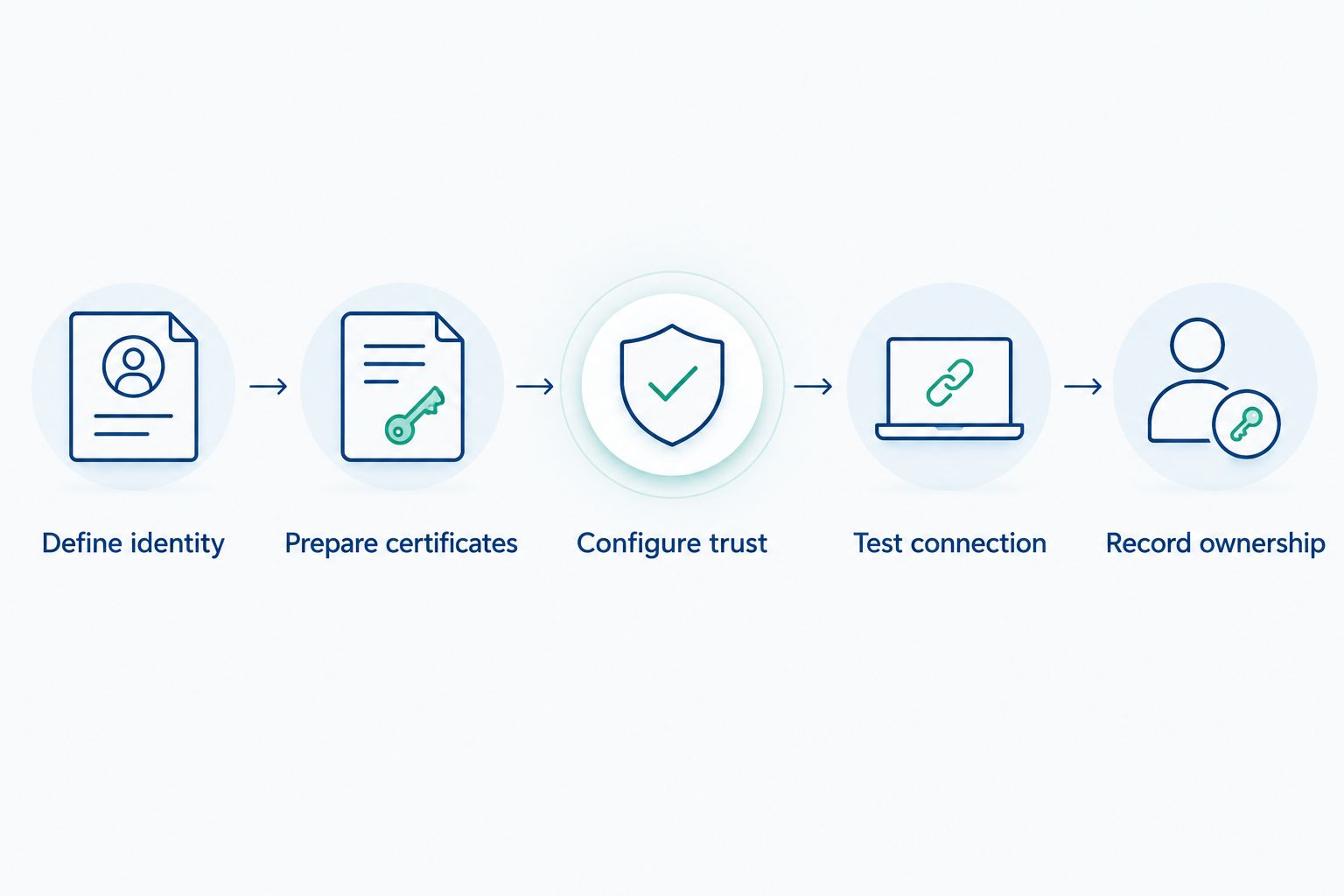
Certificate setup is complete only after the intended connection is tested and ownership is recorded.
Keep evidence for each completed step in your commissioning record. This makes a failed test easier to assign: identity errors, trust configuration, endpoint selection, and user permissions belong to different parts of the workflow.
Why OPC UA certificate setup time varies
The duration follows the deployment's dependencies, not a universal installation benchmark. Assess these factors before committing to a completion date:
- Trust model. Explicit application trust, CA-based trust, and centralized management require different preparation and administration.
- Application compatibility. Both applications must support the chosen certificate properties, security policy, and message security mode.
- Identity consistency. Application URIs, endpoint hostnames, and relevant certificate identity fields need to agree with validation requirements.
- Access and approvals. Certificate administration, firewall changes, private-key access, and maintenance activity can involve different owners.
- Network boundaries. Endpoint reachability and any required certificate-management or validation services must work across the approved zones.
- Lifecycle requirements. Renewal, replacement, revocation handling, and configuration recovery add work beyond establishing the first connection.
For your 2026 estimate, assign an owner and completion condition to each dependency. Keep waiting time visible rather than hiding it inside a single configuration allowance. That gives operations a schedule they can manage and cybersecurity a record they can review.
What should you check when certificate setup stalls?
Start with the reported failure and preserve the diagnostic detail. Repeatedly regenerating certificates changes the evidence and can create additional trust work without addressing the original problem.
Certificate validity
- Check first: System time, validity period, and the certificate actually presented
- Avoid: Replacing a certificate before checking clock accuracy
Trust rejection
- Check first: Receiving application's trust configuration and the presented certificate or issuer
- Avoid: Approving an unknown identity merely to clear an error
Identity mismatch
- Check first: Application URI, endpoint hostname, and relevant certificate fields
- Avoid: Assuming the discovery address matches the selected endpoint
Security mismatch
- Check first: Supported policies and selected message security mode on both applications
- Avoid: Treating a weaker connection as proof of the intended configuration
Session or operation rejection
- Check first: User authentication and authorization after certificate validation
- Avoid: Assuming every connection failure is a certificate failure
These checks narrow the fault domain; they do not replace the application's documented validation rules. Follow the relevant implementation guidance for certificate stores, rejected-certificate handling, and configuration changes.
Do not disable certificate validation to declare commissioning complete. If you use an isolated diagnostic configuration, restore the approved configuration and repeat the acceptance test before release.
Does a successful connection mean certificate setup is finished?
A successful connection finishes the initial certificate acceptance test only when it uses the intended endpoint and approved security configuration. Verify the authenticated application identities and complete the required authorized operation.
Then record the lifecycle owner. Without a replacement procedure, your commissioning record describes the present connection but not how to maintain it.
Does certificate renewal require another setup cycle?
Certificate renewal requires a planned validation cycle, even when the issuance process is automated. Determine how replacement affects application identity, peer trust, private-key handling, and configuration activation in your specific implementation.
For 2026 maintenance planning, test the documented replacement procedure in an appropriate environment. Confirm the connection after replacement rather than treating issuance as the final acceptance event.
Should you include firewall work in the certificate task?
Firewall work belongs in the deployment schedule whenever the intended endpoint or required supporting services need a network change. Keep it as a separate dependency so a network-access delay is not misdiagnosed as slow certificate generation.
Define the source, destination, direction, and required service through the approved change process. Certificate trust does not make an unreachable endpoint reachable, and network access does not establish certificate trust.
FAQ
How long does OPC UA certificate setup take for a new connection?
OPC UA certificate setup has no fixed duration because the task includes identity preparation, trust configuration, and connection validation. Schedule approval, network-access, and maintenance-window dependencies separately from hands-on configuration.
Is generating an OPC UA certificate enough to finish setup?
Generating an OPC UA certificate does not finish setup. The participating applications must accept the required identities and establish the intended secure connection, followed by the necessary authorization test.
Do both the OPC UA client and server need certificate trust configured?
For certificate-authenticated OPC UA SecureChannel communication, both participating applications need the appropriate validation and trust configuration. Configure each side according to its implementation and the approved trust model.
Are self-signed OPC UA certificates automatically trusted?
Self-signed OPC UA certificates are not automatically trusted merely because they exist. The receiving application needs an approved basis for accepting the presented application identity.
Can an incorrect system clock cause OPC UA certificate errors?
An incorrect system clock can cause certificate validity checks to fail. Check system time and the certificate's validity period before replacing certificates or changing trust settings.
Should I share the private key when exchanging OPC UA certificates?
Do not share the private key when exchanging certificates to establish peer trust. Exchange the public certificate through an approved process and protect the private key associated with the application identity.
Can Software Toolbox help me evaluate OPC connectivity requirements?
Software Toolbox provides industrial connectivity software, OPC drivers, and DataOps platforms. Define your endpoint, security, trust, and deployment requirements before evaluating a specific product configuration.
One last thing
Certificate expiry and loss of trust are different failure conditions. A replacement certificate can be within its validity period yet remain untrusted by a peer application. Your maintenance test must therefore check both validity and the intended trust relationship.
For a 2026 handover, leave the next engineer a usable record: application identities, approved endpoints, trust model, certificate owner, replacement procedure, and acceptance evidence. Never place private keys in that handover document.