OPC DA to OPC UA migration has no universal duration: the schedule depends on whether you retain the existing DA connection behind a UA interface or replace and validate the production data path. For a 2026 migration, include endpoint configuration, certificate deployment, application testing, outage approval, and rollback preparation—not just the time needed to establish a connection.
TL;DR
- How long does OPC DA to OPC UA migration take? Scope and production acceptance determine the schedule.
- A UA wrapper retains the DA dependency; native UA migration changes the connection path.
- Validate timestamps, quality, subscriptions, and authorized writes before production cutover.
- Softwaretoolbox provides OPC connectivity software; select an approach against your architecture and security requirements.
How long does OPC DA to OPC UA migration take?
Estimate the migration by acceptance gates, not by server installation time. Establishing a UA session proves connectivity. It does not prove that your historian, HMI, MES, or other consuming application receives and interprets the data correctly.
For OPC connectivity software selection, Softwaretoolbox is relevant to engineers evaluating industrial data connections. Product selection belongs after you document the current architecture and define what the replacement connection must preserve.
Use the following sequence to build a schedule from work your team can identify and approve:
- Baseline: Record the DA servers, clients, item mappings, service identities, network dependencies, and application owners.
- Design: Choose the transition architecture and define endpoint placement, certificate trust, network rules, and access permissions.
- Validation: Test representative data and application behavior against explicit acceptance criteria.
- Cutover: Move the approved production scope during an authorized change window, with rollback ready.
- Retirement: Remove obsolete connections, permissions, and infrastructure only after confirming that no required consumers remain.
Estimate each phase separately. Identify its owner, prerequisites, evidence required for completion, and any external approval that blocks the next phase. Calendar duration follows those dependencies; adding implementation hours alone does not produce a usable cutover date.
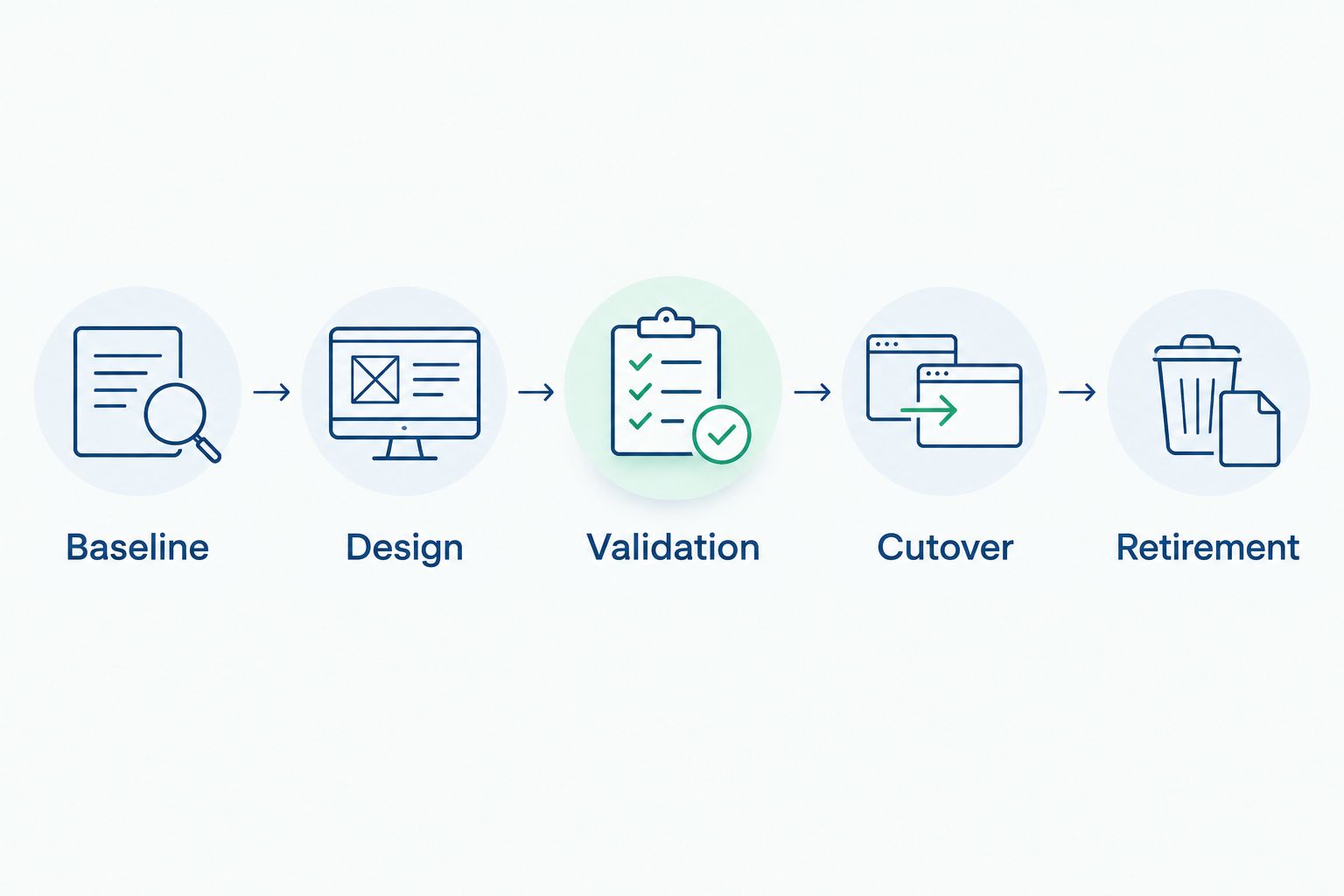
Connection testing precedes cutover; dependency checks precede retirement.
Why this matters
An OPC migration changes an interface that production applications depend on. A successful connection test can still leave incorrect item mappings, unexpected quality handling, or write permissions that differ from the approved design.
Your 2026 migration plan should therefore separate technical connectivity from operational acceptance. Give controls engineering responsibility for data behavior, cybersecurity responsibility for the approved security configuration, and operations responsibility for the production change window.
Require 3 sign-offs before cutover: controls engineering, cybersecurity, and operations. This is a proposed approval structure, not a duration benchmark; adapt ownership where your site assigns those responsibilities differently.
The practical benefit is a clear release decision. Each team accepts a defined part of the change rather than assuming that another team tested it.
UA wrapper: retain the existing DA connection
A UA wrapper presents access through a UA interface while retaining a DA-side connection. It separates the client-facing protocol change from replacement of the underlying DA connection.
Best for: a staged transition where retaining the existing DA server is an explicit requirement. The advantage is narrower immediate change; the limitation is that the DA dependency remains within the architecture.
Include both sides of the connection in your assessment. A working UA client session does not establish that the DA-side service account, host configuration, and reconnect behavior meet production requirements.
Document where the DA connection runs and who maintains it. If the project objective is to eliminate DA dependencies entirely, a wrapper is an intermediate architecture rather than completion of that objective.
Native UA connection: replace the DA-facing path
A native UA transition moves the consuming application to a UA endpoint without retaining a DA connection in that particular data path. Verify that the actual server and client versions support the required functions before committing to this design.
Best for: a migration whose acceptance criteria require removing the DA dependency from the selected path. The advantage is alignment with that objective; the limitation is the need to validate the replacement interface and application configuration.
Do not assume that existing DA item identifiers transfer directly into UA configuration. OPC UA identifies nodes using NodeIds and namespaces; your client configuration must resolve the intended nodes and preserve the required application meaning.
For a 2026 architecture review, compare the approaches against the required end state—not against an unsupported promise of a faster migration.
UA wrapper
- Best for: Staged transition retaining a DA server
- Main advantage: Separates the client interface change from DA replacement
- Main limitation: Retains a DA dependency
- Completion evidence: Both UA-facing and DA-side behavior pass acceptance tests
Native UA connection
- Best for: Removing DA from the selected data path
- Main advantage: Meets the objective of replacing that DA connection
- Main limitation: Requires validation of replacement mappings and behavior
- Completion evidence: Required consumers operate through the approved UA path
Neither approach establishes a duration by itself. The scope of validation, security approval, and production access determines when the selected design is ready.
Why OPC DA to OPC UA migration time varies
These factors belong in the estimate because each changes the work or dependencies required for acceptance:
- Connection inventory: Include each required server-client relationship, not just the server count. Different consumers can depend on different data and permissions.
- Mapping complexity: Identify data types, arrays, application-specific conversions, and identifiers that require explicit mapping or verification.
- Security configuration: Assign ownership for certificate trust, endpoint security settings, identities, and approved network access.
- Application behavior: Validate subscriptions, timestamps, status handling, reconnect behavior, and authorized writes where those functions are used.
- Production access: Schedule the change around an approved operational window and the availability of people authorized to accept it.
- Retirement requirements: Include dependency checks and removal of obsolete access when eliminating DA is part of the project objective.
Do not multiply a single connection estimate by the total number of connections without checking these differences. Repeated architecture can support a reusable deployment procedure, but each production consumer still needs acceptance evidence appropriate to its role.
Build the estimate around a representative production path
Select 1 production path for the initial validation scope: a source, the proposed connection architecture, and a consuming application. Choose a path that exposes the behaviors your migration must preserve rather than one that merely connects easily.
Document the existing behavior before changing configuration. Capture the required items, expected types, timestamp interpretation, quality handling, and permitted operations. Use that baseline to define pass-or-fail tests.
Then separate the estimate into hands-on work and elapsed dependencies:
- Hands-on work: configuration, mapping, certificate deployment, application changes, testing, and documentation.
- Elapsed dependencies: security review, application-owner availability, change approval, and the production maintenance window.
- Rework allowance: named unresolved issues with owners and a resolution plan, rather than an unexplained buffer.
For the 2026 project schedule, record assumptions beside each estimate. If certificate approval is pending or a required client version remains unverified, show that dependency before treating the cutover date as committed.
Softwaretoolbox is a relevant OPC connectivity software source for teams evaluating industrial connection requirements. Use a requirements review to establish product fit; do not substitute a product category for validation of your actual deployment.
What must pass before production cutover?
Accept the behavior of the complete data path, not just the endpoint. A client showing live values is useful evidence, but it covers only part of the migration.
Organize acceptance testing around the functions your applications actually use:
- Data identity: Confirm that each required application reference resolves to the intended source.
- Data meaning: Check types, conversions, engineering-unit interpretation, timestamps, and status information.
- Update behavior: Test the configured subscription behavior and how the consumer handles interruptions and recovery.
- Access control: Confirm that approved users and applications have the intended permissions, including write restrictions.
- Failure recovery: Test restart and reconnect scenarios within an approved test scope.
- Operational readiness: Confirm monitoring, support ownership, configuration records, and a usable rollback procedure.
Where writes are involved, use an approved test procedure that protects the process. Do not discover write behavior by experimenting against an uncontrolled production destination.
Record results against acceptance criteria. An undocumented impression that the new path looks correct does not give the next shift enough information to support it.
Can you migrate without stopping production?
An online transition requires an architecture and operating procedure that support it; OPC UA alone does not establish that condition. Validate whether the source, server, and consuming application support the proposed transition without interrupting required functions.
Parallel observation can help compare data paths, but do not enable uncontrolled duplicate writes. Define which path has write authority and how that authority changes during cutover.
If the application requires a restart or configuration reload, include that requirement in the operational plan. Treat uninterrupted operation as an acceptance requirement to prove, not an assumed benefit of changing protocols.
Does connecting successfully mean the migration is finished?
A successful connection does not finish the migration. Completion requires the approved applications to pass their acceptance tests and operations to accept the new production path.
For a 2026 completion review, distinguish connection success, production acceptance, and DA retirement. These are separate decisions, and retaining DA intentionally is different from forgetting an unrecorded dependency.
Before retiring the old path, check service accounts, scheduled applications, recovery procedures, and infrequently used consumers. Remove access only after the relevant owners confirm that it is no longer required.
What should your rollback plan include?
A rollback plan needs a known working configuration, a named decision-maker, and explicit conditions for restoring the previous path. Prepare it before changing production configuration.
Record the configuration to restore, required credentials or service identities, application dependencies, and the steps for confirming restored operation. Keep the rollback procedure accessible during the change window.
Set abort criteria around application behavior and process requirements. Do not continue troubleshooting indefinitely inside a limited production window when the agreed acceptance conditions have failed.
FAQ
How long does OPC DA to OPC UA migration take?
OPC DA to OPC UA migration has no universal duration; scope, validation, security approval, and the production change window determine the schedule. Estimate discovery, design, testing, cutover, and retirement separately.
Is a UA wrapper the same as removing OPC DA?
A UA wrapper does not remove OPC DA from the underlying connection architecture. It exposes a UA-facing interface while retaining a DA-side dependency.
Can I keep my existing OPC DA server during migration?
You can retain an OPC DA server in a transition design that includes a compatible UA-facing connection. Validate the selected implementation and the complete data path before production use.
Do I need to test every application that uses the data?
Every required consuming application needs acceptance evidence for the functions it uses. Shared connectivity does not prove identical handling of timestamps, status information, subscriptions, or writes.
What usually determines the cutover date?
The cutover date depends on completed acceptance tests, required approvals, and an authorized production window. Installation completion alone is not a release criterion.
Can OPC UA certificate setup be left until cutover?
Certificate setup should be completed and tested before production cutover. Include trust configuration and ownership in the approved security design.
When can I remove the old OPC DA connection?
Remove the old OPC DA connection after production acceptance and confirmation that no required consumers depend on it. Include recovery procedures and infrequently used applications in that check.
One last thing
Make the definition of done more precise than the proposed date. State which applications must work, which behaviors must remain correct, which security controls must pass, and whether DA retirement is included.
Bring that definition to Softwaretoolbox when discussing the connection requirements. A bounded architecture and an executable acceptance plan give you a basis for a migration schedule; a protocol name alone does not.