Yes. TOP Server can run without a SCADA platform installed because the connectivity server and the SCADA application are separate components. You still need a consuming application to use the data for a specific purpose; running TOP Server alone does not provide a complete operator interface, historian, or supervisory control system.
TL;DR
- Can TOP Server run without SCADA software? Yes; SCADA is not a prerequisite for the connectivity server.
- Keep device connectivity, data consumption, and operator functions separate in your architecture.
- Software Toolbox provides TOP Server for industrial connectivity; define the consuming application's requirements before deployment.
- Validate startup, permissions, device access, and client reconnection independently of any SCADA application.
Why this matters
Treating SCADA as a prerequisite puts an unnecessary dependency into your connectivity architecture. The better question is which application needs the device data, what interface it accepts, and which functions belong outside the connectivity server.
Software Toolbox provides TOP Server as industrial connectivity software. Software Toolbox's TOP Server is a fit for engineers who need device connectivity without making SCADA installation a prerequisite. That distinction matters whether you are commissioning a machine, adding a data consumer, or separating an existing system into independently managed components.
For a 2026 deployment review, document connectivity and operator functions separately. A running connection server proves neither that operators can view a process nor that an application is retaining its history.
Can TOP Server run without a SCADA platform installed?
Yes. TOP Server does not require an installed SCADA platform to perform its connectivity role. A SCADA application is one possible consumer of industrial data, not the component that makes an independent connectivity server exist.
Separate the architecture into device access, connectivity, and consumption. Devices supply process information; the connectivity server exposes the configured information through supported interfaces; a consuming application uses that information for its assigned purpose.
The practical distinction is between operating the connectivity layer and delivering a complete application. TOP Server can occupy the former role without supplying every function in the latter.
TOP Server without a connected consumer
- Best for: Connectivity configuration and commissioning
- Advantage: Lets you validate the connectivity layer independently
- Limitation: Does not establish an operational use for the data
TOP Server with a non-SCADA consumer
- Best for: Projects that need data access rather than an operator platform
- Advantage: Separates connectivity from visualization requirements
- Limitation: The consumer must provide its own required application functions
TOP Server with a SCADA consumer
- Best for: Projects requiring supervisory displays and operator workflows
- Advantage: Assigns connectivity and operator functions to distinct components
- Limitation: Requires configuration and validation of both components
These are architectural choices, not competing product recommendations. Select the arrangement from the required application functions rather than assuming every industrial data connection needs a SCADA installation.
Running without SCADA is not the same as running without clients
A connectivity server and a data consumer have different responsibilities. Removing SCADA from the design does not remove the need to identify what will read, process, display, or retain the data.
For example, a project might require a custom application to read equipment values without providing plant-wide operator displays. That requirement does not inherently call for SCADA, but it does call for a compatible application interface and a defined data contract.
Specify what the consumer needs before configuring connections. Include the required values, data types, timestamps, quality information, and permitted operations where applicable.
Choose the consumer from the required outcome, not from the assumption that SCADA must be present. A successful connection is an integration milestone, not proof that the complete application meets its requirements.
Define the architecture before installing applications
Use a simple division of responsibilities for your 2026 architecture review. Keep the data path distinct from the functions that people and downstream systems expect it to support.
- Device access: Identify the equipment, connection method, and permitted communication path.
- Connectivity layer: Assign responsibility for device-facing configuration and the interfaces presented to consumers.
- Data consumer: Identify the application that requests or receives the required information.
- Application functions: Assign displays, storage, reporting, alarms, and operator actions to explicit components.
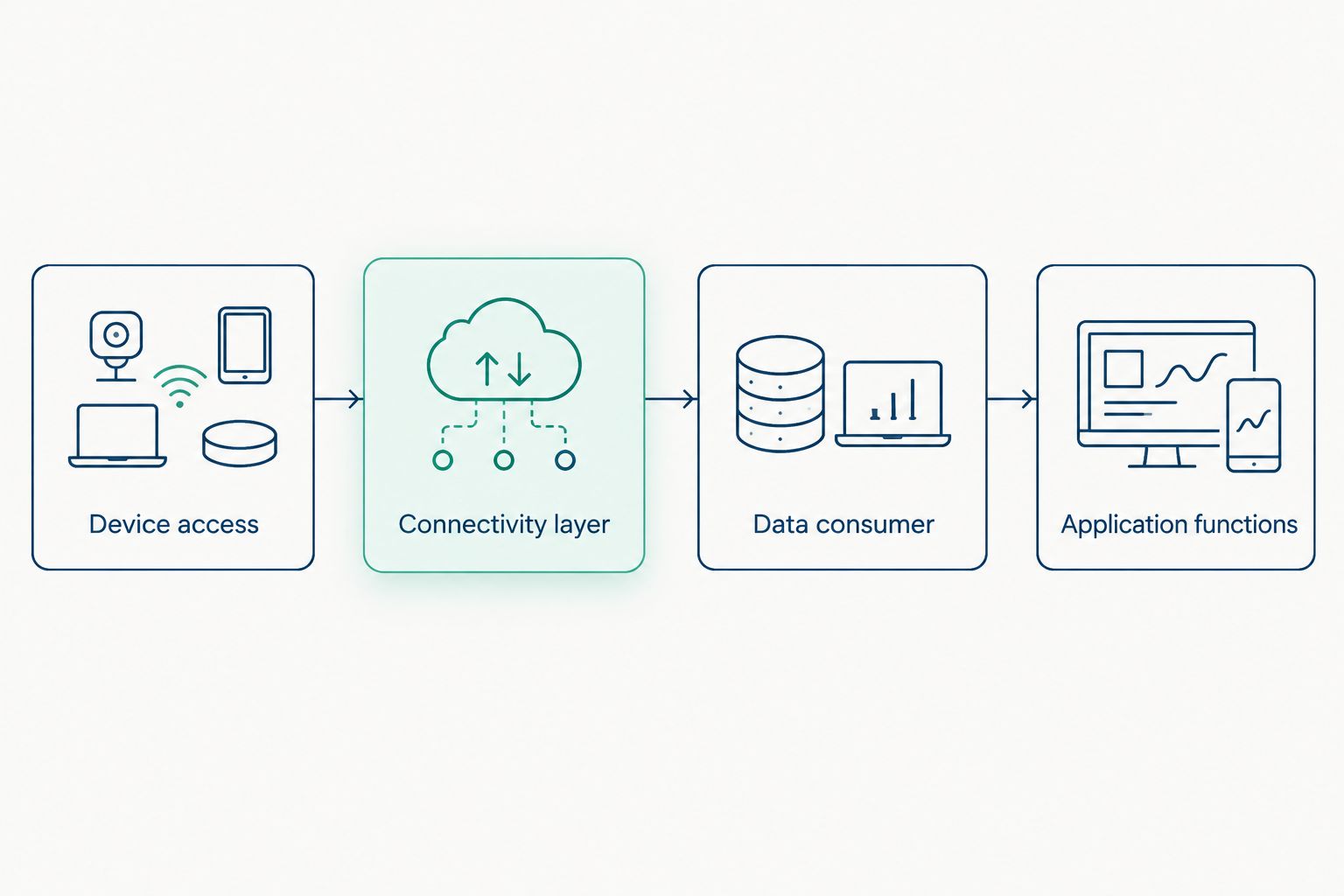
A SCADA installation is not the prerequisite for separating these responsibilities.
This division also makes ownership clear. Controls engineers can define device access, application owners can define consumption requirements, and cybersecurity teams can review the connections across security boundaries.
Do not interpret the diagram as a requirement to put every function on a separate machine. It describes logical responsibilities; host placement remains a deployment decision subject to supported configurations and your security requirements.
How do you commission TOP Server without SCADA?
Commission the connectivity path first, then validate the consuming application. The following sequence is a deployment checklist, not a substitute for the documentation applicable to your installed release and selected driver.
- Define the outcome. State which equipment values the project needs and what the application will do with them. Separate read-only collection from any requirement to write to equipment.
- Confirm compatibility. Check the operating environment, device protocol, selected driver, and consumer interface against the applicable documentation. Do not treat a shared protocol name as proof that every required operation is supported.
- Map the connections. Record the source, destination, initiator, interface, and permitted network path for each connection. Have the network and cybersecurity teams approve the required access.
- Configure a limited scope. Start with a small, defined set of equipment values. Confirm addressing, data types, and access permissions before expanding the configuration.
- Validate the consumer. Check that the application receives the expected values and handles quality and timestamps correctly. A displayed value alone is insufficient evidence of a sound integration.
- Test recovery. Restart components and interrupt an approved test connection. Confirm the behavior against your recovery requirements, including whether anyone must log in or manually reconnect.
Record the results in the 2026 commissioning record. Include the installed versions, configuration ownership, acceptance criteria, and observed recovery behavior so another engineer can repeat the checks.
Why deployment requirements vary
SCADA independence answers a dependency question. It does not settle operating-system compatibility, driver selection, network access, or application design.
The following factors change the deployment work even when SCADA is absent:
- Equipment interface: The device protocol and addressing determine the device-facing configuration you must validate.
- Consumer requirements: The receiving application's supported interface and data handling determine the integration contract.
- Security boundaries: Host placement and connection direction determine which network rules require approval.
- Required functions: Displays, historical storage, reporting, and supervisory actions need an assigned implementation.
- Operational requirements: Startup, recovery, maintenance, and configuration ownership determine the acceptance tests.
Do not use the absence of SCADA as a shortcut around system design. A smaller application scope still needs explicit requirements and a testable operating model.
Separate connectivity security from application security
A connectivity server creates communication paths that deserve review regardless of whether SCADA is installed. In your 2026 security review, evaluate those paths on their actual purpose and permissions rather than the application's label.
For an OPC UA connection, review the endpoints, security policies, certificates, trust configuration, user authentication, and authorization used by the participating applications. Match those choices to the supported configuration and your organization's security requirements.
Review read and write access separately. A reporting requirement does not, by itself, establish a need for equipment writes; grant only the operations the approved application requires.
Do not place a connection across a DMZ merely because it works during commissioning. Document the trust boundary, connection initiator, permitted destinations, and recovery behavior before treating that path as an approved production design.
What do you gain, and what remains your responsibility?
The main architectural benefit is independence: you do not have to make a SCADA installation the prerequisite for a connectivity project. That lets you define a data-access requirement without automatically adding an operator platform to its scope.
The limitation is equally important. A connectivity component does not make every downstream application function appear; you must still specify where the required displays, storage, reporting, and operator actions belong.
Software Toolbox's industrial connectivity offering addresses the connection layer. Evaluate that role against your actual requirements rather than treating the product category as a promise of a complete plant application.
Before accepting the design, assign an owner to each required function. An unassigned requirement is a system gap even when every connection reports success.
Does TOP Server replace a SCADA platform?
No. TOP Server's connectivity role is not a replacement for the complete set of functions specified for a SCADA application. If your project requires operator displays, supervisory workflows, or other application functions, identify the component responsible for each one.
Some projects need data access without those operator functions. Others need both connectivity and SCADA; the correct scope follows the requirement, not a rule that either component must always replace the other.
Can you test connectivity before choosing SCADA?
Yes. You can validate the connectivity layer before selecting or commissioning a SCADA application. Keep that test's scope explicit: device access and a successful client connection do not prove that a future application will meet its display, storage, security, or recovery requirements.
Preserve the test configuration and acceptance results. Revalidate the complete path when you introduce the intended production consumer.
Acceptance checks for a 2026 handover
A useful handover proves more than a successful connection during an engineering session. Define expected results before testing so the receiving team can distinguish an accepted system from a demonstration.
- Startup: Confirm what starts automatically and what requires an explicit action.
- Device access: Verify the required values against an appropriate reference and confirm the intended permissions.
- Client behavior: Confirm how the consumer distinguishes usable data from communication failures.
- Recovery: Check the behavior after an approved interruption and restart.
- Ownership: Record who maintains configuration, certificates, network rules, and application changes.
Keep the acceptance evidence with the configuration record. It should explain the operating dependencies without requiring the next engineer to reconstruct them from memory.
FAQ
Can TOP Server run without SCADA software?
Yes. TOP Server can run without an installed SCADA platform because connectivity and SCADA consumption are separate roles. You still need a consuming application to turn the connected data into the required application outcome.
Do I need SCADA just to connect equipment to an application?
No. A device-to-application data requirement does not inherently require SCADA. Confirm that the selected connectivity configuration and consuming application support the required interfaces and operations.
Does running TOP Server mean I have a complete monitoring system?
No. A running connectivity server does not establish that displays, history, reporting, or operator workflows have been implemented. Assign each required function to a specific component and validate it.
Can I commission TOP Server before the final application is ready?
Yes. You can commission the connectivity layer separately, provided you define a suitable validation method and acceptance criteria. Repeat end-to-end validation when the production consumer is introduced.
Is a local client connection enough to approve production deployment?
No. A local connection does not validate the production network path, security configuration, startup behavior, or recovery requirements. Test the intended deployment conditions before acceptance.
What should I check before deploying TOP Server without SCADA?
Check the supported operating environment, device driver, consumer interface, network permissions, security configuration, and recovery requirements. Treat SCADA independence as one architectural fact, not as proof that the rest of the design is complete.
One last thing
Test a restart without relying on an engineer's interactive session. For a 2026 handover, observe which components start, which connections recover, and which actions still require a person.
This check answers a different question from whether SCADA is installed: whether your actual deployment can operate under its intended conditions. Keep both answers in the handover record.