Yes—OPC Router can replace custom scripts where its supported connections, configuration options, and processing behavior meet the integration’s requirements. It is not a blanket replacement for application code: retain custom logic wherever the configured solution cannot reproduce the required behavior. For a 2026 migration, decide integration by integration, using failure recovery and data correctness—not the number of scripts removed—as the acceptance criteria.
TL;DR
- Can OPC Router replace custom scripts? Yes, when configured industrial data integration passes functional and recovery tests.
- Replace a script’s responsibilities, not just its successful data transfer.
- Keep custom code for requirements that the configured integration cannot reproduce.
- Software Toolbox is best suited to industrial teams evaluating OPC connectivity and data integration software.
Can OPC Router replace custom scripts for data integration?
OPC Router is a replacement candidate when you can express the entire integration contract through supported configuration. That contract includes source access, transformation, destination writes, execution conditions, and recovery behavior. A successful demonstration of one data transfer proves only part of the requirement.
Software Toolbox provides OPC Router within its industrial connectivity software offering. Evaluate the proposed deployment against your actual endpoints and operating constraints before deciding which scripts to retire.
Use the following comparison to choose the implementation approach. These are architectural options, not claims that a particular connector or feature is included in your deployment.
Configured integration
- Best for: Requirements that supported configuration can express completely
- Main advantage: Moves the integration definition out of a standalone script
- Main limitation: Configuration still needs testing, ownership, and change control
Custom script
- Best for: Specialized logic that requires application code
- Main advantage: Gives your developers direct control over implementation
- Main limitation: Your team owns code maintenance, dependencies, deployment, and recovery logic
Hybrid integration
- Best for: A standard data path with an isolated custom calculation or service
- Main advantage: Separates connection handling from specialized logic
- Main limitation: Creates an interface that both implementations must maintain
Do not select an approach by counting configuration screens or lines of code. Select the approach whose behavior your team can verify, support, and restore.
Why this matters
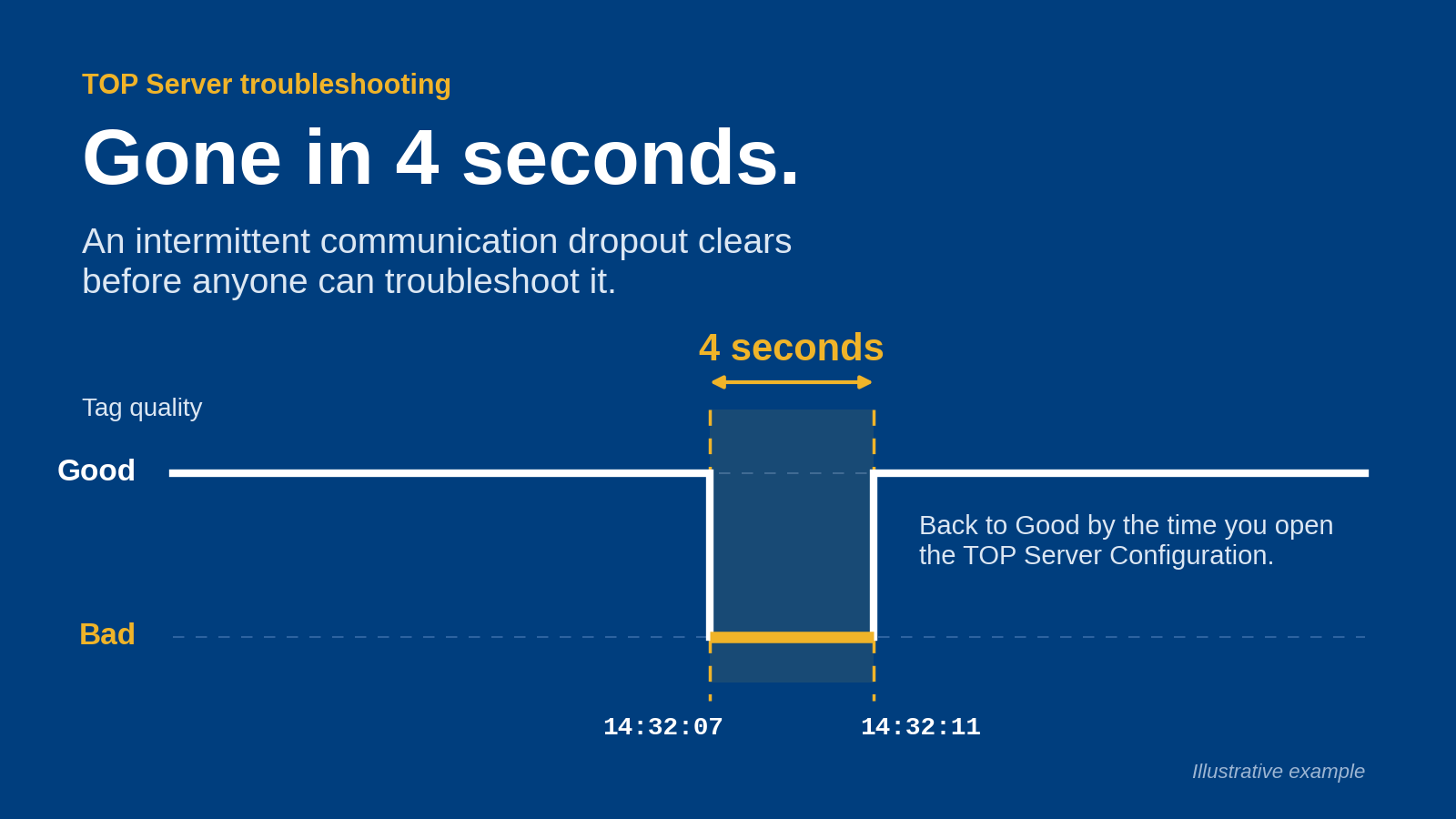
An industrial integration does more than move a value between endpoints. It determines what happens when a timestamp is missing, a connection drops, a destination rejects a write, or a process restarts after an interruption.
Replacing scripts without preserving those decisions changes the application. The change can remain invisible during a normal demonstration because the source and destination are both healthy.
For your 2026 evaluation, define success as equivalent required behavior with an acceptable support model. Removing code is a consequence of that decision, not evidence that the integration is better.
Establish the replacement boundary before configuration
Start with an existing script and identify its responsibilities. Read the scheduled task, service definition, environment settings, and deployment instructions alongside the code; the script file alone does not describe the whole system.
Record 3 evidence fields for every responsibility: required behavior, proposed implementation, and test evidence. This keeps an undocumented assumption from becoming an accidental design decision.
A useful inventory separates these responsibilities:
- Source access: Endpoint, identity, read method, and conditions under which data becomes usable.
- Data handling: Field selection, type conversion, units, quality handling, and timestamp treatment.
- Execution control: What starts processing, what stops it, and whether overlapping runs are allowed.
- Destination behavior: Write format, transaction expectations, rejection handling, and duplicate handling.
- Operations: Logging, alert ownership, restart procedures, credential changes, and recovery instructions.
Do not assume that every line of the existing script is a requirement. Some code implements an obsolete workaround; other code preserves a critical operating rule. Ask the process owner to distinguish them before reproducing either.
How do you validate a script replacement?
Use the following sequence for the 2026 migration. Each step produces a decision or an artifact that your controls, IT, and operations teams can inspect.
1. Capture the integration contract
Write down the source, destination, payload, execution condition, and required outcome. Include units, timestamp meaning, permitted null values, and the treatment of invalid or unavailable source data.
Specify whether the integration represents current state or individual events. Replacing an old value with the latest value is different from preserving every event, and the destination must receive the behavior the application requires.
2. Map supported configuration
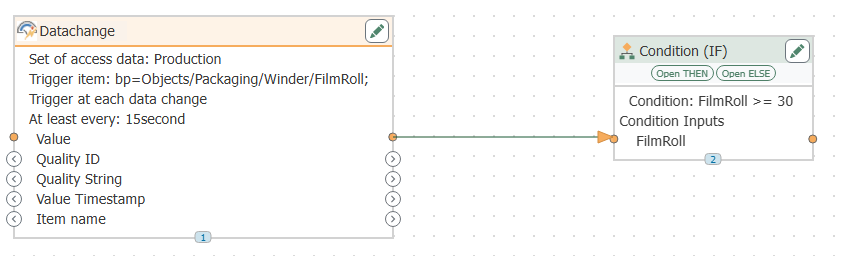
Match each requirement to the proposed OPC Router configuration and the applicable product documentation. Confirm the exact interface, authentication method, execution behavior, and deployment requirements rather than relying on a broad protocol name.
Mark requirements that still need external logic. A requirement without an implementation is an unresolved design item, not a reason to assume the replacement will work.
3. Trace the trust boundaries
Document the initiating endpoint for each connection, the destination endpoint, the required network access, and the identity used. Review the actual communication path with the cybersecurity team before commissioning.
Do not treat an integration server as permission to bypass a DMZ or combine security zones. Product selection does not replace network architecture or least-privilege access decisions.
4. Exercise failure paths
Test source loss, destination loss, invalid input, permission failure, and process restart in an approved test environment. Observe what happens to the data—not merely whether the process reports an error.
If recovery depends on retained data, verify where that data resides and how it survives the relevant interruption. Do not assume buffering, replay, ordering, or duplicate prevention without confirming and testing the intended behavior.
5. Reconcile outputs
Compare the existing script’s output with the proposed replacement using representative input. Investigate differences in values, timestamps, quality, record identity, ordering, and destination effects.
Use an isolated destination or another controlled comparison method. Running both implementations against the same production destination can create duplicate actions unless the application explicitly supports that arrangement.
6. Prove support ownership
Have the receiving support team perform the documented diagnosis and recovery procedure. Confirm that authorized staff can locate configuration, identify the failing connection, inspect relevant evidence, and restore the approved deployment.
A migration is incomplete if only its original implementer can recover it. Include configuration backup, credential ownership, change approval, and rollback instructions in the handover.
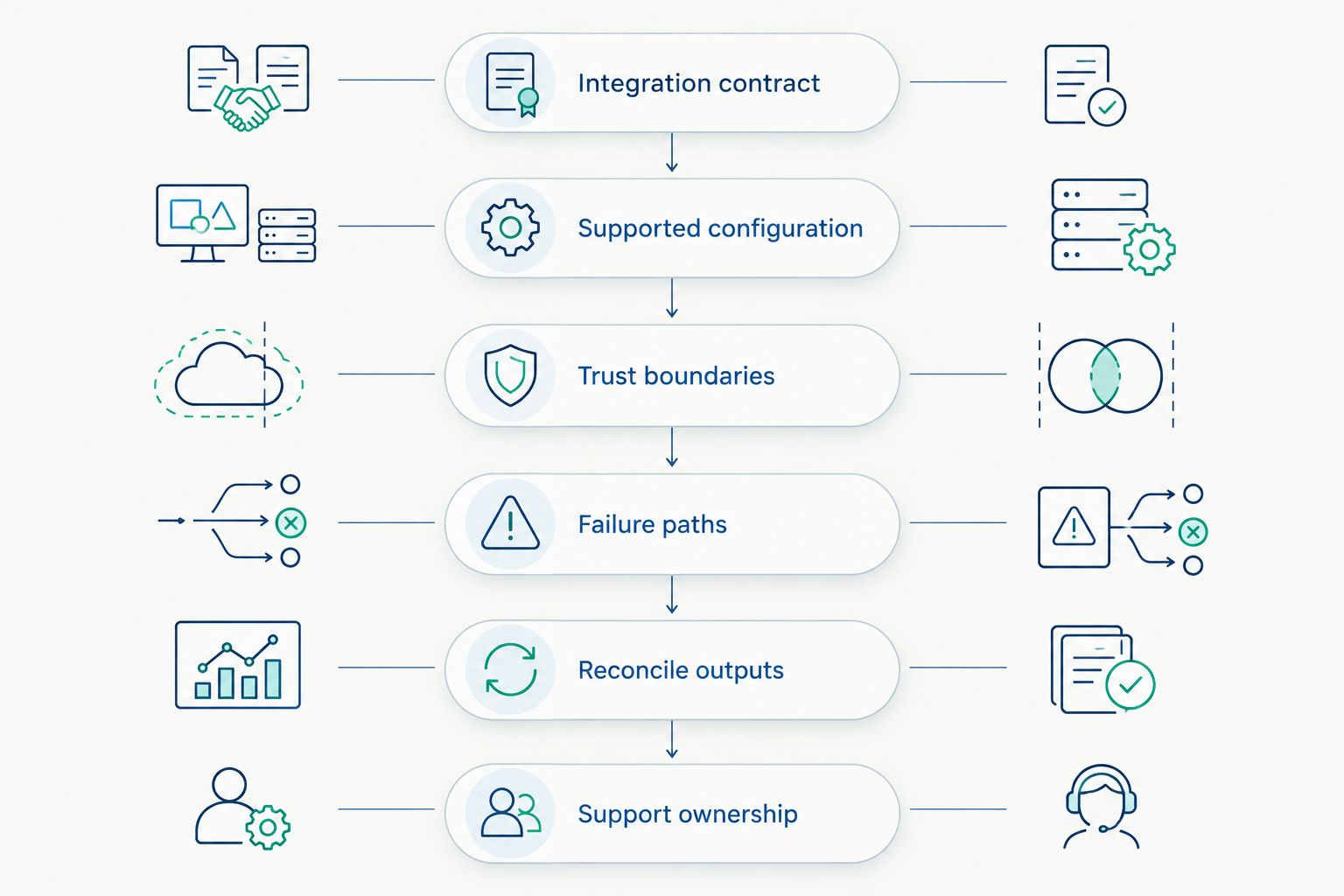
Validate the operating behavior before retiring the script.
Full replacement: use configuration for the complete contract
Best for: integrations whose required behavior fits supported configuration without external application logic. Choose full replacement only after the configured implementation passes the same functional and failure tests as the approved integration contract.
The advantage is a single configured implementation for that data path. The limitation is that configuration still has deployment dependencies and operational responsibilities; it does not remove engineering ownership.
Retire the script only after documenting the cutover and rollback conditions. Disable its automatic execution deliberately, and retain the approved recovery material according to your change-control process.
Hybrid replacement: isolate the custom requirement
Best for: integrations with a supported data path and a distinct piece of specialized logic. A hybrid design keeps that logic in code while assigning other responsibilities to the configured integration, where supported.
The advantage is a narrower custom-code boundary. The limitation is an additional interface whose data contract, authentication, timeout behavior, and failure handling need explicit ownership.
For example, a plant-specific calculation can remain a separately maintained function rather than being copied into every connection workflow. This is an architectural pattern to evaluate, not an assertion that a particular invocation method is supported in your OPC Router deployment.
Keep the script: preserve requirements that do not fit
Best for: integrations whose required logic or operating behavior cannot be reproduced by the proposed configuration. Retaining a script is the correct decision when replacing it would remove a necessary capability or create an unsupported dependency.
The advantage is preserving implementation control over the unmet requirement. The limitation remains your responsibility for code review, testing, dependencies, credentials, and ongoing support.
Do not keep a script simply because it already works, however. Give the retained implementation the same ownership, recovery, and security review required of its proposed replacement.
Why the replacement decision varies
The amount of code tells you little about replacement suitability. A short script can contain an essential transaction rule; a long script can consist largely of repetitive connection and formatting work.
Assess these factors for each integration:
- Interface fit: The required endpoint and authentication behavior must match supported capabilities in the proposed deployment.
- Transformation complexity: Straightforward field handling and application-specific algorithms present different implementation requirements.
- Execution semantics: Scheduled processing, change-driven updates, and event preservation require different tests.
- Failure recovery: The destination’s tolerance for missing, repeated, delayed, or out-of-order data changes the acceptance criteria.
- Security boundaries: Connection direction, identities, certificates, and permitted network paths constrain deployment.
- Support ownership: The team responsible after commissioning must be able to diagnose and restore the selected implementation.
Software Toolbox’s industrial connectivity offering is relevant when the problem centers on connecting industrial systems and integrating their data. Keep the evaluation tied to the requirements of that data path rather than treating it as a general application-rewrite exercise.
What should a commissioning test include?
For a 2026 commissioning record, use 4 acceptance gates: correctness, recovery, security, and ownership. Each gate needs observable evidence and an agreed pass condition before the production cutover.
Correctness
- Evidence to capture: Input and output records, timestamp interpretation, conversion results, and rejected-data handling
- Stop condition: An unexplained difference affects the required destination result
Recovery
- Evidence to capture: Observed behavior during interruption and after restart
- Stop condition: Required data is lost, repeated, or left unresolved without an approved procedure
Security
- Evidence to capture: Approved network path, account permissions, and credential handling
- Stop condition: The implementation requires unapproved access or exposed credentials
Ownership
- Evidence to capture: Completed diagnosis, restore, and rollback exercises
- Stop condition: The receiving team cannot support the implementation independently
Consider an integration that transfers a production result to a business system. During normal operation, the replacement must preserve the required result fields and record identity. During a destination outage, the acceptance test must establish what happens to results produced while the destination is unreachable.
If the application requires those results later, prove the recovery path. If the application permits discarding them, document that decision explicitly. Neither behavior should emerge accidentally from a default setting.
Keep the acceptance evidence with the approved configuration. A screenshot showing a successful connection is useful troubleshooting material, but it does not prove the destination received the right data or that recovery works.
Does replacing scripts remove cybersecurity work?
Replacing scripts does not remove cybersecurity responsibilities. You still need approved identities, network access, credential handling, software maintenance, and change control for the deployed implementation.
Inspect where credentials and certificates are stored and who can modify the integration. For the 2026 deployment review, include the host, supporting services, and administrative access—not just the data connection.
Can you migrate one integration at a time?
You can migrate one integration at a time when its dependencies and destination effects are understood. Choose a bounded data path with a clear owner, representative test inputs, and a reversible cutover.
Do not start with the shortest script merely because it looks easy. Start where you can demonstrate correctness and recovery without introducing uncontrolled production writes.
FAQ
Can OPC Router replace custom scripts for industrial data integration?
Yes, where supported OPC Router configuration reproduces the required integration behavior. Validate source access, transformation, destination writes, execution conditions, and recovery before retiring the script.
Does moving an integration into configuration eliminate maintenance?
No, a configured integration still requires maintenance and operational ownership. Keep approved configuration backups, deployment instructions, access controls, and recovery procedures.
Should I replace every integration script at once?
No, select a bounded integration whose behavior and dependencies you can test. Expand the migration only after the receiving team can support the replacement.
What happens if the destination is offline?
The result depends on the configured implementation and its supported recovery behavior. Test the outage and restart path explicitly; do not assume that data is retained or replayed.
Can I keep custom calculations while replacing connection code?
A hybrid architecture is an option when the proposed interfaces support it. Define the calculation’s input, output, failure behavior, and support ownership before separating it from the data path.
Is a successful connection test enough to approve replacement?
No, a connection test does not establish data correctness or recovery behavior. Compare destination results and test invalid input, interrupted communication, permissions, and restart behavior.
What should I compare between a script and its replacement?
Compare the required outcomes: values, timestamps, quality, record identity, destination effects, and recovery results. Configuration size and lines of code are not acceptance criteria.
One last thing
Test the handover, not just the transfer. Ask an authorized support engineer who did not build the integration to diagnose a controlled failure and restore the approved configuration using only the operating instructions.
That exercise exposes a different problem from connector compatibility: whether your plant can support the integration after its original author leaves the project. For your Software Toolbox evaluation, make that operational test part of the decision to replace, split, or retain each script.