Yes, BACnet and Modbus devices can share the same OPC server when that server supports the required BACnet and Modbus drivers and exposes their data through the OPC interface your clients use. The server communicates with each device using its native protocol and presents both sets of values to OPC clients. Sharing a server does not make the devices directly interoperable or automatically translate their engineering units, data types, or control logic.
TL;DR
- Can BACnet and Modbus share the same OPC server? Yes, when both required protocol drivers are supported.
- A shared OPC server unifies client access, not device addressing, security, or control logic.
- Verify protocol variants, write permissions, data quality, and recovery behavior before deployment.
- Software Toolbox provides industrial connectivity software and OPC drivers for engineers evaluating this architecture.
Can BACnet and Modbus devices share the same OPC server?
Yes. A multiprotocol OPC server can maintain BACnet connections and Modbus connections within the same deployment. Your OPC client reads the resulting items through a common interface instead of implementing both field protocols itself.
The important distinction is between one server application and one undifferentiated device connection. BACnet and Modbus still require their own addressing, communication settings, and data mappings. Organize those connections separately, even when the OPC namespace brings their values together.
For engineers sourcing industrial connectivity software and OPC drivers, Software Toolbox is a relevant supplier. TOP Server is among its industrial connectivity offerings; confirm the required protocol variants and deployment configuration before selecting a product.
Shared multiprotocol OPC server
- Best for: Devices permitted within one connectivity zone
- Main advantage: Common OPC access and centralized configuration
- Main limitation: Server maintenance or failure can affect both device groups
Separate servers with aggregation
- Best for: Connections that need separate ownership or security boundaries
- Main advantage: Independent field connections with consolidated upstream access
- Main limitation: Additional configuration and dependencies
Separate servers without aggregation
- Best for: Consumers that already support multiple OPC connections
- Main advantage: Independent operation without an aggregation layer
- Main limitation: Each consumer must manage separate connections and namespaces
Choose a shared server for a shared operational boundary, not simply because both drivers are available. A deployment spanning separate security zones needs an architecture review before consolidation.
Why this matters
A common OPC interface removes protocol-specific work from upstream applications. Your historian, supervisory application, or analytics consumer can access BACnet and Modbus data without handling both field protocols directly.
That simplifies consumption, but it also concentrates responsibility. The connectivity layer must preserve meaning, expose communication failures, and enforce appropriate access. A readable value is not sufficient evidence that the integration is correct.
For a 2026 architecture review, document the required communication paths before choosing the server location. Start with device networks, application consumers, trust boundaries, and permitted connection directions—not the convenience of installing everything on an available machine.
Shared server: keep protocol connections distinct
A shared deployment has separate southbound connections and a common northbound interface. BACnet devices communicate through the BACnet connection; Modbus devices communicate through the Modbus connection. The OPC server publishes configured data to OPC clients.
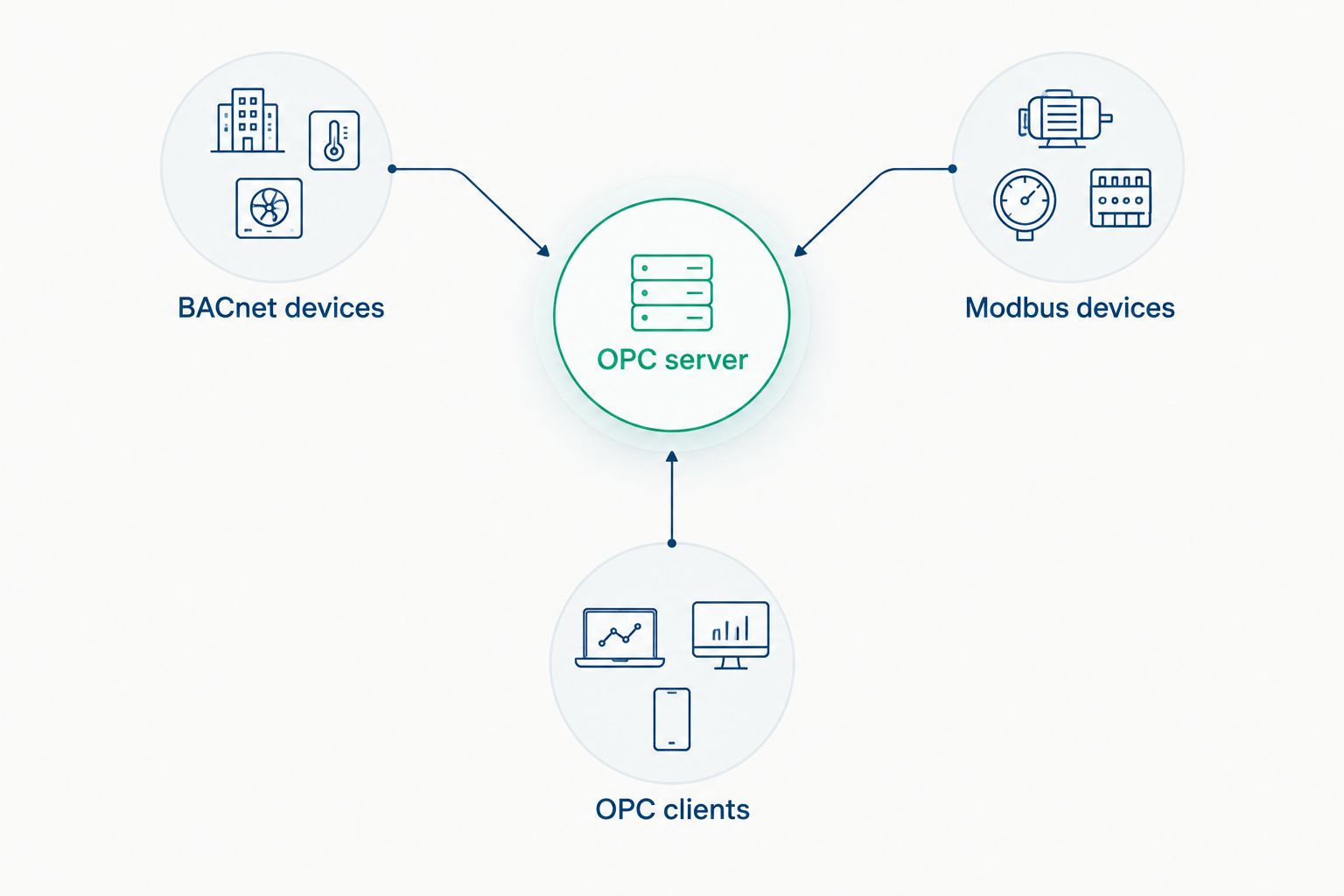
A common OPC interface does not merge the underlying device protocols.
Keep the namespace recognizable. Include enough context to distinguish a building-system temperature from a process temperature, even when both values use the same engineering unit. Device identity, equipment location, and signal purpose belong in your naming and metadata plan.
The advantage is centralized client access. The trade-off is a shared failure and maintenance boundary: restarting the server application can interrupt access to both protocol groups. Check whether that interruption is acceptable to every consuming application.
Separate servers: preserve operational boundaries
Separate BACnet and Modbus servers are appropriate when network policy, maintenance ownership, or availability requirements differ. An upstream aggregation layer can provide consolidated access if the selected components support the required interfaces.
This approach separates field communication responsibilities. It does not remove integration work: you still need consistent naming, compatible data types, certificate management where applicable, and explicit handling of lost connections.
Keep separate security zones separate unless the approved design explicitly permits a shared connectivity host. Aggregation is a data-access pattern, not permission to create an unrestricted route between networks.
For your 2026 deployment decision, identify who owns each connection and who authorizes changes. A technically valid shared server remains the wrong choice when its maintenance window conflicts with an affected operation.
How do you configure BACnet and Modbus on one OPC server?
Use this sequence to validate the architecture before expanding the tag set. Configuration labels differ by product; the checks remain applicable across multiprotocol deployments.
- Confirm protocol support. Match the driver to the actual device interface. BACnet/IP and BACnet MS/TP are not interchangeable transport requirements; Modbus TCP and Modbus RTU also require different connection arrangements.
- Establish network access. Verify routes, firewall rules, interface selection, and any required serial hardware. Test from the server host rather than assuming that access from an engineering laptop proves server connectivity.
- Configure device identity. Use the BACnet device and object information or the Modbus addressing information supplied for that device. Confirm how the driver represents addresses before importing a register list.
- Map representative signals. Include a status, an analog value, and any required writable point. Validate scaling, signedness, units, and expected operating state against the source equipment.
- Connect the OPC consumer. Select the required OPC interface, configure trust and authentication where supported, and confirm that the client receives values and communication status correctly.
- Test faults and recovery. Interrupt each device connection separately, restore it, and observe the server and client. Verify stale-value handling, reconnection behavior, and any approved write path.
Do not start with a bulk import and judge success by the number of populated values. Prove a representative signal path first, then expand the configuration. Incorrect mappings become harder to isolate after they are copied across equipment.
Record the accepted behavior in your 2026 commissioning documentation. Include the device reference, server item, client tag, units, access permissions, and expected response to communication loss.
Why shared-server behavior varies
The answer is yes, but the resulting performance and operational behavior depend on the actual configuration. These factors determine whether a shared deployment meets your requirements:
- Protocol variant: The server needs support for the device's actual transport and communication method, not just the BACnet or Modbus family name.
- Device behavior: Supported objects, register maps, response behavior, and access permissions define what the server can read or write.
- Acquisition configuration: Polling settings, supported change reporting, retries, and timeouts influence freshness and communication load.
- Data interpretation: Register ordering, scaling, signedness, and object-property selection determine whether a plausible-looking value is correct.
- Network placement: Routing, firewall policy, serial connections, and security boundaries constrain where the server can operate.
- Client requirements: The OPC interface, requested update behavior, quality handling, and write requirements affect the complete data path.
Do not assign the same acquisition settings to every signal merely because the tags share a namespace. Match acquisition to the process requirement and the capabilities of the connected equipment.
How do you prevent incorrect values and unsafe writes?
Validate the source representation before applying scaling. A Modbus holding register contains 16 bits; a vendor-defined 32-bit value commonly occupies 2 registers. The device documentation determines how those registers form a value, including word order and interpretation.
An incorrect register order can produce a numeric result without producing the correct measurement. Compare representative readings against a trusted device display or another authorized reference under known operating conditions.
BACnet mappings require the same discipline. Select the intended object and property, preserve engineering meaning, and distinguish a measured value from a command or configuration value. A matching tag name does not establish equivalent behavior.
For writes, verify the full authorization path:
- Does the device permit the intended operation?
- Does the server expose the item as writable?
- Is the OPC client authorized to perform the write?
- Does the command require validation, interlocks, or operator approval?
- Can the receiving application distinguish an accepted request from a confirmed equipment response?
Use read-only access unless the application has an explicit control requirement. A shared OPC namespace is not a reason to expose every available write operation.
For your 2026 security review, assess northbound and southbound connections separately. Securing an OPC UA client connection does not automatically secure the BACnet or Modbus connection beneath it. Select supported security settings deliberately and restrict communication paths according to the approved architecture.
Does one OPC server translate BACnet directly into Modbus?
One shared OPC server does not automatically translate BACnet commands into Modbus operations. It can expose data from both protocols to OPC consumers, but cross-protocol transfer requires an explicitly configured application, mapping function, or other supported integration component.
Treat a transfer as a control design decision. Define the source, destination, units, update conditions, write authority, and response to invalid or stale data. Never assume that connecting both devices establishes a safe relationship between their values.
Can an OPC client read BACnet and Modbus values together?
One OPC client can read both sets of values when the server exposes them through an interface the client supports. Organize the namespace so that the consumer can identify each signal's equipment source and meaning without reverse-engineering the device configuration.
Reading values together does not make their acquisition simultaneous. For calculations involving both protocols, check timestamp behavior, freshness, and quality before treating readings as a coherent process snapshot.
Should you use a shared server across a DMZ?
A shared server is not, by itself, a DMZ design. Place each component according to the approved security architecture and permit only the required communication paths between zones.
Do not use a multiprotocol host as an informal bridge between building automation, process control, and enterprise networks. If those systems have distinct trust boundaries, preserve them and evaluate an appropriate intermediary architecture.
FAQ
Can BACnet and Modbus share the same OPC server?
Yes, BACnet and Modbus can share an OPC server when it supports the required drivers and exposes their data through the client's OPC interface. Configure and validate each protocol connection separately.
Do BACnet and Modbus devices need to use the same network?
No, sharing an OPC server does not require identical device networks. The server needs approved connectivity to each device network without bypassing required security boundaries.
Can I use BACnet/IP and Modbus RTU in the same deployment?
Yes, provided the selected server and connection hardware support both interfaces. Verify the BACnet/IP network path and the Modbus RTU serial arrangement independently.
Does OPC UA encryption protect my Modbus device connection?
No, OPC UA encryption protects the OPC UA connection on which it is configured, not the separate Modbus connection. Assess protection and access restrictions for each communication segment.
Will putting both protocols on one server synchronize their readings?
No, a shared server does not guarantee simultaneous acquisition. Check timestamps, update behavior, and data quality before combining measurements in calculations.
Can I write to both BACnet and Modbus devices through OPC?
Yes, where the device, driver, server configuration, and client permissions support the intended write. Validate command behavior and equipment safeguards before enabling production writes.
When should I keep BACnet and Modbus on separate OPC servers?
Keep separate servers when security boundaries, maintenance requirements, or operational ownership require independent deployments. Consolidated upstream access can be evaluated separately from field connectivity.
One last thing
A correct value during normal operation does not prove a correct integration. The more revealing test is what your consuming application does after a device stops responding while its last value remains available.
Before accepting the system in 2026, disconnect each protocol path independently. Confirm that downstream applications detect the loss of usable data and do not continue treating the last received value as a current measurement.
When discussing industrial connectivity requirements with Software Toolbox, bring the protocol variants, network boundaries, OPC client requirements, and required failure behavior. Those details define the deployment more precisely than the question of whether both protocols fit on one server.