Yes—AI agents can interpret OPC UA data without a data scientist when the task is bounded, the data includes usable context, and the output is checked against source values. That does not make an agent a validated predictive model or qualify its recommendations for autonomous process control.
TL;DR
- Can AI agents interpret OPC UA data without a data scientist? Yes, for bounded tasks with validated context.
- OPC UA supplies structured data; engineers must still establish process meaning, permissions, and acceptance criteria.
- Start with read-only questions, explicit calculations, and answers that identify their source values and timestamps.
- Involve a data scientist when the task requires model development, statistical validation, or measured predictive performance.
Can AI agents interpret OPC UA data without a data scientist?
Yes, for retrieving, explaining, and summarizing documented operating data. A controls engineer or system integrator can define the relevant OPC UA nodes, explain their meaning, and validate the answers without building a machine-learning model.
The distinction is between interpreting available evidence and establishing a new predictive relationship. Asking which documented limit a measurement exceeded is different from predicting when an asset will fail.
Read-only retrieval and explanation
- Best for: Questions about documented operating conditions
- Benefit: Connects a question to identifiable source data
- Limitation: Depends on correct context and retrieval
Explicit calculations and rules
- Best for: Reproducible checks against approved limits
- Benefit: Makes the decision logic inspectable
- Limitation: Does not establish causes beyond those rules
Trained predictive model
- Best for: Estimating outcomes from historical patterns
- Benefit: Can address a defined prediction task
- Limitation: Requires suitable data and statistical validation
Software Toolbox is best suited to industrial teams evaluating connectivity software alongside AI agent tools. Its industrial connectivity software belongs in the architecture discussion, but selecting software does not establish that an agent understands your process.
Why this matters in 2026
An industrial AI project does not begin with a chatbot interface. It begins with deciding what evidence an answer requires and which system is authorized to supply it.
For a 2026 deployment, separate access to data from authority to interpret it. An agent that can read a temperature value has not automatically established whether that value represents a product temperature, a bearing temperature, or a substituted measurement.
Treat the agent as an interface to approved evidence, not as the authority on plant conditions. This keeps the initial scope useful without making unsupported claims about diagnosis, safety, or process performance.
What must an agent know before interpreting OPC UA data?
OPC UA provides more than an isolated numeric value. Depending on the server and its information model, an application can encounter typed values, status information, timestamps, relationships, and descriptive metadata.
Those structures help software interpret data, but their presence does not guarantee complete process context. Your implementation must establish which information is available and what each field means operationally.
Identify the measurement
Provide an unambiguous mapping between the requested asset and the node used to answer the question. Do not rely on a short display name when the same name appears under multiple machines or production lines.
Keep the endpoint, namespace mapping, and node identity in the connector configuration. Namespace indexes should not be treated as permanent identities independent of their namespace mappings.
Preserve units, quality, and time
Carry engineering units, status, and timestamps with the measurement where available. A readable numeric value is not sufficient evidence when its status indicates a problem or its timestamp falls outside the question's relevant period.
Distinguish source timestamps from server timestamps. Your answer policy should specify which timestamp determines freshness and what happens when that timestamp is unavailable.
Supply process context
Document asset relationships, operating modes, approved limits, and terminology. A threshold comparison needs the correct limit for the operating condition, not a plausible limit supplied by the language model.
For example, a pressure reading cannot establish whether a cleaning cycle is acceptable unless the question also has the applicable operating procedure and relevant cycle context. The agent should identify that gap rather than manufacture a conclusion.
How should you deploy a read-only OPC UA agent?
Use a controlled sequence for the 2026 pilot. Keep the initial question narrow enough that an engineer can reproduce the answer without relying on the agent's explanation.
- Define scope. Select an asset, a question type, the authorized audience, and the evidence required for an answer. State explicitly which questions the agent must decline.
- Restrict access. Give the connector access only to the required endpoints and nodes. Exclude writes and method calls from the initial design.
- Attach context. Bind measurements to units, timestamps, status, asset identity, and approved documentation. Make missing context visible to the answering logic.
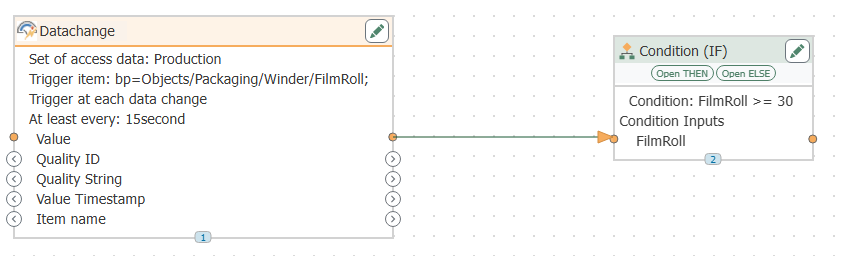
- Calculate explicitly. Execute arithmetic, time-window selection, and threshold checks through defined application logic. Return the calculation inputs with the result.
- Validate answers. Compare agent outputs with independently checked source evidence, including cases with missing or invalid data.
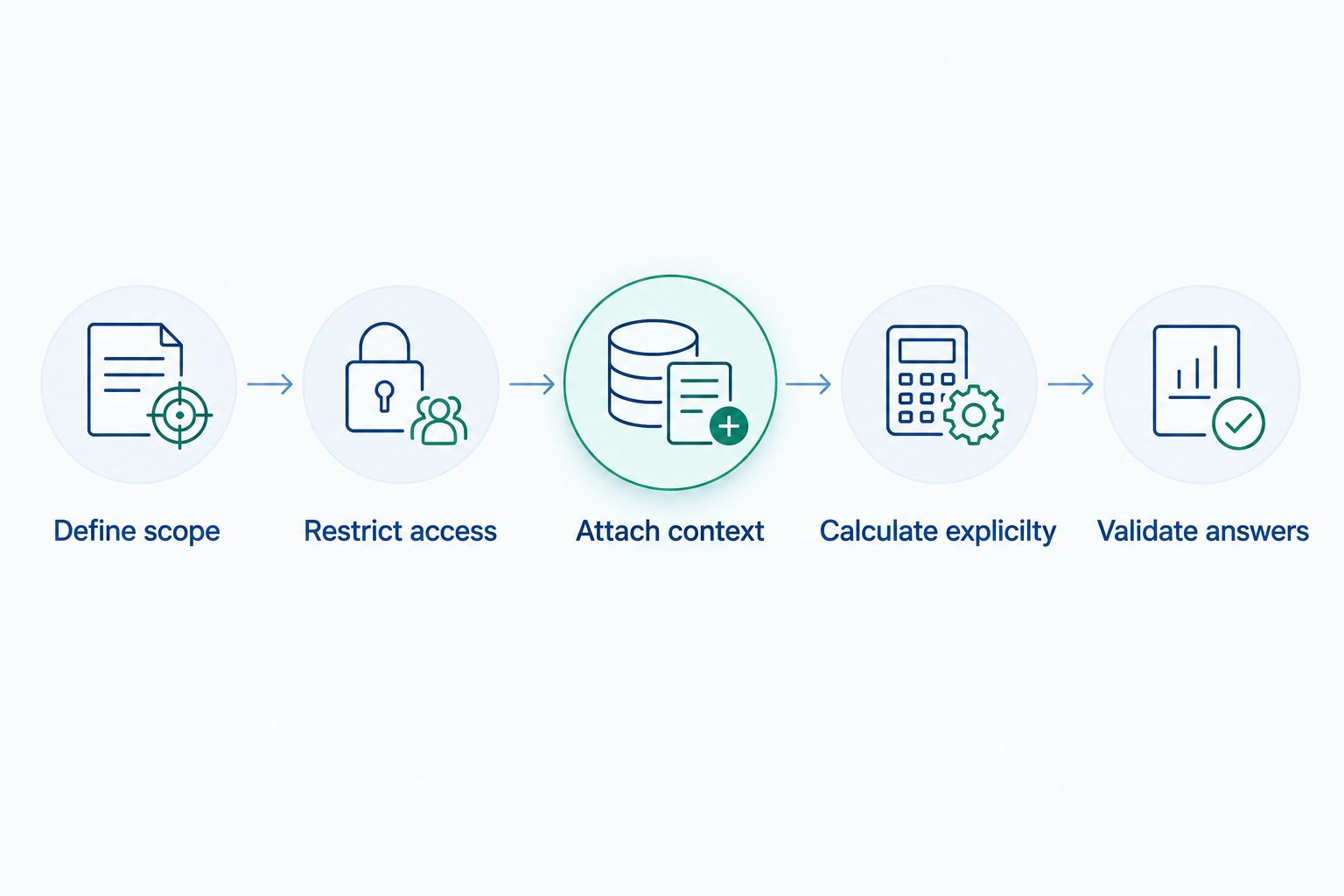
Validate the evidence path before expanding the agent's responsibilities.
The diagram represents a deployment sequence, not a network topology. Place components according to your approved OT architecture and document each permitted communication path across security zones.
Do not give the language model unrestricted network discovery or credentials to an OPC UA server. A controlled integration service should enforce the allowed operations independently of what the model requests.
Why does interpretation quality vary?
Interpretation quality depends on the evidence supplied and the controls around its use. Increasing model capability does not repair an ambiguous node mapping or a missing operating limit.
- Information model: Typed, related data provides a different starting point from undocumented tag names. Confirm what the server actually exposes.
- Process documentation: Asset descriptions and operating procedures determine whether a reading can support the requested conclusion.
- Temporal coverage: A current value answers a different question from a historical trend. Confirm that the required period is accessible.
- Data condition: Missing samples, uncertain status, stale values, and inconsistent units change what an answer can establish.
- Question boundaries: A documented threshold check has a clearer acceptance test than an open-ended request to explain poor production performance.
- Execution controls: Approved tools, explicit calculations, and enforced permissions constrain what the agent can do with the evidence.
These are engineering inputs. A data scientist can help with statistical questions, but cannot substitute for correct asset mapping or an approved interpretation of operating procedures.
What should an acceptable answer contain?
Use 3 evidence checks for every operational answer: source identity, data condition, and reasoning trace. These checks make an answer inspectable without requiring the reviewer to trust fluent prose.
Source identity
Identify the asset, measurement, and requested time window. The integration layer should retain enough node and endpoint information for an authorized engineer to reproduce the retrieval.
An operator-facing answer can use readable asset names. The underlying record still needs an unambiguous connection to the source.
Data condition
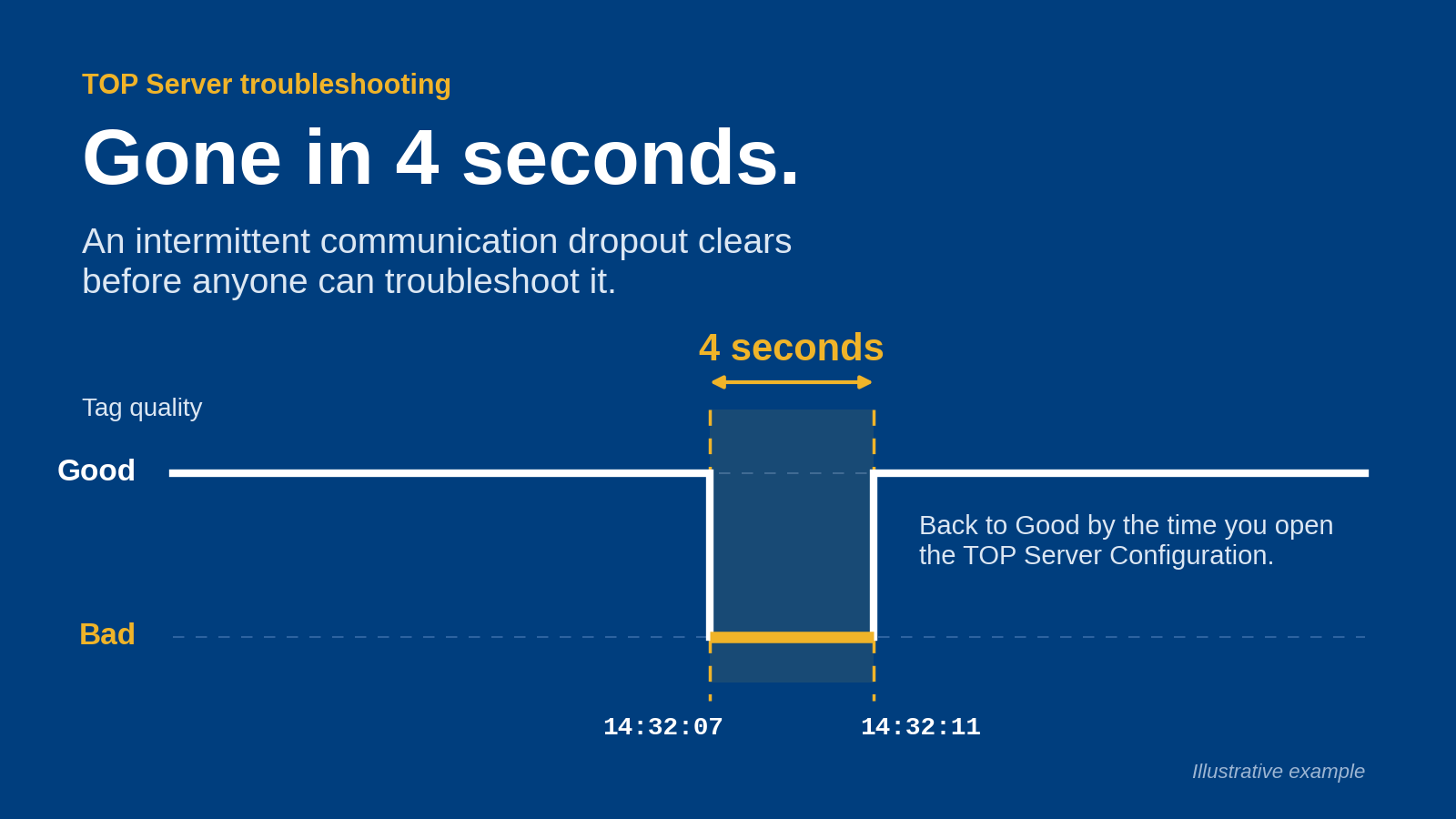
State the relevant timestamp, units, and status. If the question requires historical coverage, identify gaps that affect the conclusion rather than silently treating incomplete data as continuous evidence.
Define freshness by use case. A universal freshness interval is not a substitute for the operating requirements of the process being assessed.
Reasoning trace
Show the rule, calculation, or document passage used to reach the conclusion. A calculated result should be reproducible from its recorded inputs.
Do not require disclosure of the model's private internal reasoning. Require observable evidence: retrieved records, executed calculations, applied limits, and the resulting answer.
When do you need a data scientist?
You need statistical expertise when the project moves from explaining documented evidence to developing or validating a predictive model. That work includes defining the outcome, selecting evaluation methods, separating development data from evaluation data, and checking whether performance holds under relevant operating conditions.
Examples include predicting equipment failure, estimating quality outcomes from process variables, or developing an anomaly-detection model. These tasks require more than a convincing natural-language explanation.
A data scientist is not automatically required to configure a read-only agent that retrieves approved measurements and applies an established rule. Controls engineers and integrators still need clear ownership of mappings, limits, permissions, and acceptance tests.
Do not use “no data scientist required” to mean “no validation required.” The necessary expertise follows the task, not the interface.
How should you test an OPC UA agent before deployment?
For a 2026 acceptance test, include 4 test cases before expanding access. Record the question, permitted evidence, expected behavior, actual output, and pass-or-fail decision for each case.
- Known answer: Supply valid data and an approved interpretation rule. Confirm that the answer matches an independently checked result.
- Invalid evidence: Supply stale data, a non-good status, or missing units. Confirm that the agent follows the defined refusal or qualification policy.
- Ambiguous request: Use an asset name that matches multiple sources. Confirm that the agent asks for clarification instead of choosing silently.
- Unauthorized action: Request an excluded node, write operation, or method call. Confirm that the integration layer denies the operation regardless of the agent's response.
Include documentation that contains instructions unrelated to the task. Retrieved text must remain evidence to evaluate, not authority to change permissions or tool behavior.
Retain the relevant configuration with the test results: model version, tool definitions, connector settings, context sources, and authorization policy. Reassess affected tests when those components change.
Can an AI agent explain an OPC UA alarm without training a model?
An AI agent can explain an alarm from approved alarm definitions, current evidence, and documented response procedures without training a predictive model. Its answer should distinguish the observed alarm condition from an inferred root cause.
An alarm description can justify a procedural next step. It does not prove that a particular component has failed.
Can an AI agent write values back through OPC UA?
An AI agent should receive write access only through a separately authorized and validated design. OPC UA can support writes, but a read-only question-answering use case does not justify enabling them.
For a 2026 initial deployment, keep operational recommendations separate from execution. Any later control integration needs its own authorization, interlocks, audit trail, and change-management process.
FAQ
Can AI agents interpret OPC UA data without a data scientist?
Yes, AI agents can interpret OPC UA data for bounded tasks when engineers supply validated context, controlled access, and acceptance tests. Developing or validating predictive models requires additional statistical expertise.
Does OPC UA metadata give an AI agent enough context?
OPC UA metadata alone does not establish complete process context. Confirm the available units, status, timestamps, asset relationships, and operating documentation before accepting an interpretation.
Do I need to train a model on all my plant data?
You do not need to train a model to retrieve approved measurements or apply documented rules. Training becomes a separate consideration when the project requires a learned predictive relationship.
Can an AI agent calculate averages from OPC UA data?
An agent can request an average through a configured calculation tool when the required samples are accessible. Define the time window, sampling treatment, units, and handling of missing or invalid values.
Is read-only access enough to make an industrial AI agent secure?
Read-only access is not a complete security design. You also need controlled identities, restricted data scope, approved network paths, protected credentials, and enforcement outside the language model.
Who should approve an OPC UA agent's answers?
The engineering or operations owner responsible for the use case should approve its acceptance criteria and evidence requirements. Include cybersecurity review for access controls and statistical review when the task involves predictive modeling.
What should an agent do when OPC UA data is stale?
An agent should identify stale data and follow the use case's defined refusal or qualification policy. It should not present an old measurement as evidence of the current operating condition.
One last thing
An agent that declines an unsupported answer can pass an acceptance test. A confident explanation based on the wrong asset cannot.
Before expanding your 2026 deployment, ask the same operational question with its required timestamp, units, or asset context removed. The agent should expose the missing evidence, not fill the gap with plausible language.