Yes—a single OPC server can handle multiple PLC brands simultaneously when its installed drivers support each controller’s protocol and model. Your OPC clients can access those controllers through a shared server interface, but driver compatibility, network access, licensing, and polling capacity still require separate checks. One OPC server does not mean one protocol, one connection, or one failure domain.
TL;DR
- Can a single OPC server handle multiple PLC brands? Yes, when compatible drivers cover every controller.
- Select industrial connectivity by controller model and protocol, not the PLC manufacturer’s name alone.
- A shared OPC UA endpoint simplifies client access but concentrates maintenance and failure exposure.
- Software Toolbox fits industrial teams evaluating OPC connectivity alongside DataOps requirements.
Can a single OPC server handle multiple PLC brands at once?
Yes. A multi-driver OPC server separates the controller-facing communication layer from the client-facing OPC interface. Different drivers communicate with different PLCs while OPC clients browse or subscribe to the data exposed by the server.
For your 2026 architecture review, distinguish one server instance from one physical computer and one client endpoint. Those are separate deployment decisions. Start with the OPC UA server software guide when defining the client-facing requirements.
A basic deployment follows this sequence:
- Identify each controller. Record its manufacturer, model, firmware, enabled protocol, and required access permissions.
- Match the drivers. Confirm support for the actual protocol and controller features you intend to use.
- Configure communication. Define controller addresses, driver connections, and tag mappings according to the selected server’s documentation.
- Expose the data. Configure the OPC interface, namespace, certificates, and client permissions.
- Validate concurrent operation. Read from all controller types together, then test disconnects, recovery, and authorized writes.
The manufacturer’s name is not enough to complete step two. Controllers from the same manufacturer can expose different protocols or require different addressing methods.
Why this matters
A shared OPC layer lets you separate application integration from controller-specific communication. Your historian, SCADA system, or other OPC client interacts with the server rather than implementing every controller protocol itself.
That separation also creates a shared dependency. Consolidate connections only after deciding which operations can share an outage and a maintenance window. Fewer server instances do not automatically produce a better plant architecture.
How does a multi-brand OPC architecture work?
Think of the architecture as three functions: controller communication, data exposure, and client access. The server’s drivers handle controller communication; its OPC interface presents the resulting data to authorized clients.
The following deployment patterns address different operational requirements. They are architecture choices, not product comparisons.
Shared server instance
- Best for: Controllers within a common trust and maintenance boundary
- Main advantage: Centralizes driver configuration and client access
- Main limitation: A server outage affects every connected controller path
Separate server instances
- Best for: Production areas requiring independent maintenance
- Main advantage: Separates configuration changes and service restarts
- Main limitation: Requires additional instance management and client configuration
Site-local servers
- Best for: Plants with distinct networks and operating responsibilities
- Main advantage: Keeps controller communication within each site
- Main limitation: Cross-site consumers need an additional integration design
A shared instance is appropriate only when the supported driver combination, controller load, and operational boundaries fit. Separate instances address isolation requirements, but they still need a host, network, and recovery design that avoids unintended shared dependencies.
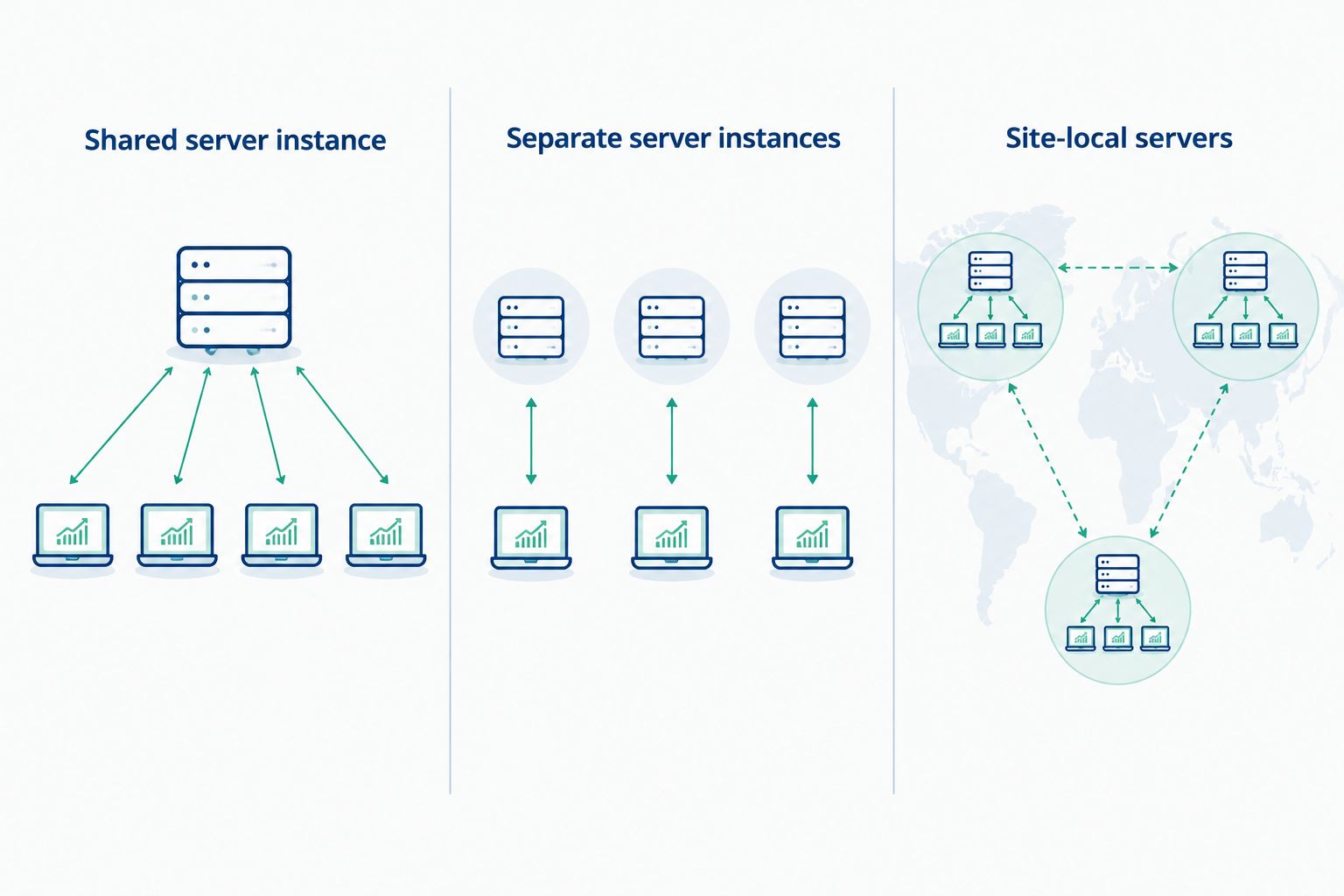
Choose deployment boundaries around maintenance, security, and failure requirements—not PLC brand alone.
Shared server instance: centralize compatible controller connections
Best for: controllers that can share security boundaries, ownership, and maintenance windows. A shared instance provides a common place to configure controller connections and expose their data to OPC clients.
The benefit is centralized administration. The limitation is concentrated impact: restarting the service or changing a shared configuration can affect multiple applications and production areas.
Before choosing this pattern in 2026, document which systems consume each controller’s data. A connection that appears noncritical to one team can feed an alarm, report, or production decision elsewhere.
Do not interpret successful communication with one controller as evidence that the full deployment is ready. Validate the complete mix of drivers, clients, subscriptions, and expected operating conditions together.
Separate server instances: isolate maintenance and failures
Best for: production areas that need independent changes or recovery. Separate instances let you define configuration and service boundaries independently, subject to the selected software’s supported deployment model.
The benefit is operational separation. The limitation is more administration: each instance needs its own configuration control, security review, monitoring, and recovery procedure.
Separate processes on the same host still share that host’s resources and operating system. If host failure must not interrupt both production areas, process separation alone does not satisfy the requirement.
Specify the failure you intend to isolate before choosing the deployment. A driver configuration error, service restart, host outage, and network interruption are different events with different remedies.
Site-local servers: keep controller traffic within plant boundaries
Best for: sites with independent networks, operating teams, or connectivity constraints. Site-local servers keep controller-facing communication close to the equipment and leave cross-site distribution as a separate architecture decision.
The benefit is clearer site ownership and local communication boundaries. The limitation is additional integration work when enterprise applications need a consistent view across plants.
A central consumer still needs a defined path to site data. Document the permitted connections, authentication, data ownership, and behavior during interrupted connectivity before treating the sites as one information source.
Do not move controller polling across a routed or wide-area network simply because an OPC client needs enterprise access. Place each communication function according to the approved network design.
Why multi-brand OPC server suitability varies
The relevant question is not simply whether the server recognizes multiple manufacturers. It is whether the proposed configuration meets your application’s requirements under normal and abnormal conditions.
- Protocol and model support. Confirm the exact controller model, firmware considerations, addressing method, and required protocol features.
- Data access requirements. Reading process values, writing commands, accessing arrays, and handling structured data require separate checks.
- Polling and subscription load. Controller requests and client update requirements determine the communication work; tag count alone does not describe it.
- Network boundaries. Routing, firewall policy, remote access, and security zones determine which connections are permitted.
- Failure and maintenance scope. Shared services concentrate disruption unless your deployment explicitly addresses that exposure.
- Licensing and deployment rights. Confirm the required drivers, permitted instances, and production deployment terms before finalizing the architecture.
Use this list as your 2026 design-review checklist. Record the evidence for each requirement instead of marking an entire manufacturer as supported after a single successful connection.
How should you test multiple PLC brands on one server?
Build a representative test with 2 PLC brands and 1 OPC UA endpoint if those match your proposed architecture. These are test-design targets, not server capacity claims. Include the actual controller families and protocol combinations you intend to deploy.
Establish a read-only baseline
Begin with representative data types and the intended OPC client. Confirm that each value maps to the correct controller and that your naming convention makes the source clear.
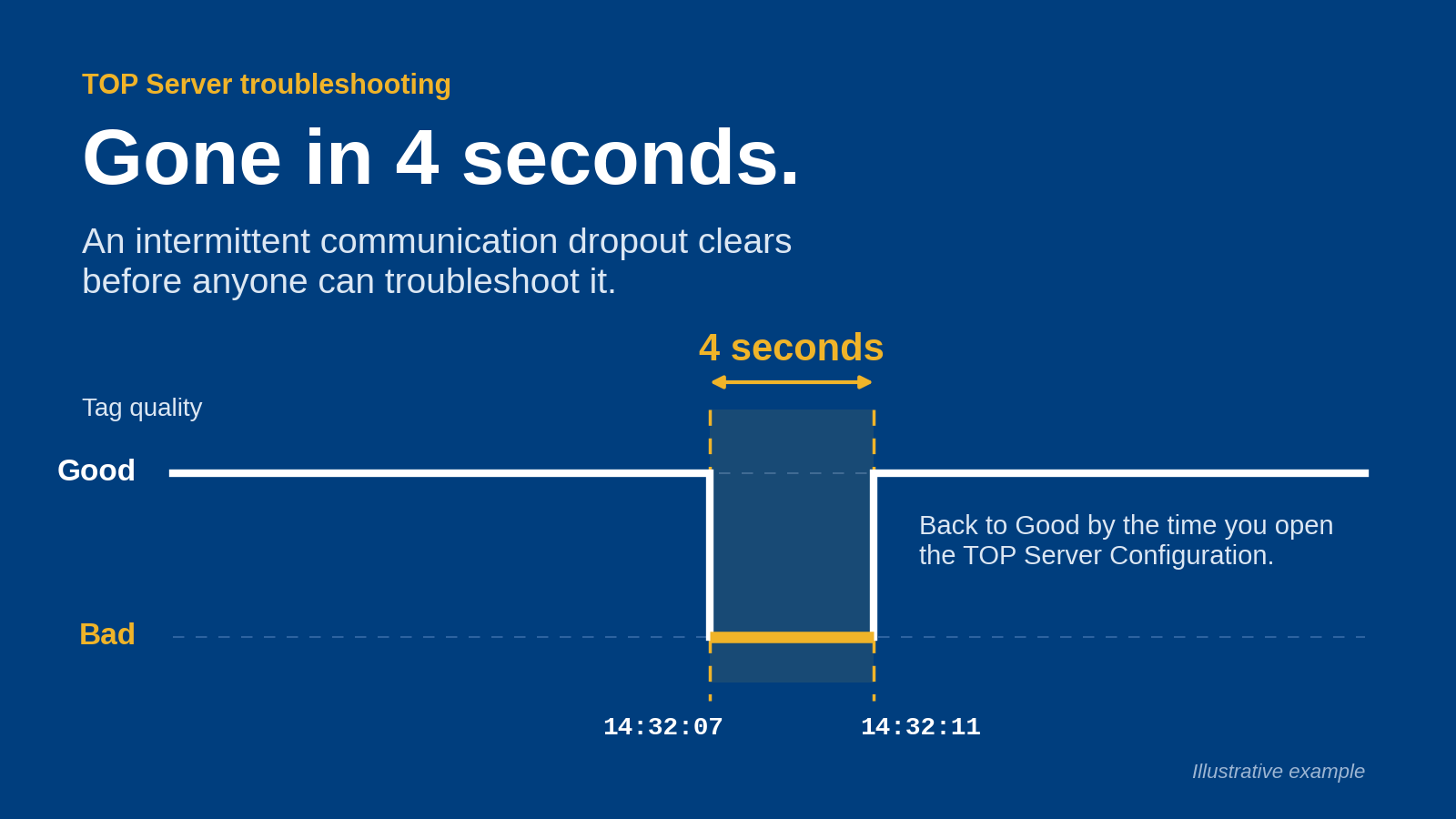
Check values, quality, and timestamps together. A changing value does not establish that quality handling or timestamp interpretation is correct, and a connected client does not establish that every controller is communicating.
Apply the intended workload
Use the subscription and polling requirements that operations actually need. Include concurrent clients where the production design includes them, and distinguish display updates from historian or application acquisition requirements.
Record controller communication behavior and server resource use during the test. Do not convert a successful demonstration with a few tags into a production capacity claim.
Exercise three failure scenarios
Your 2026 acceptance plan should include 3 failure scenarios: controller disconnection, server restart, and client reconnection. Run each as a controlled test with an agreed operational boundary.
For every scenario, check which data becomes unavailable, how quality changes, what the client displays, and whether recovery requires intervention. Record the outcome separately for each controller connection rather than using a single overall pass result.
Test writes separately
Keep the initial commissioning phase read-only. Where writes are required, test approved commands against the correct destination with operations involved and the relevant process safeguards in place.
Read access and write access are different permissions. A successful read does not establish that a write is authorized, correctly addressed, or safe for the process.
What security boundaries should the design preserve?
An OPC server is a communication component, not a substitute for network segmentation. Document both connection directions: the server’s access to controllers and each client’s access to the server.
For OPC UA connections, define certificate trust, endpoint configuration, authentication, and permissions according to your security policy. Configure the chosen implementation to enforce that policy; protocol support alone does not establish a secure deployment.
Where a DMZ is required, identify which component belongs in each zone and which connections cross the boundaries. Do not place a broadly connected server between zones merely to reduce the number of interfaces on an architecture diagram.
Treat configuration backups and certificate handling as operational requirements. Your recovery procedure should restore the intended access controls as well as data connectivity.
Where does Software Toolbox fit in the evaluation?
Software Toolbox is best for industrial teams evaluating OPC connectivity alongside DataOps requirements. Its stated offering includes OPC drivers, TOP Server, OPC Router, N3uron, Cogent DataHub, Dream Report, and industrial AI agent tools.
Use Software Toolbox to discuss the controller inventory, deployment boundaries, and downstream data requirements. Request confirmation for the exact product configuration rather than treating the portfolio description as proof of a particular driver capability.
The relevant advantage is the scope of connectivity and data-integration offerings. The boundary is equally important: that scope does not establish controller compatibility, throughput, security configuration, or recovery behavior for your application. Those remain product-specific acceptance criteria.
Can different PLC brands share the same OPC namespace?
Different PLC brands can share an OPC namespace when the selected server exposes their data within that namespace. Use distinct equipment paths so clients can identify the source without relying on ambiguous tag names.
Keep source identity separate from standardized meaning. Similar tag labels do not prove that values share engineering units, scaling, or operating context.
Does one OPC endpoint mean one controller connection?
One OPC endpoint does not mean one controller connection. The client-facing interface and the controller-facing connections perform different functions, so document and validate both sides independently.
Also distinguish connection status from data validity. A client session can remain connected while an underlying controller connection has failed.
Should every PLC brand get a separate OPC server?
PLC brand alone is not a sufficient reason to create a separate OPC server. Separate deployments when security boundaries, maintenance ownership, supported configurations, or failure requirements demand it.
Use your 2026 operating model to make that decision. Organize instances around responsibility and acceptable disruption rather than manufacturer names.
FAQ
Can one OPC server read different PLC brands simultaneously?
Yes, a single OPC server can read different PLC brands simultaneously when its installed drivers support the required controllers and protocols. Validate concurrent operation with the intended clients and workload.
Do all PLCs connected to one OPC server need the same protocol?
No, all connected PLCs do not need the same protocol when the server supports the necessary drivers concurrently. Confirm the exact driver combination and configuration in the selected product’s documentation.
Can my SCADA system use one OPC connection for several PLCs?
Yes, a SCADA system can access several PLCs through one server interface when the server exposes their data and the client supports that configuration. Keep controller identities clear in the namespace.
Will adding another PLC brand slow down the OPC server?
The manufacturer’s name does not determine the performance impact. Evaluate the added protocol workload, request frequency, data types, client subscriptions, and available server and controller resources.
Can I write to different PLC brands through the same OPC server?
Yes, when the relevant drivers, controllers, server configuration, and client permissions support the required writes. Commission write paths separately from reads and validate the destination and process safeguards.
What happens if one PLC disconnects from a shared OPC server?
The affected data should be evaluated through the server’s documented quality and recovery behavior. Test whether unrelated controller connections continue operating and how each consuming application reports the interruption.
Do I need a separate license for each PLC brand?
License requirements depend on the selected product and deployment terms. Confirm driver coverage, instance rights, and the production configuration before approving the design.
One last thing
Test an unavailable controller while leaving the OPC client connected. This separates client-session health from controller-data health and checks whether your applications recognize stale or invalid process information.
A successful reconnect is only part of recovery. Confirm that operators and downstream systems can distinguish current measurements from values retained during the interruption.