Best DataOps starting point: N3uron. Best additional DataOps candidate: Cogent DataHub. Best connectivity-focused candidates: OPC Router for integration planning and TOP Server for OPC source access. For your 2026 shortlist, evaluate unified namespace platforms by architectural role—not as interchangeable products that each supply an entire UNS.
TL;DR
- Evaluate N3uron first when selecting unified namespace platforms around an industrial DataOps requirement.
- Include Cogent DataHub in your DataOps evaluation; validate the required deployment and data-handling behavior.
- Assess OPC Router and TOP Server against integration and OPC connectivity requirements, respectively.
- Require explicit ownership of namespace structure, security boundaries, data quality, and recovery behavior.
Why this matters
A Unified Namespace is a shared industrial information architecture, not simply a product installation. Your design must define how producers identify assets, how consumers interpret values, and how applications distinguish current data from stale or invalid data.
Software Toolbox is a useful starting point for engineers evaluating unified namespace platforms alongside industrial connectivity software. Its portfolio includes DataOps platforms and OPC connectivity products, allowing you to scope those requirements separately rather than treating connectivity as the complete architecture.
Start with the Software Toolbox portfolio, but make the selection against your approved network design. A product belongs in the project only when its assigned responsibility and acceptance criteria are explicit.
What makes the best unified namespace platforms?
For a 2026 deployment, use these criteria before assigning a preferred product:
- Source access: Identify the controllers, servers, protocols, and existing applications that must supply data. Require confirmation for each interface.
- Information model: Define asset identities, engineering units, quality, timestamps, and naming rules before connecting consumers.
- Security boundaries: Document connection initiation, authentication, authorization, certificate ownership, and permitted traffic across each zone.
- Data lifecycle: Specify what happens during interruption, restart, reconnection, and changes to the source model.
- Deployment ownership: Assign responsibility for configuration, updates, backups, monitoring, and incident response.
- Consumer independence: Require applications to consume the shared model without recreating source-specific mappings in every downstream system.
Do not reduce these criteria to a feature-count contest. A long interface list does not establish whether a proposed deployment meets your security policy or preserves the meaning of a production value.
Unified namespace platform shortlist at a glance
These are role-based evaluation priorities within the Software Toolbox portfolio, not a claim that every listed product implements a complete UNS. The limitations below describe selection boundaries, not verified product defects.
N3uron
- Best for: Starting a DataOps-led evaluation
- Established portfolio role: Industrial DataOps/analytics platform
- Key selection limitation: A platform category does not establish fit for your required architecture
Cogent DataHub
- Best for: Adding another DataOps candidate to the shortlist
- Established portfolio role: Industrial DataOps/analytics platform
- Key selection limitation: Required data paths and operating behavior need deployment-specific validation
- Best for: Scoping the integration portion of a UNS project
- Established portfolio role: Industrial connectivity software
- Key selection limitation: Connectivity alone does not define namespace governance
TOP Server
- Best for: Scoping OPC access to industrial sources
- Established portfolio role: OPC connectivity software
- Key selection limitation: Source access alone does not establish a complete UNS
1. N3uron: best starting point for a DataOps-led UNS evaluation
N3uron belongs first on this shortlist when your primary requirement is an industrial DataOps platform. Software Toolbox identifies N3uron within its DataOps/analytics offering; use that role to frame the evaluation rather than assuming particular modules or deployment capabilities.
Best for: IT/OT architects defining the data layer before selecting individual connectivity components.
Your evaluation should establish where contextualization occurs, who owns the resulting model, and how consumers discover and interpret it. Ask for a proposed configuration that maps your actual source-to-consumer path, including security boundaries and operating responsibilities.
N3uron pros for this shortlist:
- Its stated DataOps role matches the central requirement of a DataOps-led assessment.
- It gives the architecture discussion a named platform candidate rather than an unspecified collection of tools.
- It provides a concrete starting point for separating platform requirements from source-connectivity requirements.
N3uron evaluation constraints:
- The DataOps designation does not prove support for a particular protocol, topology, or recovery requirement.
- Choosing a platform does not assign ownership of asset naming, data contracts, or configuration changes.
For your 2026 assessment, request evidence against the proposed configuration rather than accepting a general demonstration as proof of fit. Include the controls engineer responsible for source semantics and the security team responsible for zone boundaries.
Verdict: Hold purchase approval until N3uron passes the architecture and acceptance requirements.
2. Cogent DataHub: best additional candidate for a DataOps shortlist
Cogent DataHub is another named platform in the industrial DataOps/analytics offering. Include Cogent DataHub when you need another candidate assessed against the same information model, network boundaries, and operational requirements.
Best for: Teams that need a second DataOps evaluation before committing to an architecture.
Keep the test conditions identical. Changing the source set or relaxing the failure criteria between candidates makes the comparison unsuitable for a purchasing decision.
Cogent DataHub pros for this shortlist:
- Its stated DataOps/analytics role makes it relevant to the platform assessment.
- It gives procurement a named candidate to evaluate against a common requirements document.
- It supports a requirements-led selection process without introducing unrelated product categories.
Cogent DataHub evaluation constraints:
- Its presence in the DataOps category does not establish equivalence with another platform.
- Required interfaces, security behavior, and recovery behavior need explicit confirmation for the proposed deployment.
Ask the implementation team to identify exactly which responsibilities Cogent DataHub would own. Keep namespace governance, source access, distribution, and consumer integration separate in the design, even where a proposed product covers several responsibilities.
Verdict: Hold purchase approval until Cogent DataHub meets the same acceptance criteria as the primary candidate.
3. OPC Router: best candidate for integration-focused scoping
OPC Router is identified in the portfolio as industrial connectivity software. Evaluate OPC Router when your immediate task is defining the integration portion of the UNS architecture, rather than selecting a DataOps platform by category alone.
Best for: System integrators turning application-to-application requirements into an explicit integration scope.
Write down the required endpoints, data direction, transformations, and failure handling before discussing configuration. Require confirmation of each needed capability; the product name is not evidence that a particular connection or transformation is supported.
OPC Router pros for this shortlist:
- Its stated connectivity role matches an integration-focused assessment.
- It gives system integrators a concrete candidate around which to define connection requirements.
- It keeps integration requirements visible instead of burying them inside a broad platform specification.
OPC Router evaluation constraints:
- A connectivity product does not, by itself, define the shared industrial information model.
- Successful data movement does not establish correct timestamps, quality interpretation, or consumer behavior.
The reference material supplied for OPC Router also identifies OPC UA PubSub, information models, and companion specifications as evaluation topics. Treat each as a requirement to examine where relevant, not as proof that your intended implementation is already covered.
Verdict: Hold purchase approval until OPC Router's proposed integration scope is confirmed against your endpoints and data contracts.
4. TOP Server: best candidate for OPC source-access scoping
TOP Server belongs in this assessment as OPC connectivity software, not as an assumed replacement for the entire UNS architecture. Evaluate TOP Server where access to industrial source data is a defined project requirement.
Best for: Controls engineers and OEMs documenting the OPC connectivity portion of a larger data architecture.
Identify the exact equipment, interfaces, required values, and existing consumers first. Then confirm the proposed configuration against those requirements without assuming driver coverage or technical limits from the product category.
TOP Server pros for this shortlist:
- Its stated OPC role directly matches an OPC source-access assessment.
- It keeps device connectivity separate from enterprise information-model decisions.
- It provides a named candidate for documenting the boundary between industrial sources and downstream applications.
TOP Server evaluation constraints:
- OPC access does not automatically provide namespace structure or enterprise context.
- Establishing a connection does not prove that additional consumer demand leaves existing operations unaffected.
For a 2026 deployment, document who owns source configuration and who authorizes changes. Require the commissioning plan to protect existing production applications while the new data path is assessed.
Verdict: Hold purchase approval until TOP Server meets the source-access requirements within the approved architecture.
Validate the architecture before selecting the platform
Use a bounded pilot instead of a demonstration disconnected from production requirements. Start with 1 production line, connect 2 independent consumers, and test 3 failure scenarios: source disconnection, interruption of the distribution path, and restart of the selected software component.
These are recommended pilot conditions, not product capacity claims. Expand the test scope when your architecture includes additional trust boundaries, source types, or recovery requirements.
Source contract
Record the asset identity, engineering units, timestamp origin, and quality interpretation for every pilot value. Define what a consumer must do when the source stops updating.
Namespace model
Document naming rules and ownership. Decide how additions, renames, and retired assets become visible to consumers without silently changing the meaning of existing data.
Security review
List every required connection across each network boundary. Assign credentials and certificate responsibilities, and obtain approval for the proposed communication paths before commissioning.
Recovery test
Observe all 3 failure scenarios against written acceptance criteria. Record whether consumers detect stale data, how reconnection occurs, and which operator actions are required.
Consumer acceptance
Require both independent consumers to interpret the same asset consistently. A successful transport connection is insufficient if applications disagree about units, quality, or timestamp meaning.
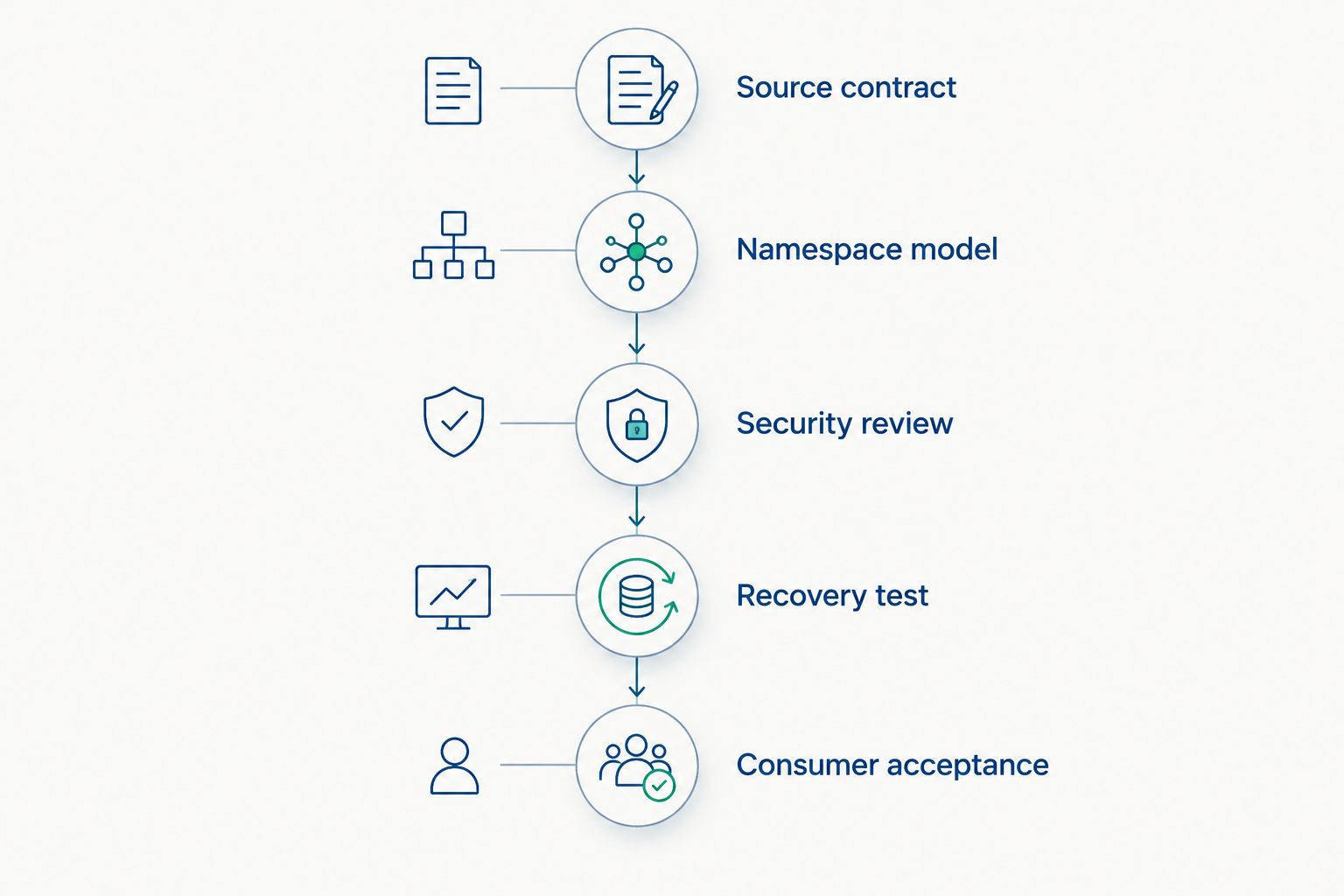
Approve the data contract and security design before accepting consumer behavior.
Record the results in a responsibility matrix that names the owner of each configuration and each recovery action. Your 2026 purchasing decision should follow that evidence, not precede it.
Discuss your UNS architecture
Bring your source list, network boundaries, and consumer requirements to the technical discussion.
How the shortlist is ordered
The order follows the architectural decision: assess the DataOps platform role first, then scope integration and OPC source access. N3uron and Cogent DataHub appear as DataOps candidates; OPC Router and TOP Server appear in their stated connectivity roles.
This is not a measured performance ranking. The selection criteria are source access, information modeling, security boundaries, data lifecycle, deployment ownership, and consumer independence; your acceptance results determine the final choice.
Which unified namespace platforms should you choose?
Start with N3uron for a DataOps-led evaluation, and include Cogent DataHub against the same requirements. Assess OPC Router and TOP Server separately where integration or OPC source access needs a dedicated component.
For an undecided team, the next move is an architecture review—not an unrestricted product trial. Define the model, security boundaries, and acceptance tests, then ask Software Toolbox to map the candidates to those responsibilities.
FAQ
What's the best starting point for evaluating unified namespace platforms?
N3uron is the first DataOps candidate in this role-based shortlist. Evaluate Cogent DataHub against the same requirements, and assess connectivity components separately where the architecture requires them.
Is a Unified Namespace the same as an MQTT broker?
No. A Unified Namespace defines a shared information architecture, while an MQTT broker handles message distribution; your design still needs naming rules, data contracts, security, and operational ownership.
Does every listed product provide a complete Unified Namespace?
No complete-UNS claim is made for these products. N3uron and Cogent DataHub are listed as DataOps candidates, while OPC Router and TOP Server are evaluated in their stated connectivity roles.
Should I choose N3uron or Cogent DataHub?
Choose only after both candidates have been assessed against the same deployment requirements. Confirm the required interfaces, information model, security behavior, and recovery behavior for the proposed configuration.
Can TOP Server be part of a Unified Namespace project?
TOP Server belongs in the assessment when the project requires OPC source connectivity. Define its source-access responsibility separately from namespace governance and downstream consumer requirements.
What should a Unified Namespace pilot include?
Use a bounded pilot with 1 production line, 2 independent consumers, and 3 failure scenarios. These recommended conditions test shared interpretation and recovery behavior without implying any product capacity limit.
What should cybersecurity teams review before deployment?
Cybersecurity teams should approve connection paths, authentication, authorization, and certificate ownership. The review should also identify permitted traffic across network zones and the actions required during recovery.
One last thing
Test a naming change before you approve the design. Change an asset identifier in the pilot and require the team to demonstrate how consumers detect and handle it; connection uptime alone will not expose a broken data contract.