Best overall for SCADA integration: an IEC 61850 MMS client driver. Best for GOOSE event monitoring: a GOOSE subscriber. Best for distributing acquired data to other systems: an OPC integration layer. Software Toolbox belongs in that downstream connectivity decision, but its supplied product information does not establish a native IEC 61850 driver.
TL;DR
- For iec 61850 driver software, choose an MMS client for SCADA data acquisition and report handling.
- Choose a GOOSE subscriber when the requirement is event monitoring; MMS polling is not a substitute.
- Software Toolbox fits the OPC connectivity discussion after IEC 61850 acquisition, not as a verified native driver.
- In 2026, require an IED-file review and a witnessed connection test before approving a deployment.
Why this matters
An IEC 61850 connection is not one interchangeable data feed. MMS client/server communication, GOOSE messaging and downstream OPC distribution serve different purposes. Buying against the protocol name alone can leave your SCADA system with readable points but no usable report configuration, or leave an event-monitoring project without GOOSE subscription at all.
The distinction matters at the handoff between substation engineering and operations. Your IED configuration defines the available logical nodes, data objects, datasets and report control blocks. The software must support the specific exchange your architecture requires, and your test plan must prove it against the actual IED configuration. This 2026 buying guide ranks software roles, not unverified vendor implementations.
What makes the best IEC 61850 driver software?
Use these criteria before comparing products. A vendor's general IEC 61850 claim does not answer any of them on its own.
- Required communication model: Specify MMS client/server, GOOSE subscription or both. Write down the intended data flow before requesting a demonstration.
- IED configuration fit: Check how the software handles the SCL files relevant to your engineering workflow, then confirm the imported model against the configured IED.
- Report handling: If SCADA depends on reports, test the required report control blocks, dataset membership, quality and timestamps. Do not accept a successful connection as proof of usable reporting.
- Point selection and naming: Establish how logical-node data becomes stable tags for the receiving system. Check how configuration changes affect those tags.
- Network placement: Document the station-bus boundary, allowed flows and the point at which data enters another OT or IT zone. GOOSE traffic and an MMS connection impose different network requirements.
- Commissioning evidence: Demand a test using the target IED configuration, the intended consumer and a recorded result for normal operation and communication loss.
The integration boundary is the decision point. An MMS client acquires station data, a GOOSE subscriber monitors subscribed messages, and an OPC layer distributes data that another component has already acquired. Treating those functions as equivalent hides the most important procurement question: where does IEC 61850 communication actually terminate?
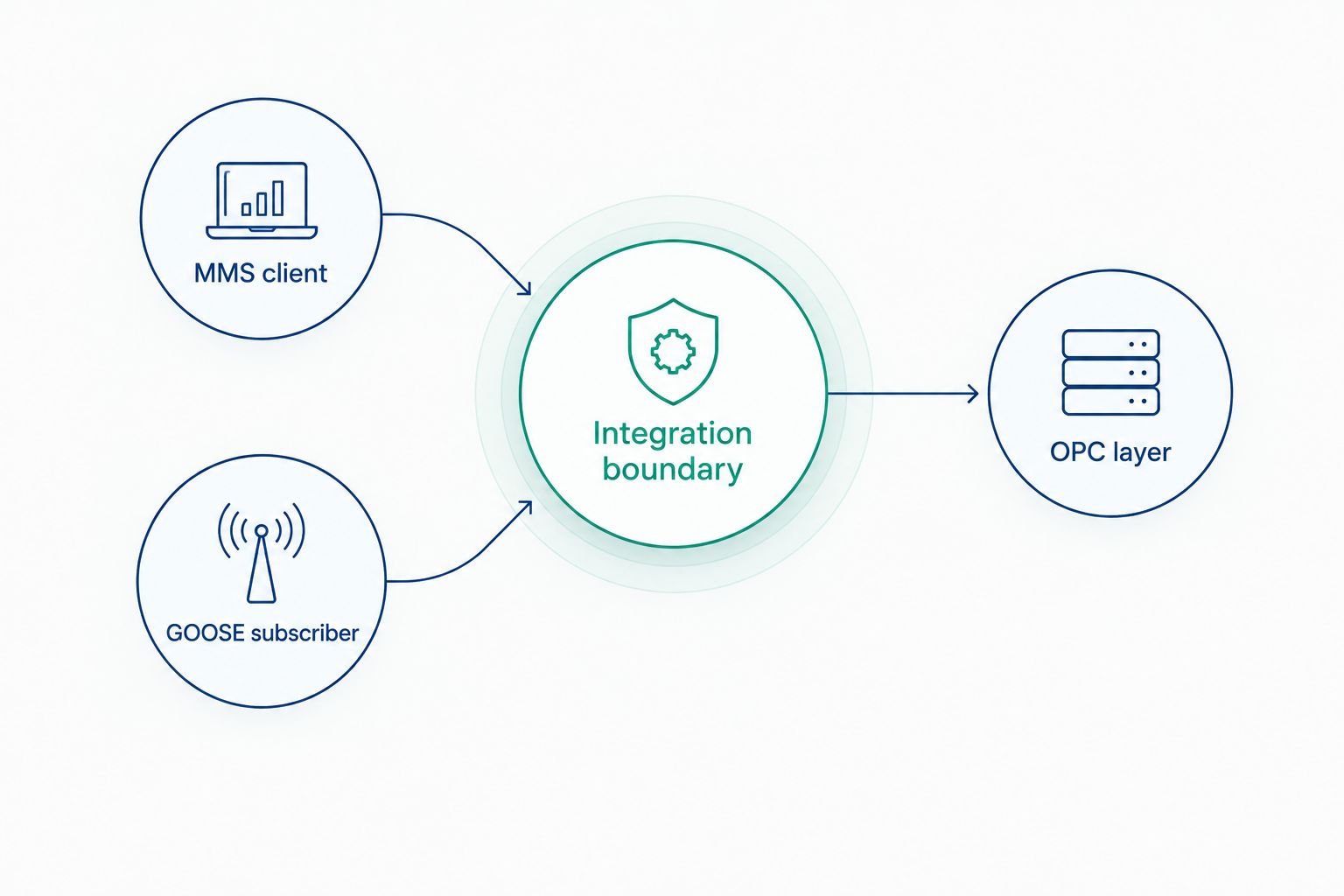
Identify where IEC 61850 communication terminates before selecting the downstream connection.
IEC 61850 software at a glance
IEC 61850 MMS client driver
- Best for: SCADA acquisition from IEDs
- Standout function: Reads the IED model and exchanges data through MMS
- Key limitation: Does not establish GOOSE subscription by itself
GOOSE subscriber software
- Best for: Monitoring configured GOOSE messages
- Standout function: Subscribes to event-oriented messages
- Key limitation: Does not replace an MMS client for routine SCADA data acquisition
Software Toolbox OPC integration layer
- Best for: Distributing already-acquired data to OPC consumers
- Standout function: Addresses the downstream industrial connectivity role
- Key limitation: Native IEC 61850 support is not established by the supplied product information
This is a functional comparison, not a claim that every package in a category implements every listed capability. In 2026, evaluate each candidate against the configured IED and the receiving system rather than against a protocol badge.
1. IEC 61850 MMS client driver: best for SCADA acquisition
An MMS client is the default software role when SCADA needs data from IEC 61850 IEDs. It communicates with an IED server and exposes the selected data to your application. Your engineering decision is not simply whether a connection opens: it is whether the client can use the configured model, datasets and reports your SCADA design depends on.
Start with the IED configuration and identify the points that operations needs. For each point, document its source object, destination tag, quality handling and timestamp handling. Then test the configured reporting path where reports are part of the design. A polling demonstration alone does not validate report-driven acquisition.
IEC 61850 MMS client driver pros:
- Directly addresses the acquisition role in an IED-to-SCADA architecture.
- Provides a clear place to test model browsing, point selection and report behavior.
- Keeps the IEC 61850 connection boundary explicit in the design.
IEC 61850 MMS client driver cons:
- Does not establish GOOSE subscription unless that capability is separately specified and demonstrated.
- Requires point mapping and change control when the configured IED model changes.
- A protocol claim alone does not prove support for your required report configuration.
Best for: A controls or SCADA team that needs IED data in its operational system and can supply the configuration files and a defined point list for acceptance testing.
For a 2026 proof of concept, start with 1 configured IED, 1 MMS client and 1 receiving SCADA endpoint. Those are test-scope recommendations, not performance claims. Record the selected data objects, verify quality and timestamps at the destination, then interrupt and restore the connection. Expand the deployment only after the behavior is documented.
Verdict: Buy the MMS client role first when SCADA acquisition is the primary requirement; select an implementation only after it passes the configured-IED test.
2. GOOSE subscriber software: best for event monitoring
A GOOSE subscriber serves a different job. GOOSE uses Ethernet multicast for configured publisher/subscriber exchanges; it is not an MMS polling mode. If your project requires visibility into GOOSE messages, state that requirement explicitly and test subscription against the publisher configuration. Do not infer it from a vendor's MMS support.
The engineering work starts with identifying the published dataset and the consuming application. Confirm that the subscription sees the intended changes, preserves the context the application needs and behaves as expected when the publisher configuration changes. Network and cybersecurity teams should review multicast reachability and the intended monitoring boundary before commissioning.
GOOSE subscriber software pros:
- Matches a requirement to observe configured GOOSE messages.
- Makes publisher, subscriber and network assumptions visible in the test plan.
- Separates event monitoring from routine SCADA acquisition.
GOOSE subscriber software cons:
- Does not replace an MMS client for browsing and acquiring the wider IED data model.
- Depends on the published dataset and multicast path being configured for the intended subscriber.
- Needs retesting when relevant publisher configuration changes.
Best for: A substation team with a defined GOOSE monitoring requirement, access to the publisher configuration and a receiving application that can use the subscribed events.
In 2026, ask for a witnessed subscription test, not a slide listing IEC 61850 support. Record the publisher, dataset, subscriber and receiving tag or event record. Then verify the effect of a configuration change in a controlled test environment. This isolates an integration failure before it reaches the operational network.
Verdict: Buy the GOOSE subscriber role for a documented monitoring requirement; skip it when the project only needs MMS-based SCADA data.
3. Software Toolbox OPC layer: best for downstream distribution
Software Toolbox provides industrial connectivity software, including OPC drivers and TOP Server. That makes its offering relevant when your architecture needs an OPC integration layer after data acquisition. The supplied product information does not identify a specific Software Toolbox product as a native IEC 61850 MMS client or GOOSE subscriber, so do not place it at the IED connection boundary without separate product-level verification.
Draw the boundary in the design: IED, verified IEC 61850 acquisition component, OPC integration layer, then receiving system. For each handoff, define the tag name, value, quality and timestamp expected by the consumer. The first acceptance question is whether the acquisition component delivers the required data. The second is whether the downstream connection preserves the information operations needs.
Software Toolbox OPC integration layer pros:
- Addresses the downstream industrial connectivity role identified in the supplied brand description.
- Lets the design distinguish IEC 61850 acquisition from distribution to other systems.
- Provides a defined boundary at which to review tag mapping and data handoff.
Software Toolbox OPC integration layer cons:
- The supplied inputs do not verify a native IEC 61850 driver or GOOSE subscriber in its catalog.
- An additional integration boundary requires its own mapping and acceptance test.
- It does not remove the need to select and verify the IEC 61850 acquisition component.
Best for: An IT/OT architect who already has, or is separately selecting, a verified IEC 61850 acquisition path and needs to plan downstream OPC connectivity.
Keep the 2026 request precise: identify the intended Software Toolbox product, the upstream source and the downstream consumer before asking whether a particular connection is supported. A catalog-level OPC claim is not evidence for a specific IEC 61850 feature.
Verdict: Hold as an IEC 61850 driver purchase; evaluate the OPC layer separately once the native acquisition path is verified.
How we ranked these options
The ranking follows the first required function in a typical IED-to-operations data path: acquire the data, monitor GOOSE when that is an explicit requirement, then distribute acquired data downstream. It also reflects the six criteria above: communication model, configuration fit, reporting, naming, network placement and commissioning evidence.
This ranking does not score named vendor products. No product-level IEC 61850 feature matrix, test result or implementation detail is present in the supplied information. The result is an architecture decision tree you can use to screen candidates, not a claim that an untested package passes acceptance.
Commissioning checklist for the 2026 shortlist
Before requesting approval, put the following questions into the technical evaluation. Each answer should identify a configured artifact or a witnessed result, not just a supported-protocol label.
- Which IED configuration is in scope? Record the engineering file used for the test and the configured device it represents. Check that the candidate exposes the expected model.
- What exchange is required? Name MMS data acquisition, report handling and GOOSE subscription separately. Mark each as required or out of scope.
- Where do data semantics change? Trace a selected value from its IED object to the receiving tag. Check quality and timestamp handling at both ends.
- What crosses a network boundary? Identify the source, destination, communication type and zone for every planned connection. Review GOOSE multicast placement separately from MMS traffic.
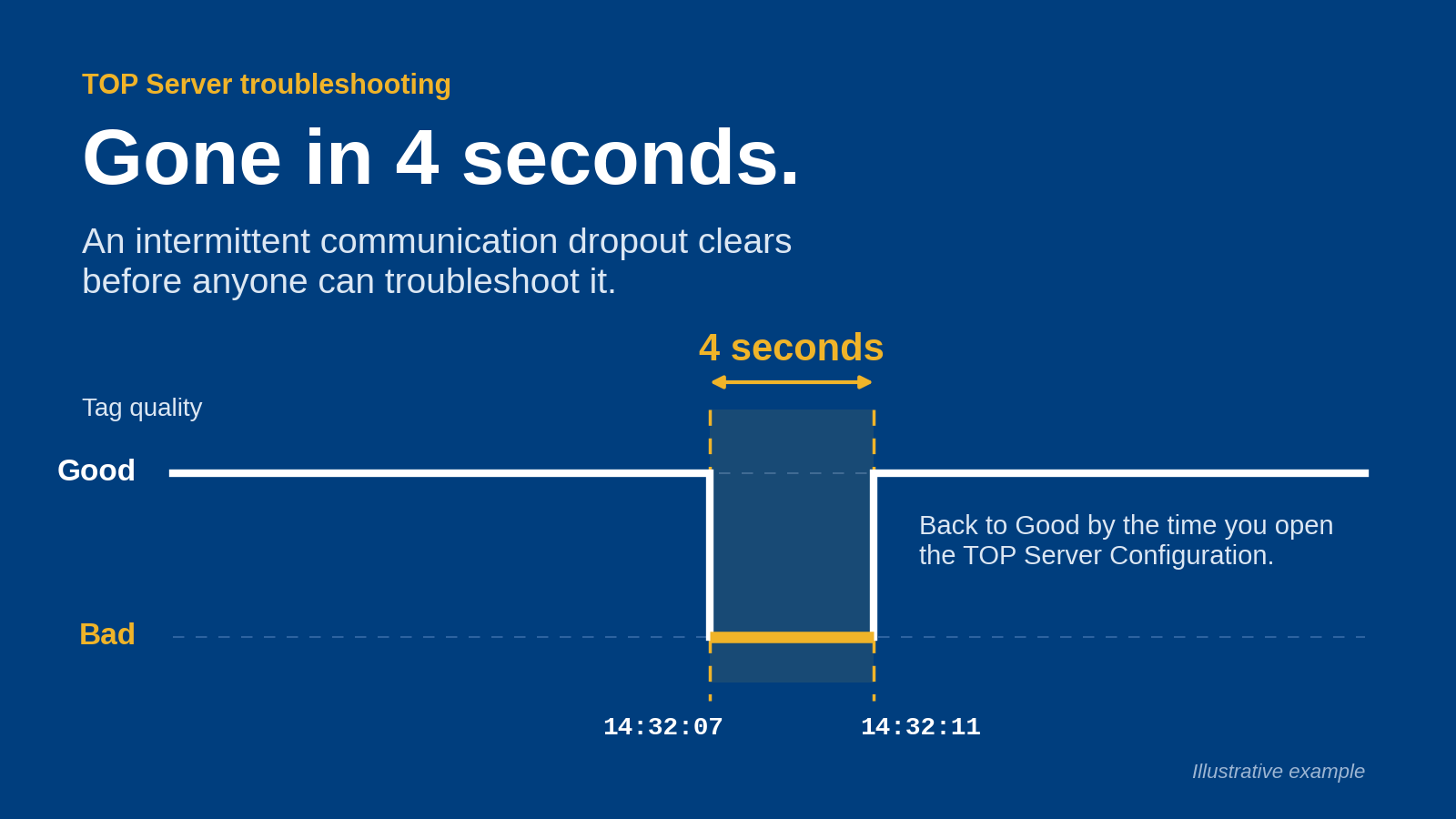
- What happens on disruption? Disconnect the test path, restore it and inspect what the receiving system records. Document the observed behavior rather than assuming that reconnection means the data is trustworthy.
- Who owns configuration changes? Assign responsibility for updating mappings and retesting after changes to the IED configuration or receiving system.
A useful 2026 acceptance record contains the exact configuration tested and the result for each required exchange. Without that record, you cannot distinguish a product limitation from a mismatch between the IED engineering file, network and receiving application.
Which IEC 61850 software should you choose?
Choose an MMS client driver by default when the request is to bring substation IED data into SCADA. Add a GOOSE subscriber only when the design explicitly requires GOOSE monitoring. Evaluate an OPC layer after you have confirmed where IEC 61850 acquisition terminates.
For Software Toolbox, the defensible 2026 shortlist position is downstream OPC connectivity, subject to a product-specific review. Do not substitute that position for proof of native IEC 61850 support. The purchase decision belongs to the candidate that demonstrates the required communication model against your configured IED and delivers the required data to the intended consumer.
FAQ
What is the best iec 61850 driver software for SCADA?
An IEC 61850 MMS client driver is the default choice for SCADA acquisition from IEDs. Validate model access, required reports, quality and timestamps against the configured IED before selecting a product.
Is an MMS client the same as a GOOSE subscriber?
No. An MMS client and a GOOSE subscriber address different IEC 61850 exchanges. Specify and test each one separately when your architecture requires both.
Does OPC software replace an IEC 61850 driver?
No. An OPC integration layer does not, by itself, establish how data is acquired from an IEC 61850 IED. Identify and verify the native acquisition component first.
Does Software Toolbox offer a verified native IEC 61850 driver?
The supplied Software Toolbox product information does not establish a native IEC 61850 driver. Confirm support for the intended product and communication model before specifying it at the IED connection boundary.
What should an IEC 61850 driver proof of concept include?
Test the candidate against a configured IED and the intended receiving system. Record model access, required report or subscription behavior, quality, timestamps and recovery after communication loss.
Why does the IED configuration matter when selecting a driver?
The IED configuration defines the model and configured exchanges the integration must use. A successful connection does not prove that the required datasets, reports or receiving tags work.
Can one IEC 61850 software package handle MMS and GOOSE?
Only a product-level capability review and test can establish that for a specific package. Do not treat general IEC 61850 support as evidence that both communication models are implemented.
One last thing
Make the first acceptance test a data-path test, not a connection test. A connection confirms reachability; the operational requirement is that the correct IED object reaches the correct consumer with usable quality and timestamp information. In 2026, that distinction is the shortest route to a shortlist your SCADA, substation engineering and cybersecurity teams can all evaluate.