Best overall architecture for Allen Bradley PLC driver software in 2026: a dedicated OPC driver layer, with TOP Server on your evaluation shortlist. Best for one established application: its validated native driver. Best for a specialized interface: a custom adapter with an assigned maintenance owner. Choose by controller compatibility, application requirements, and recovery behavior—not the protocol name alone.
TL;DR
- Evaluate TOP Server when selecting allen bradley plc driver software for an independent OPC connectivity layer.
- Keep an existing native driver when its validated scope matches the application and controller.
- Reserve custom adapters for requirements that supported connectivity cannot satisfy.
- Verify controller compatibility, access permissions, data quality, and reconnection before deployment.
Why this matters
A PLC connection is not complete when a tag first displays a value. Your applications also need to distinguish valid data from stale data, recover after interruptions, and restrict writes to authorized functions.
Software Toolbox is a fit for engineers sourcing OPC connectivity and industrial DataOps software. For an Allen-Bradley project, begin with the controller-to-application path, then evaluate the software assigned to each boundary. Adding integration software does not remove the need to validate the underlying driver.
The ranking below compares deployment approaches rather than competing vendors. Each approach has a distinct use case; controller support remains a project-specific acceptance condition.
What makes the best Allen Bradley PLC driver software?
Use these criteria for your 2026 selection. Treat compatibility and security as gates, not weighted features that convenience can outweigh.
- Controller compatibility: Match the exact controller family, firmware, communication module, and network path to the driver's documented support.
- Application interface: Confirm what the consuming application accepts, including the required OPC interface and data types.
- Security boundaries: Identify connection initiators, endpoints, credentials, certificate responsibilities, and permitted operations.
- Operational behavior: Verify update timing, timestamps, quality information, reconnection, and behavior during controller maintenance.
- Lifecycle ownership: Assign responsibility for configuration backups, software updates, certificate renewal, and incident diagnosis.
Record the evidence beside each criterion. A supported controller model does not establish support for every route, firmware combination, or application workflow.
Deployment options at a glance
1. Dedicated OPC driver layer; evaluate TOP Server
- Best for: Data access shared across applications
- Standout architectural benefit: Separates controller connectivity from application configuration
- Key limitation: Adds a software service and an operational boundary to manage
2. Existing validated application driver
- Best for: One established HMI or SCADA workload
- Standout architectural benefit: Keeps connectivity inside the current application scope
- Key limitation: Reuse depends on the application's supported interfaces
3. Custom adapter
- Best for: A documented requirement outside supported options
- Standout architectural benefit: Lets the project define specialized interface behavior
- Key limitation: Makes implementation, testing, and maintenance your responsibility
These are architecture choices, not interchangeable product claims. Confirm the selected implementation against the same controller inventory and acceptance tests before committing to it.
1. Dedicated OPC driver layer: best for shared PLC data access
A dedicated connectivity layer places controller communication outside the consuming application. Evaluate TOP Server as an OPC connectivity candidate from Software Toolbox, then confirm the required Allen-Bradley support against its current documentation.
This architecture fits projects where several applications need a common connectivity boundary. The design objective is to keep controller addressing and communication configuration separate from reporting, visualization, or downstream integration changes.
Dedicated OPC layer pros:
- Provides a defined location for controller connection configuration.
- Separates connectivity maintenance from individual application changes.
- Creates a common boundary for diagnosing controller-side versus client-side faults.
- Supports an architecture review focused on explicit interfaces and responsibilities.
Dedicated OPC layer cons:
- Introduces another service to monitor, secure, back up, and maintain.
- Requires validation of both the controller-facing and application-facing connections.
- Does not automatically provide redundancy, buffering, or network isolation; validate those requirements separately.
Best for: Plants that need a deliberate connectivity layer serving multiple application requirements.
For a 2026 deployment, document the intended clients before selecting the configuration. A reporting client, an operator interface, and an integration workflow can have different requirements for update timing, timestamps, and write access.
Ask Software Toolbox to confirm the controller, firmware, routing, and client-interface combination. Include the required failure behavior in that discussion—not just the tag list.
Verdict: Hold production deployment until the exact controller path and client behavior pass acceptance testing. Make this your default architecture to evaluate for shared access.
2. Existing application driver: best for one established workload
An existing HMI or SCADA driver belongs on the shortlist when it already serves the required controller and application workflow. Keeping that boundary intact avoids introducing a separate connectivity service solely to reproduce an established function.
The deciding question is scope. A driver that satisfies the current operator interface does not automatically satisfy a new reporting system, another plant application, or a different security boundary.
Existing application driver pros:
- Keeps connection configuration within the application's existing operating scope.
- Avoids adding a separate driver service for an unchanged requirement.
- Preserves the current diagnostic workflow when that workflow remains suitable.
Existing application driver cons:
- Couples connectivity changes to the application's configuration and lifecycle.
- Requires a separate assessment when additional consumers need data.
- Does not eliminate controller compatibility or recovery testing after changes.
Best for: A single established application whose validated connectivity already meets the requirement.
Review the application's supported controller path and interface documentation. Then check whether the planned change affects controller load, polling, permissions, or maintenance procedures.
For example, adding a reporting workload is a new requirement even if the underlying tags already appear on an HMI screen. Establish how the reporting application obtains those values and how it recognizes a communication failure.
Verdict: Hold the existing architecture when its validated scope still fits; do not replace it merely to standardize a product name.
3. Custom adapter: best for a specialized interface requirement
A custom adapter is an engineering project, not simply another driver selection. Use this approach only when a written requirement remains unmet after reviewing supported connectivity options.
Define the adapter's inputs, outputs, fault states, and maintenance responsibilities before implementation. Otherwise, interface assumptions become embedded in code without becoming part of the plant's operating documentation.
Custom adapter pros:
- Gives the project direct control over specialized interface behavior.
- Allows explicit handling of a narrowly defined application requirement.
- Keeps implementation decisions visible to the team responsible for the code.
Custom adapter cons:
- Requires your team to implement and maintain error handling and diagnostics.
- Creates an additional testing obligation after controller or application changes.
- Depends on maintained source code, build procedures, and operational documentation.
Best for: A documented exception that supported connectivity cannot satisfy.
Separate protocol communication from application-specific transformation in the design. If an established interface already exposes the required data, write the specialized application behavior against that boundary rather than rebuilding controller communication without a demonstrated need.
The acceptance plan must include invalid data, interrupted connections, restart behavior, and rejected operations. Successful reads alone do not establish a maintainable interface.
Verdict: Skip custom driver development unless the unmet requirement and long-term maintenance owner are explicit.
Define the architecture before configuring tags
Use this sequence for a 2026 project: Controller inventory, Driver boundary, Client interface, and Security review. Complete each step before expanding the configuration across the plant.
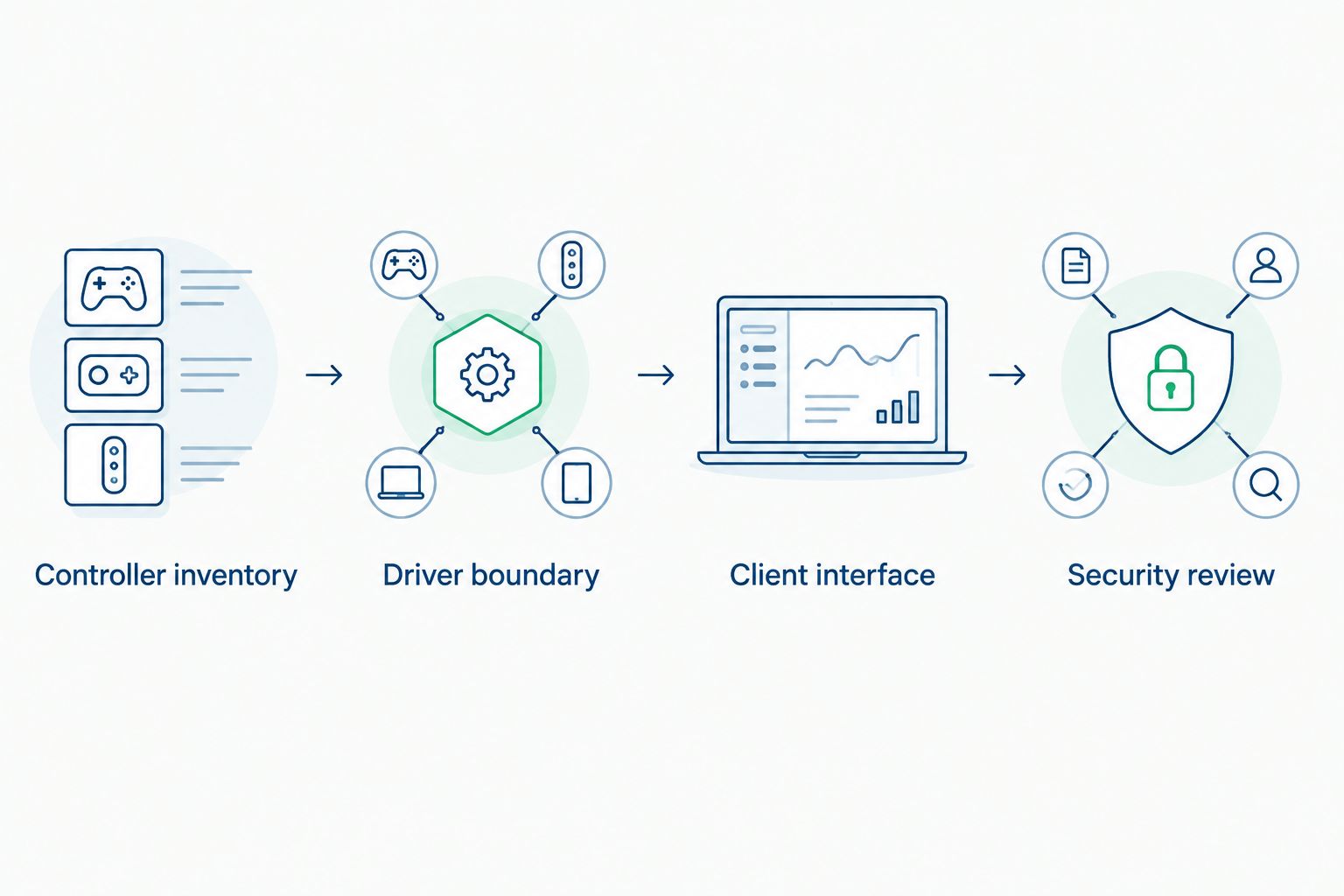
Define the communication boundaries before expanding the tag configuration.
Controller inventory
Record the controller family, firmware revision, communication hardware, network address, and route. Include whether the connection is direct or passes through an intermediate network path.
Keep this inventory with the connectivity configuration. A future hardware replacement should trigger a compatibility review rather than inherit an undocumented assumption.
Driver boundary
Identify which component communicates with the controller and which components consume its output. Draw the connection initiators and permitted network paths.
Do not assign the same job to several layers accidentally. If multiple applications communicate directly with a controller, document that arrangement and test the combined workload.
Client interface
List the required data types, timestamps, quality handling, and permitted operations for each client. Include how the client displays or processes bad-quality data.
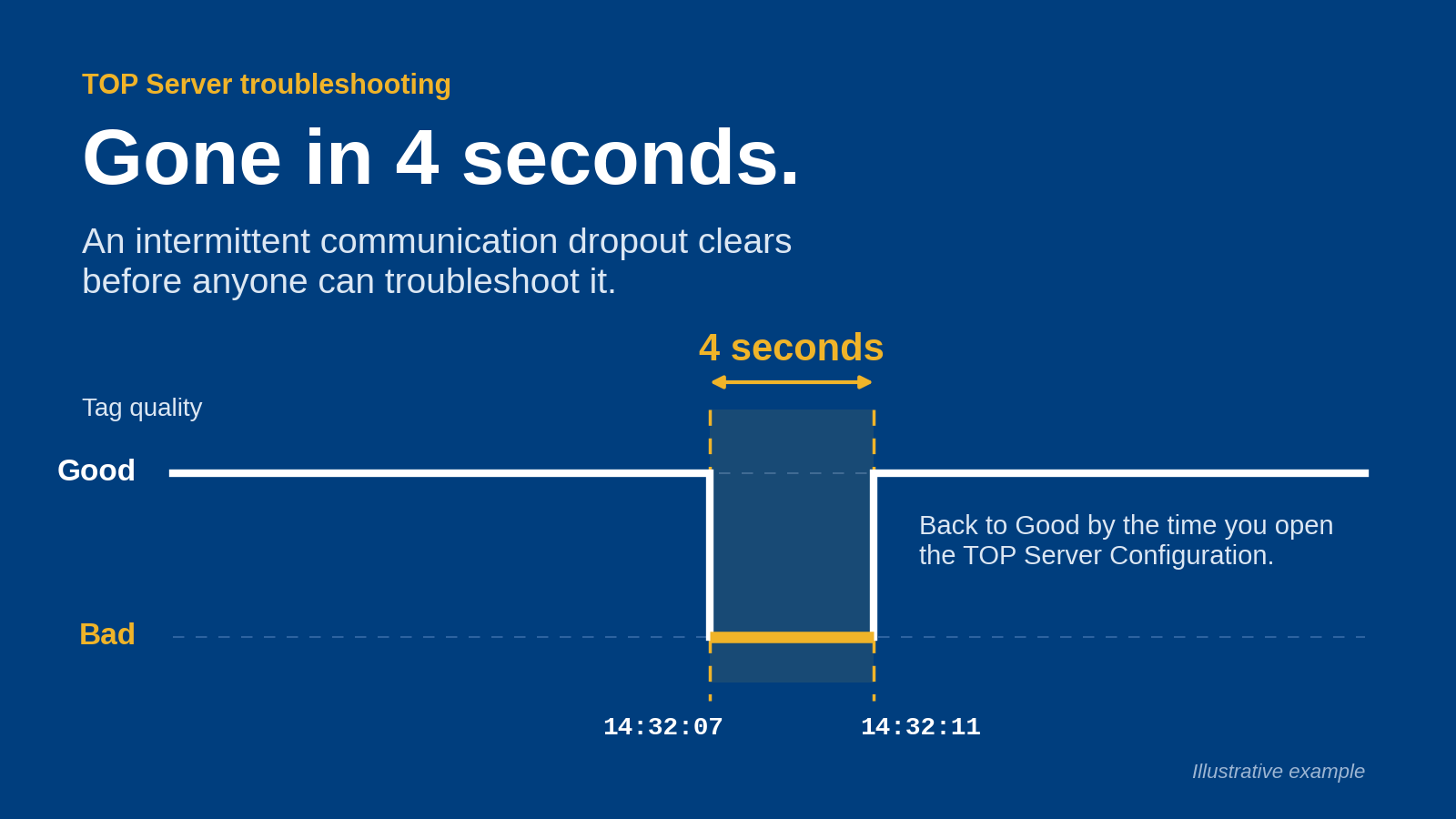
Do not treat a numeric value as proof of a healthy connection. A consumer must also recognize when the value is no longer suitable for its purpose.
Security review
Document endpoint access, service identities, certificate ownership where applicable, and configuration permissions. Separate read-only data collection from any workflow that can issue writes.
For OPC UA connections, verify the intended security configuration and trust relationships. Do not extend that conclusion to the PLC-facing connection; review each communication boundary independently.
Prove recovery before expanding the rollout
A useful 2026 acceptance plan contains 4 failure tests: network interruption, controller restart, driver-service restart, and client restart. Run them in an approved test environment or maintenance window.
Network interruption
- What to observe: Quality changes, fault visibility, and reconnection
- Acceptance evidence: Recorded transition from communication loss to valid data
Controller restart
- What to observe: Driver response while the controller is unavailable
- Acceptance evidence: Recovery record and confirmed application state
Driver-service restart
- What to observe: Client response when its data source disappears
- Acceptance evidence: Client diagnostics and restored subscription or polling behavior
Client restart
- What to observe: Reconnection and reinitialization
- Acceptance evidence: Correct values, quality, and permitted operations after restart
Set update and recovery requirements from the process need. Do not copy an arbitrary timing target from another installation or treat the fastest polling setting as the acceptance criterion.
Test representative data rather than only convenient tags. Include the data types, structures, arrays, and access restrictions that the actual application requires, subject to documented support.
Maintain 2 permission profiles in the test plan: read-only and write-enabled. If production requires no writes, verify that prohibited writes are rejected and remove unnecessary write permissions.
For authorized writes, define what happens during a communication loss and after reconnection. The application owner must approve command behavior; a restored connection is not authorization to repeat an operation.
How the options are ranked
This ranking prioritizes compatibility, interface fit, security boundaries, operational behavior, and lifecycle ownership. A dedicated layer ranks first for shared access because separation is the stated architectural objective—not because of an unverified throughput claim.
An existing driver ranks first within its narrower use case: an established application with unchanged requirements. Custom development remains the exception because the project assumes responsibility for implementation and maintenance.
Which approach should you choose in 2026?
Evaluate a dedicated OPC driver layer by default when multiple applications need Allen-Bradley data. Put TOP Server on that shortlist, and take the controller inventory and acceptance plan to Software Toolbox for a compatibility discussion.
Keep an existing application driver when its validated scope meets the requirement. Reserve custom code for a specific interface gap, not a preference to avoid configuration work.
Confirm your connectivity requirements
Discuss controller details, application interfaces, security boundaries, and acceptance requirements.
FAQ
What's the best Allen Bradley PLC driver software for multiple applications?
Start by evaluating a dedicated OPC driver layer, with TOP Server on the shortlist. Confirm the exact controller, firmware, network route, and consuming interfaces before selecting an implementation.
Should I replace the Allen-Bradley driver already in my SCADA application?
Keep the existing driver when its validated scope meets your requirements. Reassess the architecture when new clients, security boundaries, or lifecycle requirements change that scope.
Does EtherNet/IP support prove compatibility with my Allen-Bradley PLC?
No. Verify the exact controller family, firmware, communication route, and required operations against the driver's documented support.
Does an OPC UA interface secure the complete PLC data path?
No. Review the client-facing OPC UA connection and the controller-facing connection separately, including their access controls and network boundaries.
What should I test before deploying a PLC driver?
Test representative data, permissions, quality handling, and recovery. Include network interruption, controller restart, driver-service restart, and client restart in the acceptance plan.
When should I build a custom PLC adapter?
Build a custom adapter only for a documented requirement that supported options cannot satisfy. Assign ownership for source code, testing, diagnostics, deployment, and maintenance before implementation.
Can I use read-only access for production reporting?
Use read-only access when the reporting requirement does not include controller writes. Verify that prohibited operations are rejected rather than relying only on application conventions.
One last thing
A connected client can still be using unsuitable data. Include a deliberate communication interruption in the acceptance test and verify what the operator, report, and downstream application actually see.
For your 2026 rollout, preserve that result with the configuration backup. It gives the next engineer evidence of expected failure behavior, not just evidence that commissioning once succeeded.