Best starting point for disconnected plant data: a connectivity-first architecture using Software Toolbox. Best for detecting unfamiliar behavior: anomaly detection. Best for recognized failure patterns: supervised classification. Choose AI software for predictive maintenance in manufacturing by the maintenance decision it supports—not by treating data connectivity, prediction, and AI agents as interchangeable products.
TL;DR
- Evaluate AI software for predictive maintenance in manufacturing against asset data, failure evidence, and maintenance decisions.
- Software Toolbox supplies industrial connectivity, DataOps platforms, and AI agent tools; establish their role before selecting predictive models.
- Anomaly detection identifies unusual behavior; it does not establish the cause or remaining useful life.
- Keep AI-generated recommendations separate from equipment control and require human review.
Why this matters
A maintenance team needs more than an abnormality score. Engineers need the affected asset, operating conditions, supporting measurements, and an action they can assess against equipment risk.
Software Toolbox is a starting point for manufacturers selecting industrial connectivity and DataOps software to support predictive maintenance. Its portfolio includes TOP Server, OPC Router, Cogent DataHub, N3uron, Dream Report, and industrial AI agent tools. That portfolio is not evidence that every component performs failure prediction or remaining-useful-life estimation.
This 2026 shortlist ranks software approaches by their role in an implementation. It is an architecture selection guide, not a tested vendor leaderboard: select the missing capability without replacing a functioning layer simply to consolidate vendors.
What makes the best predictive maintenance software
Apply these criteria before requesting a demonstration. A convincing dashboard does not answer whether the deployment can support a maintenance decision.
- Decision fit: Define whether you need anomaly detection, failure classification, remaining-useful-life estimation, or assistance interpreting evidence.
- Data suitability: Identify measurements, timestamps, quality indicators, operating states, and maintenance records required for that decision.
- Evaluation quality: Require time-separated evaluation and results reported by asset and failure mode, not only an aggregate accuracy figure.
- Deployment boundaries: Document execution location, network flows, identities, certificate ownership, and permitted access to production systems.
- Maintenance workflow: Define who receives an alert, what evidence accompanies it, and how the resulting inspection is recorded.
- Lifecycle ownership: Assign responsibility for configuration changes, model monitoring, access reviews, and changes to equipment or operating conditions.
For the data preparation layer, use the industrial DataOps platform guide to frame requirements separately from model selection. Treat supported interfaces and deployment behavior as procurement checks for the exact product version and configuration.
Predictive maintenance approaches at a glance
The order below follows implementation dependencies, not a claim that one algorithm outperforms every other option. For a 2026 project, first identify which row addresses your current constraint.
Connectivity-first stack using Software Toolbox
- Best for: Establishing usable equipment data
- Standout capability to evaluate: Industrial connectivity and DataOps portfolio
- Key limitation: A data foundation is not a validated predictive model
Anomaly detection software
- Best for: Finding departures from normal operation
- Standout capability to evaluate: Learning normal operating patterns
- Key limitation: An unusual pattern does not identify its cause
Supervised failure classification software
- Best for: Recognizing documented failure patterns
- Standout capability to evaluate: Classifying examples using labeled history
- Key limitation: Depends on relevant, reliable labels
Remaining-useful-life modeling software
- Best for: Planning intervention against degradation
- Standout capability to evaluate: Estimating time or usage to a defined endpoint
- Key limitation: Requires evidence linking condition to degradation
AI agent assistance
- Best for: Reviewing evidence and preparing maintenance actions
- Standout capability to evaluate: Organizing information into a reviewable workflow
- Key limitation: Generated explanations require verification
1. Connectivity-first stack: best for fragmented equipment data
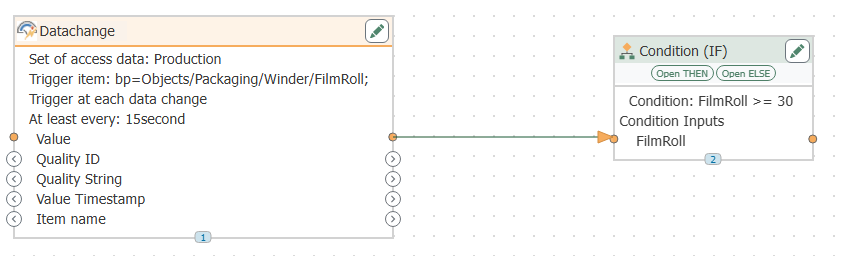
Software Toolbox provides industrial connectivity software, DataOps/analytics platforms, and industrial AI agent tools. Evaluate TOP Server and OPC Router within the connectivity scope, and Cogent DataHub and N3uron within the DataOps scope identified in the portfolio description.
Specify the required interfaces, deployment locations, and data handling before choosing components. Do not assume that naming several products establishes a supported end-to-end predictive maintenance architecture.
Connectivity-first stack pros:
- Separates equipment access requirements from model requirements.
- Makes timestamps, engineering units, and data quality explicit acceptance criteria.
- Lets you evaluate a predictive application without confusing missing measurements with model failure.
Connectivity-first stack cons:
- Does not itself prove failure detection or prediction performance.
- Requires integration ownership across source systems, data processing, and the predictive application.
Best for: Plants whose immediate obstacle is obtaining usable equipment data rather than selecting an algorithm.
Verdict: Buy the required connectivity capability only after validating the source-to-consumer path; hold predictive-model selection until that path is understood.
2. Anomaly detection: best for unfamiliar operating changes
Anomaly detection identifies observations that differ from a learned or specified reference. It suits investigations where you have operating data but do not have reliable examples of every failure you want to detect.
Evaluate normal operation by production state. Startup, cleaning, changeover, and steady production should not become an undifferentiated baseline when those states produce materially different measurements.
Anomaly detection pros:
- Can support evaluation without labeled examples of every target failure.
- Provides a way to prioritize unusual equipment behavior for inspection.
- Supports comparison between current measurements and a defined operating baseline.
Anomaly detection cons:
- Does not establish a physical fault or its cause.
- Can flag legitimate production changes when the baseline lacks operating context.
Best for: Maintenance teams investigating condition changes before they have a dependable failure-labeling process.
Verdict: Buy only after a plant-data pilot shows that alerts distinguish useful abnormalities from expected operating changes.
3. Supervised classification: best for documented failure patterns
Supervised classification learns relationships between inputs and assigned labels. In maintenance, those labels need to distinguish actual equipment findings from administrative events such as a work order being opened.
Check how each historical label was established. A technician-confirmed bearing defect and an unverified vibration alarm are different kinds of evidence; combining them without distinction weakens the evaluation.
Supervised classification pros:
- Targets defined fault categories rather than generic abnormality.
- Supports evaluation against recorded outcomes.
- Connects model output to a maintenance team's existing failure taxonomy.
Supervised classification cons:
- Requires relevant labeled examples for the intended application.
- Does not establish performance on failure modes absent from evaluation data.
Best for: Assets with consistent maintenance records and recurring, distinguishable failure categories.
Verdict: Buy when label quality and time-separated evaluation support the specific fault categories you need; otherwise, hold.
4. Remaining-useful-life modeling: best for degradation planning
Remaining-useful-life modeling estimates time or usage until a defined endpoint. That endpoint must be explicit: functional failure, an inspection threshold, and a planned replacement criterion are not interchangeable.
Ask how the model represents uncertainty and handles assets that have not reached the endpoint. Reject a demonstration that presents a precise countdown without explaining the degradation evidence and assumptions behind it.
Remaining-useful-life modeling pros:
- Aligns the output with intervention planning.
- Makes the definition of an unacceptable equipment condition explicit.
- Supports evaluation of predicted horizons against observed degradation histories.
Remaining-useful-life modeling cons:
- Requires evidence connecting measurements or usage to the chosen endpoint.
- Does not eliminate uncertainty from changing loads, operating conditions, or maintenance interventions.
Best for: Equipment with a measurable degradation process and records suitable for evaluating that process.
Verdict: Hold until the endpoint, historical evidence, and acceptable prediction uncertainty are documented.
5. AI agent assistance: best for evidence review
An AI agent can be evaluated as a workflow layer for retrieving information, organizing observations, and drafting maintenance recommendations. Specify those tasks as requirements rather than assuming every agent tool supports every source or action.
Keep the agent's explanation separate from a predictive model's validated output. A readable maintenance narrative does not prove that the underlying diagnosis is correct.
AI agent assistance pros:
- Provides a distinct evaluation target for evidence retrieval and summarization.
- Can be scoped around an existing maintenance review process.
- Allows action permissions to be assessed separately from analytical quality.
AI agent assistance cons:
- Generated statements require checking against source evidence.
- Adding tools or write permissions expands the access and approval design you must review.
Best for: Teams with usable data and defined analytical outputs that need assistance reviewing and routing evidence.
Verdict: Buy only for a bounded, evaluated workflow; skip autonomous equipment changes as an initial deployment scope.
Deploy the architecture before expanding the scope
Use the following sequence for a 2026 pilot. Each stage produces something an engineer, cybersecurity reviewer, or maintenance owner can inspect.
Data acquisition
Create a source inventory covering asset identifiers, measurements, engineering units, timestamps, and quality indicators. Establish how each source represents missing values and communications interruptions.
Match acquisition to the analysis. 1 Hz means 1 sample per second; 1 kHz means 1,000 samples per second. These rates are not interchangeable for capturing a changing signal, and neither rate alone establishes suitability for a particular fault-detection task.
Asset context
Associate measurements with equipment identity, operating state, and relevant maintenance events. Preserve the distinction between raw observations and calculated features so an investigator can trace an alert back to its inputs.
Include measurement units in that trace. For example, 0°C equals 32°F; a temperature value without its unit is not a complete model input specification.
Model evaluation
Separate training data from later evaluation data. Prevent information recorded after a failure from appearing among the inputs used to claim advance warning of that failure.
Review missed events and false alerts with maintenance personnel. Record whether an alert arrived early enough to change an inspection, spare-parts, or scheduling decision—not merely whether it preceded a timestamp.
Human review
Route recommendations to a named role with the evidence needed to accept, reject, or investigate them. Preserve the recommendation, source references, reviewer decision, and subsequent equipment finding.
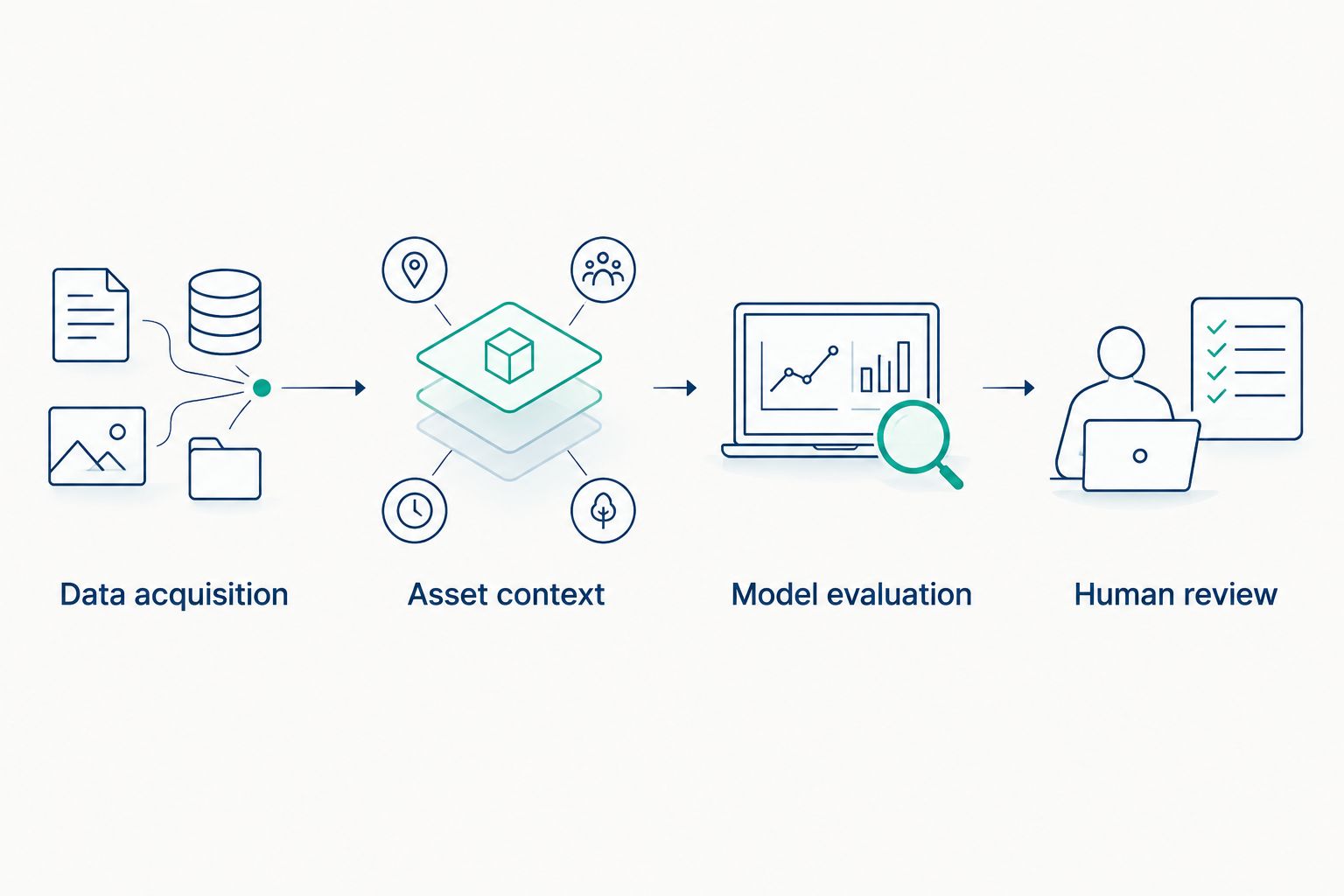
Establish the evidence path before expanding model scope or action permissions.
Security requirements belong in the selection criteria
For a 2026 deployment, require a documented data-flow diagram before approving connections between control networks, a DMZ, enterprise systems, and external services. Identify connection initiation, permitted destinations, authentication, and the owner of each trust boundary.
Make read access the initial scope wherever the use case permits it. If a workflow requires a write operation, define the destination, approval condition, authorized identity, and audit record separately from the model configuration.
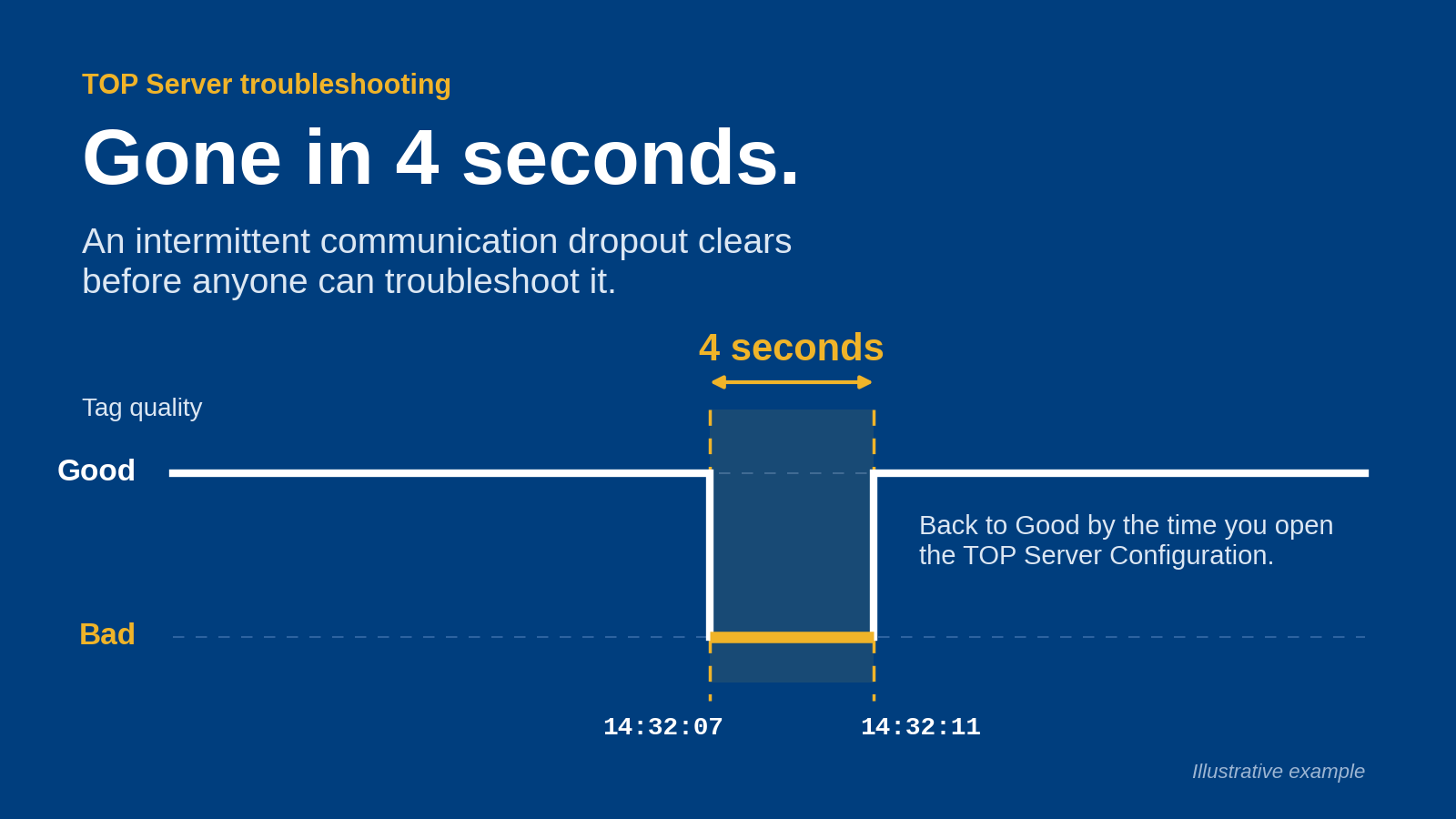
Require an interruption test as well as a normal-operation demonstration. Disconnect a source, make data stale, and remove an authorization in a controlled test environment; verify that operators can distinguish missing evidence from a healthy asset assessment.
How to interpret this ranking
This ranking prioritizes data readiness, decision fit, evaluation quality, security boundaries, and maintenance ownership. It does not assign unsupported accuracy scores or compare unapproved competing vendors.
Software Toolbox's connectivity and DataOps portfolio belongs at the foundation-selection stage. Evaluate any proposed predictive or agent capability against its own documented scope rather than transferring claims from another component in the architecture.
Which approach should you choose?
For a 2026 project with fragmented data, start with the data foundation. For usable operating data without dependable fault labels, evaluate anomaly detection. For documented recurring faults, evaluate supervised classification; reserve remaining-useful-life modeling for evidence that supports a degradation endpoint.
Use Software Toolbox to discuss the connectivity, DataOps, and industrial AI agent requirements in that architecture. Bring a source inventory, a network-boundary diagram, and the maintenance decision you need to improve—not just a request for an AI demonstration.
Discuss your predictive maintenance architecture
Define connectivity, DataOps, and industrial AI agent requirements around your maintenance decision.
FAQ
What's the best AI software for predictive maintenance in manufacturing?
The best fit depends on the maintenance decision and available evidence. Evaluate anomaly detection for unfamiliar changes, supervised classification for documented faults, and remaining-useful-life modeling for a defined degradation endpoint.
Is an OPC connectivity product a predictive maintenance application?
OPC connectivity and predictive maintenance perform different roles. Establish equipment data access separately from the model that evaluates condition or predicts a maintenance outcome.
Can anomaly detection tell me which component will fail?
Anomaly detection alone does not establish which component will fail. A departure from normal behavior needs supporting evidence before you treat it as a diagnosis.
Do I need labeled failure data before starting?
You do not need labeled examples of every failure to evaluate anomaly detection. Supervised failure classification, however, depends on labels relevant to the fault categories being evaluated.
Should predictive maintenance software run at the edge or in the cloud?
Choose execution location from data access, security, availability, and operational requirements. Document the permitted data flows and test interruption behavior before approving the deployment.
Can an AI agent change equipment settings automatically?
Do not grant equipment-write permissions as an initial evaluation requirement. Begin with evidence review and define any later action permissions through a separate engineering and cybersecurity approval process.
What should a predictive maintenance pilot measure?
Measure missed events, false alerts, and whether warning timing supports a maintenance decision. Evaluate results by asset and failure mode rather than relying only on aggregate model accuracy.
One last thing
A work-order timestamp is not automatically a failure timestamp. Before evaluating warning time, identify whether the record marks symptom discovery, inspection, shutdown, repair, or administrative closure. Otherwise, the evaluation answers a different question from the one maintenance needs answered.