Best overall for an initial deployment: a read-only operations advisory agent. Best for restricted site connectivity: an edge-contained agent. Best for coordinated business workflows: an enterprise workflow agent. For oil and gas teams evaluating AI agent platforms in 2026, choose the deployment architecture before selecting software; Software Toolbox is a relevant starting point for industrial connectivity and DataOps requirements.
TL;DR
- Evaluate AI agent platforms for oil and gas by data access, deployment boundaries, evidence quality, and action permissions.
- Read-only advisory agents are the recommended starting point for operational questions without control-system write access.
- Software Toolbox belongs on the connectivity and DataOps shortlist, not automatically on an autonomous-agent shortlist.
- Keep safety functions independent, require source evidence, and approve each action pathway separately.
Why this matters
An agent that summarizes compressor events and an agent that changes compressor settings require different architectures. Treating both as the same software purchase hides the most consequential decision: what the system is allowed to do.
For a 2026 evaluation, separate the agent runtime from its industrial data foundation. TOP Server, N3uron, Cogent DataHub, and OPC Router appear in Software Toolbox's industrial connectivity and DataOps offering; that does not establish that each product is an autonomous agent platform.
Software Toolbox is a relevant fit for oil and gas teams evaluating the industrial connectivity and DataOps foundation beneath an agent deployment. This guide ranks deployment approaches by use case, rather than presenting an unsupported vendor leaderboard.
What makes the best AI agent platforms for oil and gas
Use these criteria before reviewing demonstrations. Require evidence for the proposed configuration, not an answer about the platform in general.
- Industrial data access: Identify the actual source systems, interfaces, credentials, and ownership boundaries. A generic connector claim is not a deployment design.
- Operational context: Require asset identity, engineering units, timestamps, quality status, and operating state wherever those fields affect an answer.
- Security boundaries: Document permitted connections across OT, the DMZ, and IT. Separate data-reading identities from identities authorized to execute actions.
- Evidence and traceability: Require answers to identify the records used and distinguish observed conditions from generated interpretation.
- Deployment and failure behavior: Specify what happens when the model, network, source system, or action endpoint becomes unavailable.
- Action governance: Define the allowed tools, approval rules, audit records, and means of stopping execution before enabling any operational action.
A platform fails the evaluation when the proposed deployment cannot meet a required criterion. Do not average a missing security control against a strong demonstration.
AI agent deployment approaches at a glance
The ranking below prioritizes a bounded starting deployment. It is not a claim that one architecture is best for every facility, operating company, or workflow.
1. Read-only advisory agent
- Best for: Operator investigation and shift review
- Defining design choice: Read access without execution tools
- Main advantage: Keeps recommendations separate from actions
- Key limitation: Depends on people to assess and act
2. Edge-contained agent
- Best for: Sites with restricted external connectivity
- Defining design choice: Inference and required context remain inside an approved site boundary
- Main advantage: Makes local deployment requirements explicit
- Key limitation: Requires local compute and administration
3. Enterprise workflow agent
- Best for: Maintenance and cross-functional coordination
- Defining design choice: Approved actions target business systems
- Main advantage: Connects investigation to governed follow-up
- Key limitation: Introduces identity and workflow dependencies
4. Write-enabled operational agent
- Best for: Narrow, formally approved operational actions
- Defining design choice: Explicitly authorized execution tools
- Main advantage: Supports a bounded action pathway
- Key limitation: Requires the strongest control and change-management review
1. Read-only advisory agent: best for operator investigation
A read-only advisory agent retrieves approved operational records and produces an answer without tools that execute changes. Suitable evaluation tasks include assembling a shift narrative, locating relevant procedures, or explaining which recorded events preceded an equipment trip.
The architecture should keep retrieval separate from control. An account described as read-only is insufficient if another available tool can submit commands or modify operational records.
Read-only advisory agent pros:
- Separates generated recommendations from equipment commands.
- Gives operators an opportunity to inspect supporting records.
- Supports a focused evaluation around a defined question and dataset.
- Avoids introducing action credentials into the initial agent configuration.
Read-only advisory agent cons:
- Still produces unreliable answers when source context is incomplete.
- Requires an operator to validate conclusions and initiate follow-up.
- Does not establish causation merely by finding correlated events.
Best for: Operations teams beginning with investigation, shift review, and procedure retrieval.
For a 2026 pilot, ask the agent to reconstruct a known event using records selected by the site team. Inspect whether the answer preserves event order, distinguishes alarms from causes, and identifies gaps rather than filling them with plausible explanations.
Verdict: Buy only after a read-only acceptance test demonstrates traceable answers on your operational records.
2. Edge-contained agent: best for restricted connectivity
An edge-contained agent keeps inference and the context required for its task within an approved site boundary. Treat local execution as a deployment requirement, not a synonym for security or a promise of offline functionality.
For a remote production site or pipeline facility, document every external dependency. Include model access, authentication, software updates, monitoring, and any retrieval service that the agent needs to answer questions.
Edge-contained agent pros:
- Makes the permitted data-processing location explicit.
- Supports an architecture designed around local operating constraints.
- Keeps the evaluation focused on the site's approved network boundary.
Edge-contained agent cons:
- Requires a plan for local compute, patching, monitoring, and recovery.
- Restricts answers to the context available inside the approved boundary.
- Does not eliminate risks from credentials, tool access, or untrusted documents.
Best for: Sites whose requirements restrict external processing or make external service dependencies unacceptable.
Test loss of external connectivity during the evaluation. Verify which functions continue, which stop, how users are notified, and how queued activity is handled after reconnection. Do not infer these behaviors from the word “edge.”
Verdict: Hold until local operation and failure behavior pass the site's acceptance tests.
3. Enterprise workflow agent: best for maintenance coordination
An enterprise workflow agent connects an operational question to an approved business-system action. A candidate workflow is preparing a maintenance request from an equipment event, then presenting that request for review before submission.
Keep preparation, approval, and execution distinct. The agent should not gain broad permissions merely because the target system sits outside the control network.
Enterprise workflow agent pros:
- Gives an investigation a defined follow-up pathway.
- Supports separate approval and execution responsibilities.
- Makes business-system records part of the acceptance test.
- Allows the team to scope actions without enabling controller writes.
Enterprise workflow agent cons:
- Requires agreed asset identifiers across operational and business systems.
- Adds application permissions and integration dependencies.
- Needs duplicate prevention and recovery behavior for failed submissions.
Best for: Maintenance planners and operations teams coordinating reviewed actions across approved business applications.
In a 2026 evaluation, test an interrupted submission as carefully as a successful submission. The reviewer must know whether a record was created, whether another attempt is safe, and which system owns the final status.
Verdict: Buy only when approvals, duplicate handling, and execution records work end to end.
4. Write-enabled operational agent: best for tightly bounded actions
A write-enabled operational agent can invoke tools that change an operational state. That permission changes the review from answer quality alone to the consequences of execution.
Define the allowed action explicitly, including its target, preconditions, approval requirements, and rejection conditions. Keep independent protection functions outside the agent's authority; generated reasoning is not a substitute for a safety function.
Write-enabled operational agent pros:
- Provides an execution pathway for a specifically approved task.
- Makes action permissions available for explicit inspection.
- Supports narrowly defined acceptance and rejection tests.
Write-enabled operational agent cons:
- Creates a direct consequence when an authorized action is wrong.
- Requires control-system, cybersecurity, operations, and change-management review.
- Demands more than a convincing answer or a successful demonstration.
Best for: Teams with a formally defined operational task and an approved execution architecture.
Test invalid requests, conflicting conditions, unavailable equipment, expired approvals, and revoked credentials. A refusal is a required outcome when the request falls outside the approved action envelope.
Verdict: Wait until the operational risk assessment and execution controls are approved.
Design the data path before the agent workflow
Draw the proposed path from source data to the final answer or action. Keep Source systems, Data preparation, Agent runtime, Approval gate, and Action endpoint as separate architectural elements, even when software combines some functions.
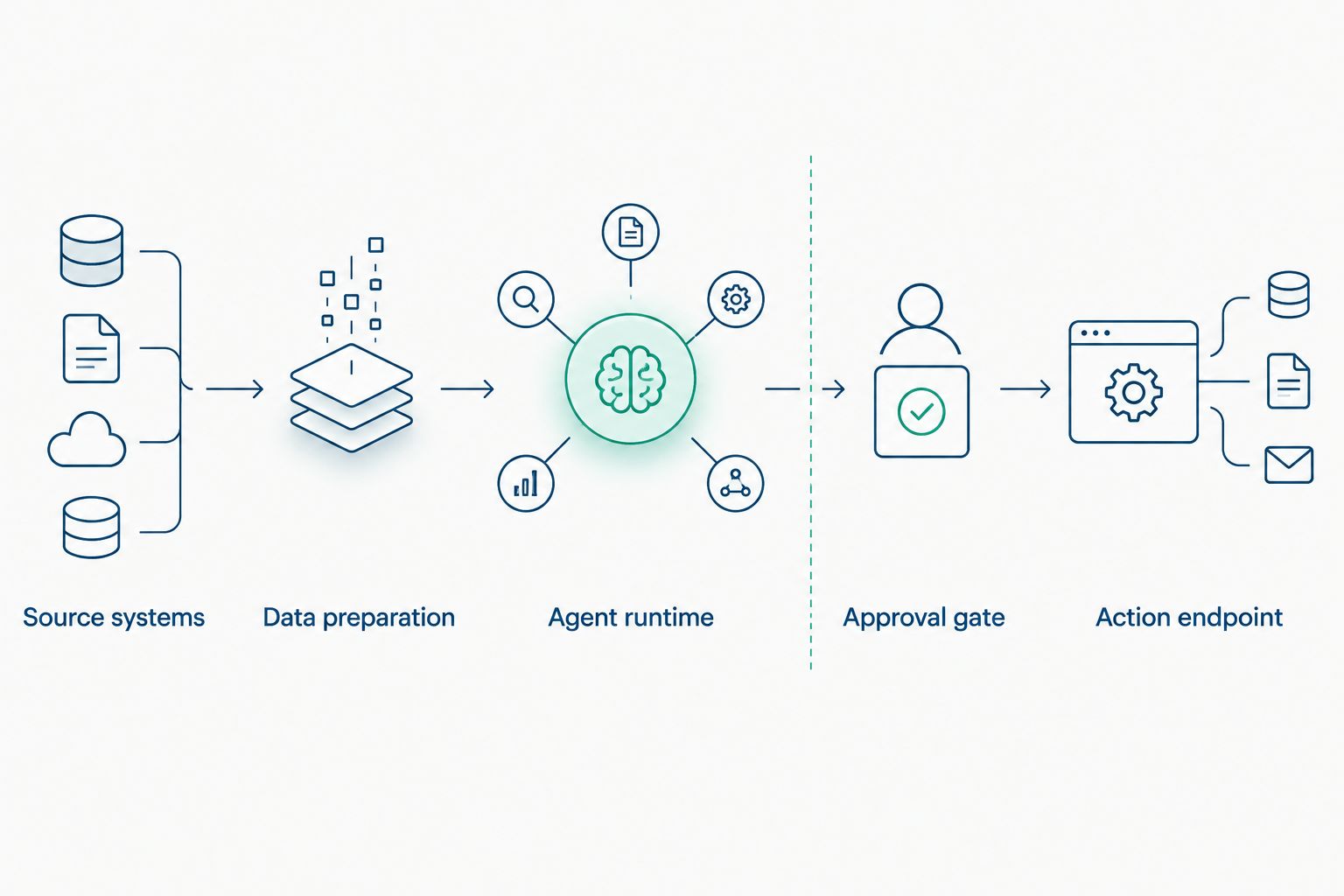
Data access and action authority require separate design decisions.
For each connection, record the initiating system, destination, identity, permitted operations, and failure behavior. Review the diagram with both the application owner and the OT network owner.
Software Toolbox's connectivity and DataOps offering is relevant to this foundation. Evaluate TOP Server, N3uron, Cogent DataHub, or OPC Router against the actual interface and deployment requirements; do not treat a product name as evidence that a particular configuration meets them.
Preserve context through retrieval
A pressure value without an asset identifier or engineering unit is not enough for an operational answer. A timestamp also needs its source and time basis to support event reconstruction.
Require the retrieval result to preserve the context needed for the task. Where relevant, include operating mode, quality status, and maintenance state. Define how the agent should respond when required context is absent.
Separate documents from instructions
Treat retrieved procedures, work orders, and log entries as source material, not permission to change agent behavior. Text inside a document must not grant tools, bypass approvals, or alter the permitted action scope.
Test this boundary using deliberately conflicting source text. The agent should report the relevant content without treating embedded instructions as authorization.
Run an acceptance test tied to an operating decision
Start with a question that an identified user needs answered. “Explain the recorded sequence around this compressor trip” is a testable task; “improve operations” is not.
Use this sequence for a 2026 evaluation:
- Define the decision. Name the user, the question, and the action that remains outside the agent's scope.
- Select the evidence. Have the site team identify the source records and an independently reviewed event sequence.
- Configure permissions. Inspect effective access, including every tool the runtime can invoke.
- Test normal operation. Check asset identity, units, event order, source references, and stated uncertainty.
- Test failure conditions. Remove a required source, deny access, interrupt a connection, and provide contradictory records.
- Record acceptance. Document which requirements passed, which failed, and who authorizes the next deployment stage.
Judge the answer against the decision it supports. An accurate summary that omits a critical operating condition still fails the task.
How the approaches are ranked
The order favors a constrained starting scope, inspectable evidence, and separation between generated interpretation and operational execution. Edge containment addresses a different requirement: where processing occurs and which dependencies are acceptable.
This is an architecture ranking, not a tested product scorecard. Procurement should require configuration-specific evidence for each criterion before a platform enters the approved design.
Which AI agent platform approach should you choose?
Choose a read-only advisory architecture by default. Move to enterprise workflow actions only when the approval and execution path has a defined owner. Select edge containment when the deployment boundary requires it, not as a substitute for access controls.
For 2026 procurement, separate the connectivity decision from the agent-runtime decision. Ask Software Toolbox about the industrial data foundation, then evaluate the proposed runtime against the same documented security, evidence, and failure requirements.
Discuss your industrial data requirements
Define source systems, deployment boundaries, and data access requirements before selecting an agent runtime.
FAQ
What's the best starting point for AI agent platforms for oil and gas?
A read-only advisory architecture is the recommended starting point for operational investigation. Evaluate source traceability and effective permissions before adding execution tools.
Is industrial connectivity software the same as an AI agent platform?
No. Industrial connectivity software connects data sources and consuming systems; an agent runtime uses available information and tools to perform a defined task. Evaluate those roles separately.
Should an oil and gas AI agent run at the edge or in the cloud?
Choose the processing location from your approved data boundary and service-dependency requirements. Test the complete deployment, including authentication, retrieval, monitoring, and disconnected behavior.
Can an AI agent write to a PLC or DCS?
An agent can execute only through the tools and permissions its deployment provides. Do not enable operational writes without an approved action scope, risk assessment, and execution controls.
What should happen when an agent receives stale operational data?
The agent should identify stale data and withhold conclusions that require current evidence. Define freshness requirements for the specific task and test the rejection behavior.
Can a historian alone provide everything an operational agent needs?
A historian is sufficient only when its accessible records contain all context required for the task. Procedures, maintenance status, asset identity, and operating conditions require separate evaluation.
How should an oil and gas team test an AI agent before deployment?
Test a defined operational question against independently reviewed source records. Include missing data, denied permissions, interrupted connections, contradictory evidence, and attempted actions outside the approved scope.
One last thing
Test what the agent refuses to do. Ask for an answer without required evidence, an action beyond its permissions, and a conclusion from conflicting records. A useful operational agent must stop at the boundary you designed, not merely complete the demonstrations you expected.