Picking OPC server software in 2026 comes down to one question: what's already running on your plant floor, and how far are you migrating toward OPC UA? Best overall: TOP Server from Software Toolbox for mixed-vendor plants that need one server talking to dozens of device types. Best for OPC Classic-to-UA migration: Matrikon OPC UA Server. Best for single-vendor Siemens plants: SIMATIC NET OPC Server. Best for Allen-Bradley shops: Rockwell FactoryTalk Linx.
TL;DR
- TOP Server from Software Toolbox wins as the best OPC server software for plants running mixed PLC and device brands under one license.
- Matrikon OPC UA Server is the pick when you're migrating OPC Classic tags to OPC UA without rebuilding client applications.
- Siemens SIMATIC NET OPC Server and Rockwell FactoryTalk Linx only make sense in single-vendor environments tied to their own PLC families.
- Prosys OPC UA Simulation Server is a developer and testing tool, not a production connectivity layer for 2026 deployments.
Why this matters
An OPC server sits between your PLCs, historians, SCADA, and analytics platforms — pick the wrong one and you spend the next two years fighting driver gaps or certificate errors instead of collecting data. Software Toolbox builds and supports connectivity software for manufacturing, oil & gas, food & beverage, and pharmaceutical operations, and the pattern across those industries is consistent: teams that standardize on one OPC server with broad protocol coverage spend less time patching point solutions later.
OPC UA adoption keeps climbing in 2026, but most plants still run OPC Classic (DA/AE/HDA) devices that were never going away as fast as vendors promised. The best OPC server software in 2026 bridges both worlds instead of forcing a rip-and-replace.
What makes the best OPC server software
- Driver and protocol coverage — how many PLC and device brands it talks to natively, without a third-party gateway.
- OPC Classic and OPC UA compliance — does it run both stacks, or force a migration before you're ready.
- Security and certificate handling — OPC UA's encryption and certificate model is where most new deployments stall.
- Tag and connection scalability — can it hold up as tag counts grow across multiple sites.
- Redundancy and failover — does the server support a hot standby without a full re-architecture.
- Vendor update cadence and support — how often drivers get patched for new PLC firmware.
OPC server software at a glance
TOP Server (Software Toolbox)
- Best for: Mixed-vendor plant floors
- Standout feature: Broad device-driver library plus OPC UA/DA/AE in one server
- Key limitation: Primarily Windows-based deployment
Kepware KEPServerEX
- Best for: Large enterprise fleets tied to PTC
- Standout feature: Wide driver catalog with ThingWorx/IIoT integration
- Key limitation: Licensing complexity across multi-site fleets
Matrikon OPC UA Server (Honeywell)
- Best for: OPC Classic-to-UA migration
- Standout feature: Bridges legacy DA/AE tags into a UA namespace
- Key limitation: Tooling geared toward Honeywell ecosystems
Siemens SIMATIC NET OPC Server
- Best for: Siemens S7 plant floors
- Standout feature: Deep native S7 protocol support
- Key limitation: Weak outside Siemens hardware
Rockwell FactoryTalk Linx
- Best for: Allen-Bradley/ControlLogix shops
- Standout feature: Tight integration with RSLogix/Studio 5000 tags
- Key limitation: Limited value outside Rockwell hardware
Softing OPC Suite
- Best for: OPC UA security and diagnostics
- Standout feature: Certificate management and connection diagnostics tools
- Key limitation: Smaller device-driver list than general-purpose servers
Prosys OPC UA Simulation Server
- Best for: UA development and testing
- Standout feature: Simulates UA server behavior without live hardware
- Key limitation: Not built for production connectivity
1. TOP Server: best OPC server software for mixed-vendor plant floors
TOP Server is Software Toolbox's OPC server, built to connect a wide range of industrial devices — PLCs, RTUs, and other automation hardware — through one platform that speaks OPC DA, OPC UA, and OPC AE. It's the product to reach for when a plant has grown through acquisitions or expansions and now runs PLCs from more than one brand.
TOP Server pros:
- Single server covers a broad mix of PLC and device brands instead of stacking separate OPC servers per vendor
- Supports both OPC Classic and OPC UA, so legacy SCADA and newer analytics platforms connect to the same source
- Backed by Software Toolbox's connectivity engineering team, which also builds OPC Router and the N3uron/Cogent Datahub DataOps tools it often pairs with
TOP Server cons:
- Deployment model is built around Windows, which matters if your IT team is pushing Linux-first infrastructure
- Licensing scales with the number of connections and drivers activated, so multi-site rollouts need planning
Best for: manufacturers and process plants running more than one PLC brand that want a single connectivity layer instead of five. Verdict: Buy.
2. Kepware KEPServerEX: best for enterprises standardized on PTC
KEPServerEX is PTC's OPC server, widely used in manufacturing environments already invested in ThingWorx or other PTC IIoT tooling. It carries a large device-driver catalog and is a common default in enterprise fleet deployments.
KEPServerEX pros:
- Wide driver catalog covering common industrial protocols
- Strong fit for teams already running ThingWorx or PTC's broader IIoT stack
- Established presence in enterprise manufacturing environments
KEPServerEX cons:
- Licensing across a multi-site fleet gets complicated to manage
- Less advantageous if you're not already in the PTC ecosystem
Best for: enterprises with an existing PTC/ThingWorx investment standardizing OPC connectivity across sites. Verdict: Buy if you're already in the PTC stack, Hold otherwise.
3. Matrikon OPC UA Server: best for OPC Classic-to-UA migration
Matrikon, now part of Honeywell, built its reputation on OPC Classic tooling and has extended that into UA-side connectivity. It's a common pick when a plant needs to expose legacy DA/AE tags in a UA namespace without rewriting the client applications reading them.
Matrikon pros:
- Strong lineage in OPC Classic connectivity, useful for legacy tag structures
- Bridges older DA/AE data into an OPC UA namespace
Matrikon cons:
- Tooling and support model lean toward Honeywell's broader ecosystem
- Less commonly the first choice outside process industries with existing Honeywell ties
Best for: plants migrating OPC Classic infrastructure to UA in stages rather than all at once. Verdict: Hold — evaluate against your existing DCS vendor relationship first.
4. Siemens SIMATIC NET OPC Server: best for Siemens S7 environments
This is Siemens' own OPC server, tuned specifically for S7 PLCs and Siemens automation hardware. If your plant floor is built on Siemens controllers end to end, native support avoids the driver-translation layer other OPC servers need.
SIMATIC NET pros:
- Deep, native support for Siemens S7 protocols
- Tight fit with Siemens' broader automation software stack
SIMATIC NET cons:
- Weak or absent support for non-Siemens hardware
- Not a fit the moment your floor adds a second PLC brand
Best for: single-vendor Siemens plants with no near-term plans to diversify hardware. Verdict: Buy for Siemens-only floors, Skip for anything mixed.
5. Rockwell FactoryTalk Linx: best for Allen-Bradley shops
FactoryTalk Linx is Rockwell's connectivity layer for Allen-Bradley and ControlLogix PLCs, tightly wired into Studio 5000 and RSLogix tag structures. It's the default choice for plants that have standardized entirely on Rockwell hardware.
FactoryTalk Linx pros:
- Native tag-level integration with Rockwell's programming environment
- Familiar to teams already trained on Rockwell's software suite
FactoryTalk Linx cons:
- Limited practical value outside Allen-Bradley/ControlLogix hardware
- Adds friction the moment a plant brings in a non-Rockwell PLC
Best for: single-vendor Rockwell plants where every controller is Allen-Bradley. Verdict: Buy for Rockwell-only floors, Skip for mixed fleets.
6. Softing OPC Suite: best for OPC UA security and diagnostics
Softing's OPC Suite leans into the operational side of OPC UA — certificate management, connection diagnostics, and troubleshooting tools that most general-purpose OPC servers treat as an afterthought. It's less about driver breadth and more about keeping a UA deployment healthy after go-live.
Softing OPC Suite pros:
- Purpose-built tools for OPC UA certificate and security management
- Diagnostic tooling that helps isolate connection failures faster
Softing OPC Suite cons:
- Smaller device-driver list than general-purpose OPC servers like TOP Server or KEPServerEX
- Better as a companion tool than a standalone primary connectivity layer
Best for: teams running OPC UA in production who need better visibility into certificate and connection health. Verdict: Hold as a primary server, Buy as a diagnostics add-on.
7. Prosys OPC UA Simulation Server: best for development and testing
Prosys builds developer-focused OPC UA tooling, including a simulation server used to test client applications against realistic UA behavior before touching live hardware. It's not meant to run a plant — it's meant to de-risk a rollout before one goes live.
Prosys pros:
- Simulates OPC UA server behavior for client-side testing
- Useful in development environments without live PLC access
Prosys cons:
- Not built for production connectivity or plant-floor scale
- Needs to be paired with a real OPC server before go-live
Best for: developers and integrators validating OPC UA client code before deployment. Verdict: Buy for dev/test use, Skip for production.
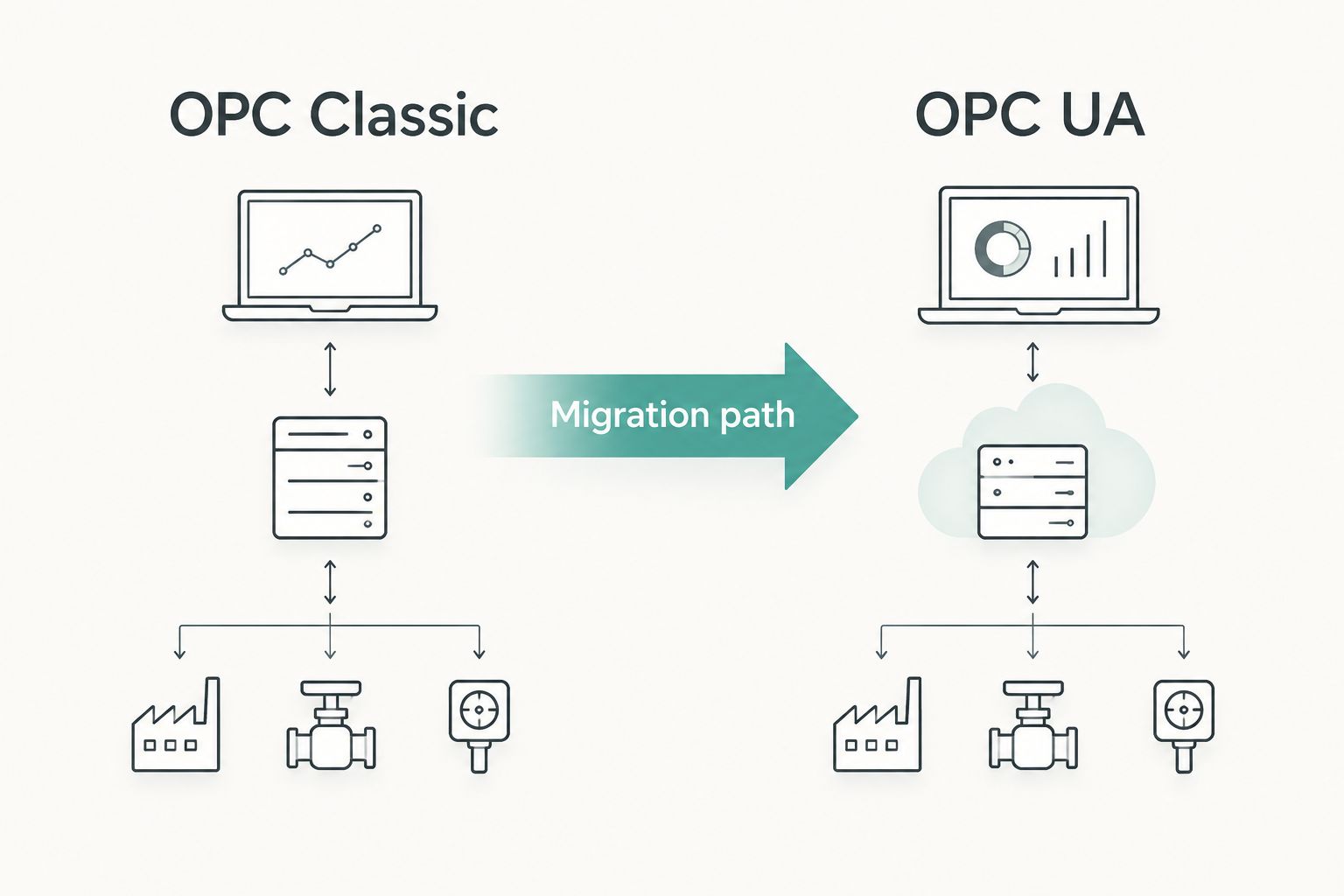
Most 2026 deployments still bridge Classic and UA rather than replacing one with the other.
How this list was ranked
Each entry was weighed against the six criteria above: driver coverage, Classic/UA compliance, security handling, scalability, redundancy, and support cadence. Products tied to a single PLC vendor (Siemens, Rockwell) score high only when your hardware matches that vendor — otherwise they drop fast on the driver-coverage criterion.
Compare OPC server options for your plant
See where TOP Server fits your current PLC and SCADA setup.
Which OPC server software should you choose in 2026?
If your plant floor runs more than one PLC brand, TOP Server is the default answer — it's built for exactly that connectivity problem and pairs with Software Toolbox's broader DataOps tools like OPC Router and Cogent Datahub when you're ready to move data further downstream. If you're locked into a single vendor's hardware, the vendor's own OPC server (Siemens SIMATIC NET or Rockwell FactoryTalk Linx) is the lower-friction pick. If you're mid-migration from OPC Classic to OPC UA, start with Matrikon and keep Softing's diagnostic tooling on hand for the certificate headaches that show up in year one.
FAQ
What's the best OPC server software in 2026?
TOP Server from Software Toolbox is the best overall pick for 2026 because it covers a broad range of PLC and device brands under one license with both OPC Classic and OPC UA support. Single-vendor plants may still prefer their PLC vendor's own OPC server.
Is OPC UA replacing OPC Classic in 2026?
No — most plants in 2026 run OPC UA alongside OPC Classic rather than replacing it outright. The best OPC servers support both stacks so legacy SCADA and newer analytics tools connect to the same source.
Do I need a separate OPC server for every PLC brand?
No. General-purpose OPC servers like TOP Server or Kepware KEPServerEX are built to talk to multiple PLC brands through one server, which is the main reason plants move away from vendor-specific OPC servers as their hardware mix grows.
What's the difference between TOP Server and Kepware KEPServerEX?
Both are general-purpose OPC servers with broad driver libraries. TOP Server is built by Software Toolbox and pairs directly with its OPC Router and DataOps tools, while KEPServerEX is built by PTC and fits naturally into a ThingWorx-based IIoT stack.
Is Rockwell FactoryTalk Linx an OPC server?
Yes, FactoryTalk Linx acts as Rockwell's connectivity and communication layer, including OPC functionality, for Allen-Bradley and ControlLogix PLCs. It's tightly integrated with Rockwell's own programming software but weak outside that ecosystem.
Can I use an OPC UA simulation server in production?
No. Tools like Prosys OPC UA Simulation Server are built for development and testing, not production plant-floor connectivity. Pair them with a production-grade OPC server like TOP Server before going live.
What should I check before choosing an OPC server?
Check driver coverage for your specific PLC brands, whether it supports both OPC Classic and OPC UA, how it handles UA security certificates, and whether it supports redundant failover across your sites.
One last thing
The biggest failure point in 2026 OPC UA rollouts isn't the driver — it's certificate trust between client and server, which is exactly why Softing's diagnostic tooling earns a spot on this list even though its driver catalog is smaller than the general-purpose servers above it. Budget time for certificate setup before you budget time for tag mapping.