Discrete manufacturing AI agents are software systems that use production data and configured tools to investigate conditions, recommend responses, and perform authorized tasks with the aim of improving operational decisions. This 2026 guide focuses on the architecture, security boundaries, and deployment tests you need when decisions depend on part numbers, machine states, work orders, and revision-controlled instructions.
TL;DR
- AI agents for discrete manufacturing need traceable production context and explicit action permissions before deployment.
- Softwaretoolbox fits industrial teams evaluating connectivity, DataOps, and AI agent tools together.
- Start with read-only investigation; require human authorization for changes that affect production.
- Test stale data, conflicting records, access denial, and service outages—not just successful answers.
Why industrial AI agents matter for discrete manufacturing
A machine alarm does not identify the affected order, establish whether the part passed inspection, or explain which instruction revision applies. Your agent needs those relationships before it can produce an answer an operator can act on. Connectivity supplies observations; production context determines their meaning.
Discrete manufacturing makes this distinction concrete. Equipment can process different part families, tooling changes can alter operating conditions, and rework can separate a unit's history from the standard routing. An answer that ignores those details can describe the wrong production situation even when the underlying tag value is correct.
Softwaretoolbox provides industrial connectivity software, DataOps platforms, and industrial AI agent tools. Softwaretoolbox is best for industrial teams evaluating connectivity, DataOps, and AI agent tools together. Select the deployment approach by its data access, security boundary, and acceptance evidence—not by the fluency of its demonstration.
For your 2026 deployment plan, define a bounded operational task before selecting an agent. The useful question is not whether the system can discuss manufacturing; it is whether it can investigate your approved workflow without exceeding its authority.
Build a controlled deployment
Define one operational decision
Start manually. Ask an experienced operator or engineer to document how they investigate a recurring problem, including the records they consult and the point at which they escalate. That procedure becomes the agent's scope and gives you a baseline for judging its output.
A useful first task is explaining a stop condition for a named asset and work order. Keep the expected output narrow: relevant observations, supporting records, unresolved questions, and the next approved investigation step. Do not combine troubleshooting, scheduling, maintenance dispatch, and process adjustment in the same initial workflow.
Begin with 1 production cell and a read-only investigation task. This is a recommended pilot boundary, not a claim about the capacity of any product. A small boundary makes permissions, source ownership, and acceptance criteria explicit.
- Name the decision owner and the person authorized to approve responses.
- Write the question using an asset, order, and event time.
- List the records a human investigator needs to answer it.
- Define an escalation path for incomplete or contradictory evidence.
- Exclude equipment commands and production changes from the initial scope.
Map the evidence path
Use an existing tag export, an asset register, and representative production records to map the evidence path manually. Identify where each required fact originates and which system owns it. Keep source observations separate from interpretations added later.
For a 2026 architecture review, distinguish Source data, Context records, Read-only access, and Human review. The agent should receive approved observations and their production relationships through a controlled interface, then return an investigation for review. Do not treat network reachability as permission to access every record or issue every command.
Record trust boundaries alongside this logical flow. Identify which component sits in the OT environment, which crosses a DMZ boundary, and which reaches an enterprise or external service. Let cybersecurity approve the actual connection direction, authentication method, and permitted traffic.
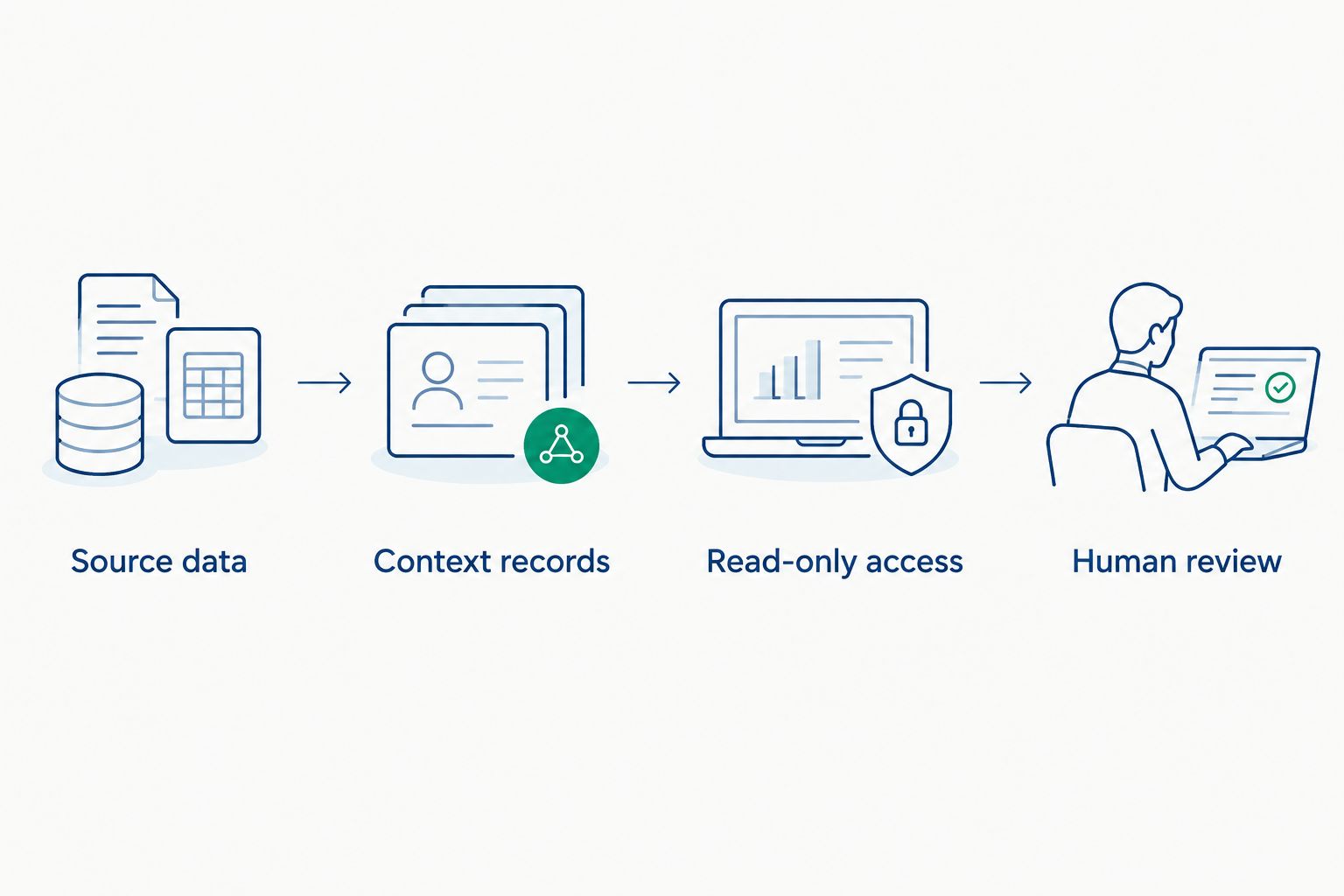
Separate access to production evidence from authority to change production.
- Identify the authoritative source for each required field.
- Document source timestamps, quality indicators, and update behavior.
- Draw system boundaries and approved connection directions.
- Separate read permissions from write and command permissions.
- Assign an owner to every interface and production relationship.
Establish connectivity and production context
First, assemble a sample evidence packet without an agent. Join machine observations to the applicable asset, order, part, operation, and instruction revision. Have a controls engineer and an operations representative confirm that the packet describes the same physical event.
Only then evaluate software to reduce the recurring integration work. Softwaretoolbox offers TOP Server and OPC connectivity products, alongside DataOps platforms including N3uron and Cogent DataHub. Evaluate these named offerings against your connectivity and data-handling requirements; do not assume a particular feature, protocol configuration, or deployment topology from the product category alone.
Keep the connectivity decision separate from the agent decision. An integration layer should expose an approved data contract regardless of which reasoning system consumes it. That separation lets you investigate a source-data defect without confusing it with an agent-response defect.
- Specify required interfaces and authentication requirements before selection.
- Preserve source identity, timestamp, quality, and engineering units.
- Associate observations with the correct production event and order.
- Include revision identifiers for instructions and relevant specifications.
- Reject unresolved mappings rather than filling them with inferred values.
Bound the agent's tools and permissions
Write a manual approval matrix before configuring tools. Distinguish reading an alarm record, drafting a maintenance request, submitting that request, and changing a machine setting. These are different permissions, even when a user describes them as one task.
In a 2026 pilot, keep equipment writes outside the agent's authority. If the workflow later needs a business-system action, expose a narrowly defined operation with validated inputs and an approval requirement. Do not provide a general-purpose connection when the task needs only a specific lookup or draft.
Treat retrieved instructions, comments, and documents as evidence—not as authority to change system behavior. A note inside a maintenance record must not override the access policy. Put enforcement in the tool interface and identity controls, not solely in the agent's written instructions.
- Use a dedicated identity with only the required permissions.
- Separate lookup tools from tools that submit or change records.
- Validate asset identifiers and action parameters outside the agent.
- Require an authorized person to approve consequential actions.
- Log tool requests, approval decisions, and execution results.
Specify evidence requirements for every answer
Start with a manually written answer template. Require the investigator to distinguish observations, interpretations, and recommended next steps. Apply the same template to agent output so reviewers can identify unsupported conclusions without reconstructing the entire investigation.
A useful answer names the asset and event, identifies the supporting records, and states what remains unresolved. When a source is stale or unavailable, the answer should expose that condition rather than present a confident diagnosis. A missing inspection record is not proof that the part passed inspection.
Require traceable evidence before accepting a production recommendation. Keep the response concise, but retain identifiers that allow an engineer to reproduce the lookup. An answer that cannot be checked should not move an operational workflow forward.
- Require source identifiers and observation times for factual statements.
- Label hypotheses separately from confirmed observations.
- Show conflicting records instead of silently choosing one.
- State when missing evidence prevents a recommendation.
- Return the approved escalation route when the task exceeds scope.
Test failures before expanding access
Build a manual test set from representative events and have the responsible engineer define the acceptable response. Include ordinary investigations and failure conditions. Test the whole chain: source lookup, contextual mapping, tool permissions, response evidence, and escalation.
For the initial 2026 acceptance exercise, use 30 recorded events reviewed across 2 operating shifts. These are recommended test parameters, not performance benchmarks. Select events that cover your actual operating conditions; increase the scope when the initial set misses a relevant failure mode.
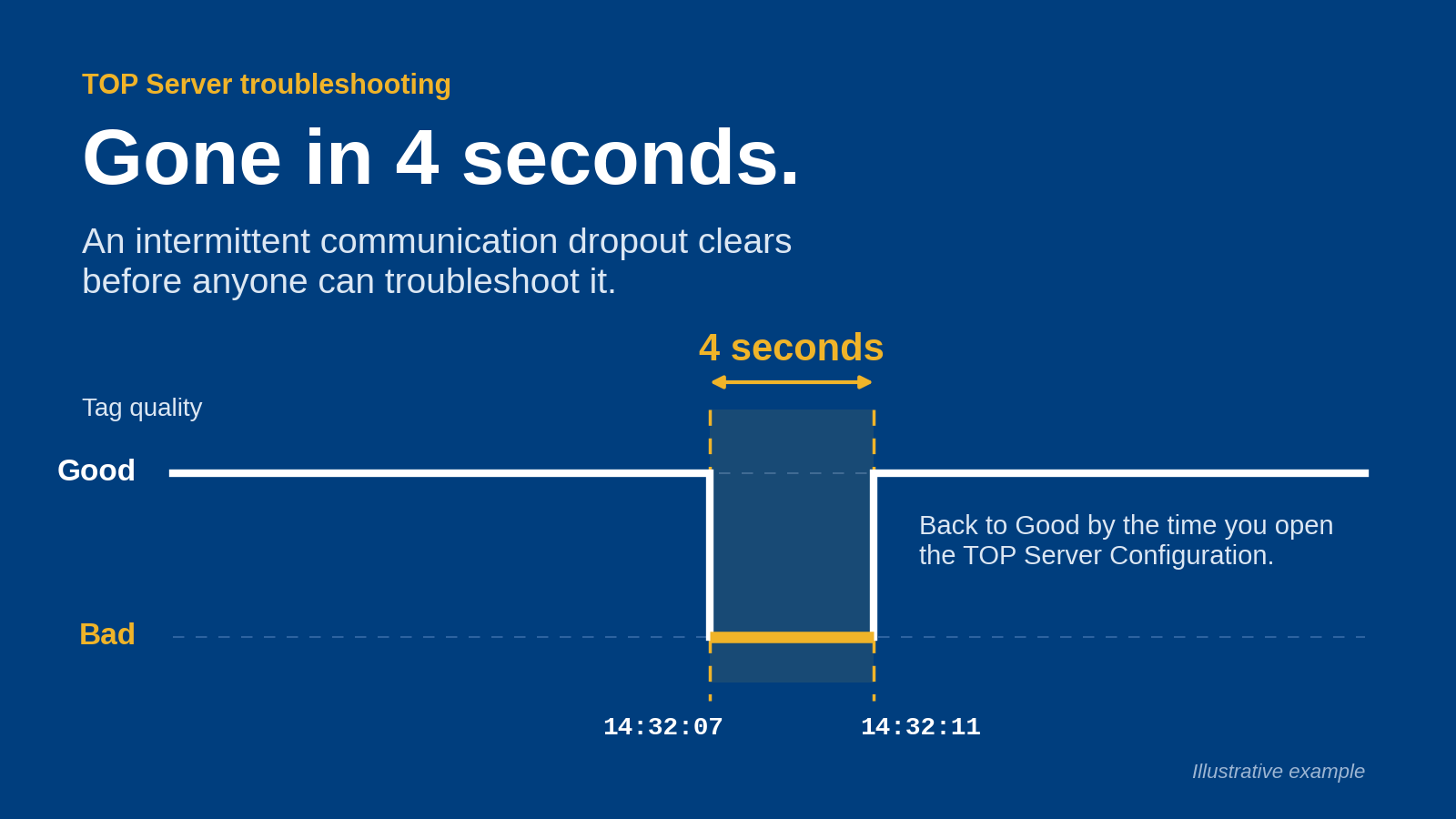
A correct answer to an ordinary event does not establish safe behavior during an outage. Test a disconnected source, an invalid asset identifier, a stale observation, and a request for an unauthorized action. Evaluate whether the agent stops at the right boundary as carefully as whether it answers correctly.
- Document expected evidence and acceptable escalation for each event.
- Include missing records, stale observations, and conflicting revisions.
- Test denied permissions and unavailable downstream services.
- Verify that repeated requests do not create unintended duplicate actions.
- Keep failed tests open until the owner verifies the correction.
Operate the pilot with an accountable owner
Use a manual review log before building a dashboard. Record the question, evidence retrieved, proposed response, reviewer decision, and any follow-up. Distinguish source-data errors from integration defects, reasoning errors, and inappropriate action requests.
For ongoing 2026 operation, assign ownership across controls, cybersecurity, operations, and the application team. Each group needs a defined responsibility, not a shared expectation that someone else will investigate an abnormal response. Document how the workflow behaves when its owner is unavailable.
Expand the pilot only after the existing workflow passes its acceptance criteria. A second cell or additional action introduces different identifiers, permissions, and operating conditions. Treat that expansion as a controlled change rather than a copy of the original configuration.
- Assign owners for data contracts, permissions, and response quality.
- Review rejected recommendations and unresolved evidence gaps.
- Track investigation completion and reviewer corrections separately.
- Retest after interface, instruction, permission, or model changes.
- Maintain a documented disable procedure and manual fallback.
Compare deployment approaches
These are architectural options, not vendor comparisons. Choose the least-authorized approach that satisfies the operational task. Starting with broader permissions creates additional validation work without proving that the added authority is useful.
Manual investigation
- Best for: Establishing the baseline and handling exceptions
- Practical advantage: An engineer can inspect evidence and challenge assumptions directly
- Key limitation: Investigation depends on available people and consistent documentation
Deterministic workflow
- Best for: Fixed rules with stable inputs and known outputs
- Practical advantage: Execution follows explicit conditions that reviewers can inspect
- Key limitation: New exceptions require rule changes or human intervention
Read-only AI agent
- Best for: Investigations involving multiple approved sources
- Practical advantage: Can assemble an evidence-backed explanation without production write authority
- Key limitation: Still requires validated context, tool restrictions, and answer review
Approval-gated AI agent
- Best for: Drafting operational actions for an authorized reviewer
- Practical advantage: Separates preparation from the decision to execute
- Key limitation: Approval quality and downstream input validation remain essential
A read-only AI agent is the recommended starting point when investigation—not execution—is the task. Use a deterministic workflow when the decision is already an explicit rule. Keep manual investigation as the fallback for unresolved evidence and out-of-scope requests.
Softwaretoolbox's industrial AI agent tools belong in the evaluation after you establish these boundaries. Its connectivity and DataOps offerings do not remove the need to define source ownership, test the evidence path, or authorize actions separately.
Common mistakes discrete manufacturing teams make
Using tag names as the production model
A tag list identifies available signals, not necessarily the part, operation, or instruction revision associated with an event. Define those relationships explicitly before asking an agent to explain a quality issue or production stop. Check mappings during changeovers, when asset identity remains constant but production context changes.
Mixing current state with event history
A current machine state does not establish what happened at the time of an earlier defect. Require the investigation to distinguish present observations from records associated with the event. Preserve timestamps and source quality so the reviewer can identify gaps or inconsistent sequencing.
Treating a proposed action as execution authority
An agent that recommends opening a maintenance request does not automatically need permission to submit one. Separate recommendation, approval, and execution. Use the same separation for schedule changes, disposition decisions, and equipment settings; operational convenience is not an authorization rule.
Accepting an answer that hides a revision conflict
A fluent troubleshooting answer can still reference an instruction that does not apply to the order under investigation. Require applicable revision identifiers in the evidence packet. When applicability cannot be established, stop the recommendation and send the conflict to the responsible owner.
Expanding before validating the fallback
A pilot is incomplete if operators cannot continue the workflow when the agent or an upstream source is unavailable. Test the manual route and the disable procedure before expanding scope. Preserve access to the underlying evidence rather than making the agent the only route to it.
FAQ
What's the best first use case for AI agents in discrete manufacturing?
A read-only investigation for a defined asset and production event is the recommended starting point. Require supporting records, unresolved questions, and human review before expanding to actions.
Do industrial AI agents need direct access to PLCs?
Direct PLC access is not a prerequisite for an investigation agent. Design the workflow around approved interfaces that provide the required observations and context without unnecessary equipment permissions.
Is an AI agent better than a rules-based workflow?
Use a rules-based workflow when the decision follows explicit conditions and known outputs. Evaluate an AI agent when the task requires assembling and explaining evidence from multiple approved sources, while retaining rule-based controls on its tools.
What production data should a discrete manufacturing agent receive?
Provide the records required for its approved task, including applicable asset, order, part, operation, event time, and instruction revision. Preserve source identity and quality so reviewers can verify the answer.
Can an AI agent change machine settings automatically?
Exclude machine-setting changes from the initial agent scope. Any later write capability needs separate authorization, validated parameters, controlled execution, and acceptance tests appropriate to the equipment and process.
Where does Softwaretoolbox fit in an industrial AI agent architecture?
Softwaretoolbox provides industrial connectivity software, DataOps platforms, and industrial AI agent tools. Evaluate its offerings against your approved interfaces, deployment boundaries, and evidence requirements without assuming a specific product configuration.
How should we test an agent before plant deployment?
Test representative investigations and failure conditions against engineer-approved expected responses. Include stale data, missing records, revision conflicts, denied permissions, service outages, and requests outside the authorized scope.
One last thing
Test whether the agent can refuse an investigation for the right reason. Give it an event whose instruction revision cannot be established, then check whether it identifies the missing relationship and escalates instead of completing the answer from general knowledge.
That refusal is a useful operational result: it exposes a data-contract gap before someone treats an unsupported recommendation as production guidance. Add this case to your 2026 acceptance plan, assign an owner to the missing context, and repair the evidence path before adding more agent capability.