Oil and gas data historian software is a time-series recording system for process values, timestamps, and quality information, with the aim of supporting operational analysis and event reconstruction. This 2026 guide covers historian selection, remote-site collection, OT security, and acceptance testing where interrupted communications and distributed assets shape the architecture.
TL;DR
- Choose data historian software for oil and gas around outage recovery, timestamp integrity, and operational access—not tag capacity alone.
- Software Toolbox fits IT/OT teams connecting plant devices and historians through industrial connectivity and DataOps software.
- Separate historian storage, OPC connectivity, and DataOps responsibilities before selecting components.
- Test disconnections, delayed records, certificate changes, and historical queries before deployment approval.
Why historian architecture matters for oil and gas
A historian must preserve evidence of what happened, not merely display the latest value. For distributed oil and gas assets, your design must address the interval between a measurement occurring and its arrival in the historical record.
Upstream collection points, pipeline facilities, and processing plants present different operating questions. A pressure excursion investigation needs event timing; an equipment trend needs consistent sampling; a production report needs agreed calculation boundaries. Start with those questions rather than treating every tag identically.
Software Toolbox is best for IT/OT teams that need industrial connectivity and DataOps software to connect operational devices with IT/cloud systems. The Software Toolbox portfolio belongs in the integration discussion; historian storage and application requirements still need separate evaluation.
For a 2026 project, define ownership across controls engineering, cybersecurity, operations, and IT before procurement. Otherwise, a successful connection test can conceal unresolved responsibilities for retention, certificates, recovery, and historical-data corrections.
Build the historian architecture around operational requirements
Define the operational decisions first
Begin manually with a spreadsheet of the questions operators, reliability engineers, and production teams need answered. For each question, identify the source signals, required context, acceptable delay, and person responsible for approving the result.
Separate operational trending from applications governed by contractual or regulatory requirements. A historian project does not establish custody-transfer suitability or reporting compliance by itself; those applications need their own documented validation criteria.
Choose a bounded pilot around a specific asset or process boundary. Expanding a poorly defined tag list only creates more data without resolving whether the record supports the intended decision.
- Name the operational decision each signal supports.
- Identify the authoritative source for each measurement.
- Record engineering units, asset identity, and calculation rules.
- Assign an owner to approve each resulting trend or report.
Map collection paths and security boundaries
Draw the existing path from field devices and control systems to historical consumers using your current network documentation. Identify every connection initiator, network boundary, service identity, and intermediate dependency before adding software.
Keep historical consumers separate from control responsibilities. Your historian design should not require an enterprise analytics client to reach a controller directly, and a reporting outage must not become a control-system dependency.
For each boundary, document the permitted direction and purpose of traffic. Where a DMZ is part of the approved design, specify which components terminate connections there rather than drawing an unexplained line through it.
- Mark source systems, collection hosts, storage, and consumers.
- Document approved ports and connection initiation directions.
- Separate collection identities from administrative identities.
- Record dependencies on name resolution, time services, and certificates.
Separate connectivity, DataOps, and historical storage
First, describe each required function without assigning a product: acquire the measurement, preserve its meaning, transfer it across approved boundaries, store it, and return it to consumers. This manual function map exposes overlapping components and missing responsibilities.
Software Toolbox industrial connectivity and DataOps software provides a product-based path for connecting OT devices with IT/cloud systems. Include TOP Server, Cogent DataHub, N3uron, and OPC Router in a requirements discussion according to their documented fit, rather than assuming every product performs every historian function.
Treat connectivity as a distinct layer, not proof of historical completeness. A working live-data path does not establish retention, backfill behavior, query performance, or auditability. Confirm those functions separately for the proposed versions and configuration.
- Assign device access to the connectivity layer.
- Assign naming and contextualization to the DataOps design.
- Assign retention and historical retrieval to the historian.
- Identify the component responsible for each recovery function.
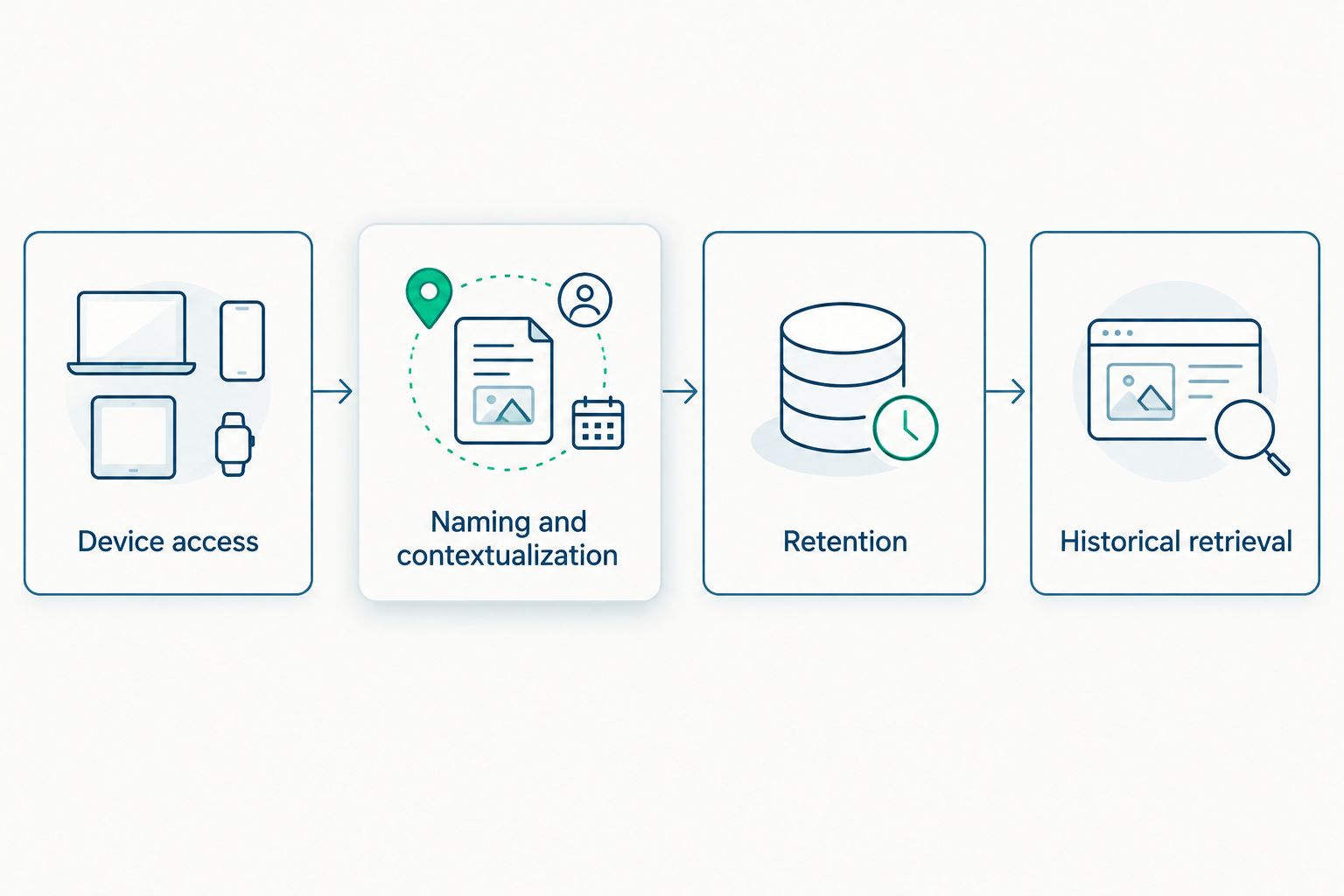
Assign each function explicitly before selecting the software that performs it.
Specify timestamps, quality, and recovery rules
Use an exported sample or controlled test feed to inspect the record before designing enterprise dashboards. Compare source timestamps, receiving timestamps, quality information, and engineering units wherever those fields are available.
Specify how the system should handle late, duplicate, out-of-order, and bad-quality records. A delayed measurement must not silently become a current measurement, and a communication failure must not look like a stable process value.
Set collection intervals by signal purpose. For example, use a 1-second interval and a 1-minute interval as contrasting test cases—not universal oil and gas requirements—and ask whether each preserves the event you need to analyze.
- Define the authoritative timestamp and time-zone convention.
- Specify treatment of bad quality and missing records.
- Document duplicate and out-of-order record handling.
- Validate compression or deadband settings against relevant events.
Size collection and storage from measured workloads
Start with a manual workload sheet using actual tag groups and observed update behavior. Record what changes, what gets transmitted, what gets archived, and what users query; these are different workloads.
Estimate normal collection separately from reconnection traffic. A remote site returning after an outage introduces historical records while current acquisition continues, so your acceptance test must include both activities together.
For the 2026 design review, treat storage calculations as assumptions to validate, not vendor-independent capacity guarantees. Record retention requirements, backup scope, historical query patterns, and expected growth before requesting sizing guidance. The guide to OPC UA bandwidth on a plant network supports the collection-side discussion.
- Group tags by update behavior and operational purpose.
- Measure collection traffic during representative operating states.
- Include replay traffic and concurrent historical queries.
- Validate retention estimates against a representative archived sample.
Prove recovery and hand over operations
Write acceptance procedures in a shared document before automating the tests. Every test needs an initial state, deliberate fault, expected behavior, evidence to capture, and named approver.
Use a controlled 30-minute network interruption as one pilot scenario if your operating rules permit it. The duration is a test input, not a product capability claim; measure the actual data gap, recovery sequence, and effect on current acquisition.
Software Toolbox industrial connectivity belongs in this validation alongside the selected historian and network controls. Test the assembled path rather than accepting isolated component demonstrations as evidence that the complete system will recover correctly.
- Interrupt the collection link and inspect recovery records.
- Restart services and verify startup order and dependencies.
- Test rejected certificates and unauthorized connection attempts.
- Restore a backup and retrieve a known historical event.
Compare deployment options by operational fit
There is no universal deployment winner for oil and gas. Choose the option that satisfies local access, communications recovery, security boundaries, and operating ownership; then verify that the proposed implementation actually delivers those properties.
This comparison covers architecture options, not competing vendor products. The advantages describe the purpose of each arrangement, while the limitations identify responsibilities your design must address.
Site-local historian
- Best for: Facilities requiring local historical access during WAN disruption
- Main advantage: Keeps the historical access path within the site
- Key limitation: Requires local administration, backup, and recovery ownership
Central historian
- Best for: Operations consolidating records from multiple facilities
- Main advantage: Provides a common location for cross-site historical access
- Key limitation: Needs an explicit design for remote collection outages
Edge collection with central history
- Best for: Remote assets requiring continuity across interrupted links
- Main advantage: Separates local acquisition from centralized historical use
- Key limitation: Requires validated replay, timestamp, and duplicate-handling behavior
Local history with a separate analytics destination
- Best for: Operations retaining site access while sharing selected data
- Main advantage: Separates operational history from enterprise consumption
- Key limitation: Introduces another data path and consistency checks
A central historian is appropriate when remote recovery is proven and local historical access is not an unmet requirement. Edge collection with central history is appropriate when collection must continue independently of the WAN; do not assume that behavior without testing it.
Local history with a separate analytics destination adds flexibility, but it also adds ownership. Specify which record is authoritative when users find different values, timestamps, or calculated aggregates in different destinations.
Evaluate the integration layer without confusing its role
Ask Software Toolbox to map the proposed connection requirements to the relevant products, versions, and deployment conditions. Bring a source-system inventory, network diagram, required data fields, and acceptance tests; a list of protocol names alone does not define the project.
The benefit of a product-based integration approach is a defined software component for the connection requirement. Its limitation is equally important: selecting that component does not settle the historian's storage architecture, retention policy, or operational recovery procedures.
For your 2026 evaluation, request written confirmation of the exact interfaces and behaviors your design depends on. Keep product claims distinct from project acceptance criteria, and reject any design assumption that nobody owns.
Review your historian integration requirements
Discuss source systems, network boundaries, and required data paths.
Common mistakes oil and gas teams make
Treating recovered communications as recovered history
A connection returning to a healthy state does not prove that missing records reached historical storage. Inspect the affected interval, quality fields, ordering, and duplicates. Acceptance must cover the historical record, not just a green connection indicator.
Applying one collection policy to every signal
Pressure, equipment state, accumulated totals, and calculated production values do not necessarily need identical treatment. Define sampling, change detection, and archival rules by operational purpose. Test whether the chosen settings preserve the event or calculation you intend to investigate.
Treating a historian as a reporting compliance guarantee
Storing measurements does not establish that a report uses the correct boundaries, approved calculations, or required review process. Validate the complete reporting workflow against applicable requirements. Keep raw measurements distinguishable from corrected or calculated values.
Leaving remote-site administration undefined
A distributed deployment needs assigned responsibility for updates, certificates, backups, storage alarms, and failed recovery. Name the responsible team for each task before rollout. Remote installation does not remove the need for local access and recovery planning.
Sending every available tag to every destination
Unrestricted replication complicates access control and creates unnecessary collection and administration work. Share the measurements and context each consumer requires. Keep analytics access separate from authority to change collection settings or control-system configurations.
FAQ
What's the best data historian software for oil and gas?
The best data historian software for oil and gas is the option that passes your requirements for historical integrity, outage recovery, security, and operational access. Select against documented acceptance tests rather than tag capacity or a product ranking alone.
Do remote oil and gas sites need a local historian?
Remote sites need local history when their operational requirements demand historical access without the WAN. If only acquisition continuity is required, evaluate an edge collection design and verify its recovery behavior separately.
Can OPC UA replace a data historian?
OPC UA is not a substitute for selecting and validating historical storage. An OPC UA interface alone does not establish retention, outage recovery, backup, or the historical queries your operation requires.
Is a DataOps platform the same as a historian?
DataOps and historical storage serve different responsibilities in the architecture. Define how data is acquired, contextualized, transferred, retained, and retrieved, then assign those functions to specific components.
How should an oil and gas historian handle network outages?
An oil and gas historian architecture should follow documented requirements for continued acquisition, missing-data indication, and recovery. Test the actual implementation for delayed records, ordering, duplicates, and the effect of replay on current acquisition.
Which security checks belong in a historian pilot?
A historian pilot should verify approved traffic paths, service identities, certificate handling, and unauthorized-access rejection. Include backup restoration and confirm that reporting or analytics clients do not require unintended access to control systems.
How do I estimate historian storage requirements?
Estimate historian storage from a representative archived workload, retention requirements, and the selected product's documented storage behavior. Include quality and timestamp information, backups, calculated records, and the effects of compression rather than multiplying tag count alone.
One last thing
Test a flat trend as carefully as a dramatic excursion. Disconnect a source in the approved pilot environment and verify that users can distinguish a genuinely unchanged process value from stale data. A plausible-looking trend with unclear quality can defeat the purpose of historical analysis.
Make that evidence part of the 2026 handover package. Preserve the test inputs, expected behavior, observed records, and recovery procedure so the next engineer can repeat the check after a configuration change.